






What would you treat?

nicol_verheem

New Member
Thread Starter
Joined
Feb 17, 2020
Posts
8
Hi All.

First time in a long time here. Please pardon the long post.

I recently decided to treat my family room, within reasonable esthetic limits. I would love some suggestions from you all, as this is my first time treating.

I attached .mdat file that included 3 sets of measurements, (1) without any treatment, (2) with bass trap (BT) in right rear corner, and (3) with the BT and Dirac Active Room Treatment enabled, ART did a reasonably good job of smoothing the nulls from room modes in SPL plot, but (obviously) couldn't do much for decay times.

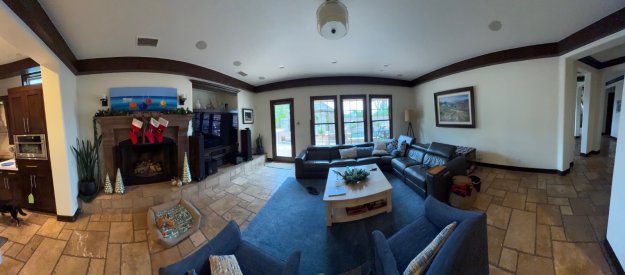
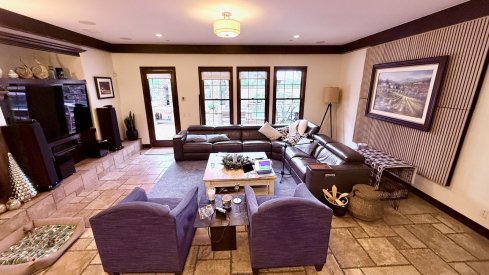
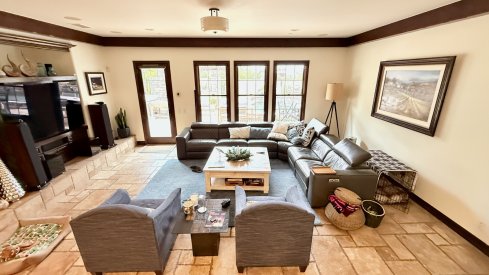
I attach two pics showing the room, taken from the kitchen, which has a 12'x12' opening where the left wall would have been. There is a hallway entrance diagonally in the left rear corner. The room is fairly large, 22x18x10'. The listening position middle of back coach. BTW all dimensions accurate in the Room Sim. I treated the opening to kitchen as room as high absorbance. The room sim off by quite bit tho, I could not figure that out. Wall is drywall with very flat, hard, painted surfaces.

Not shown in the pics is with 2'x8' round bass trap tower that I had in the right rear corner, but as can be seen in the included measurements, the BT did not do a whole lot, except for in the RT decay you can see a little quicker decay in the low frequencies.

Note I can't do anything about speaker placement due to room design (the step in front of TV and the door position). Going from one sub to two had less of an impact than I hoped, probably because they are too close to each other, so basically act as one?

I'm sure if can't convince her of curtains, there are already electric blinds within each window. Unfortunately I didn't measure with them down...

I'm thinking I can get away to treat the rear wall and ceiling, and that should be a good start, possibly even enough. The goal is to make vocals (mostly jazzy music but also TV) clearer. There's bass to spare, and the Dirac ART can stay close to my preferred Harman house curve. So frequency response decent, room decay, not so much.

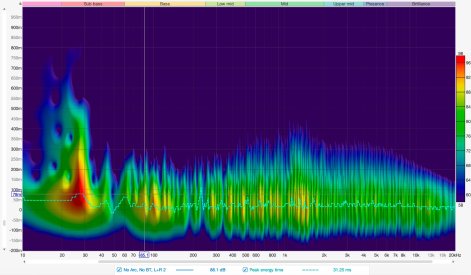
Spectrogram clearly shows bass lingers, and I need traps. Big ones.

But I also suspect an RT60 decay of up to 700ms between 1-2kHz is problematic. Any thoughts welcome.

I'm thinking lots of absorption. And about as much dispersion. I already have quite a few of the 2'x4' absorbers and 2x4' slatted wood diffuser panels courtesy of GIK's Black Friday sale. But I'm still undecided where to put them and how much of it.

I think absorbers for 1st reflection and just in front and above listening position on ceiling, so basically 4 panels symmetrically around the ceiling light. And then mostly dispersion on rear wall, since I'm 6' away from back, and the wooden slats esthetically pleasing. Any thoughts?

I'm still waiting on the matching wood bass trap for right rear corner. The measurements makes me think they won't be adequate, so I might do one in right front corner too, or try to air gap.

Appreciate any input from the community, and Happy new year!

Thanks in advance!

Cheers
Nicol
 

Attachments

  • IMG_3927.jpeg
    IMG_3927.jpeg
    475.7 KB · Views: 31
  • IMG_3925.jpeg
    IMG_3925.jpeg
    320.1 KB · Views: 31
  • Spectrogram.jpg
    Spectrogram.jpg
    312.7 KB · Views: 32
  • Proper Measurement 12-30.mdat
    Proper Measurement 12-30.mdat
    9.2 MB · Views: 7
Welcome @nicol_verheem, I would think about treating corners, where three surfaces come together floor and/or ceiling... Next is two sides including wall and ceiling wall and floor... I might look at Digital Room Correction to push that hot spot down... Maybe there is a way to adjust ART down there... I'm not an ART user so I don't know what to say there... You might also look into hiding some Mass Loaded Vinyl behind some art or any absorbers you already have...

BTY, beautiful room...
 
Last edited:
Happy new year.

1767231415203.png


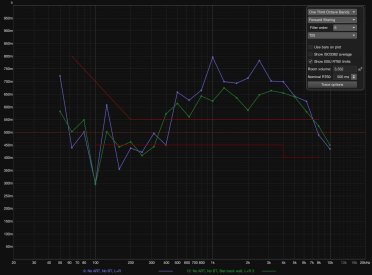
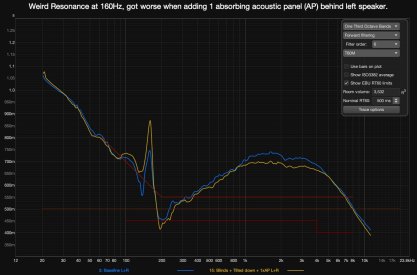
This is your RT60 with upper and lower tolerance curves calculated for your room volume (112m^3) and target of 500ms. This tells you what frequencies are within target and what you need to do. You are fortunate in that you probably don't need more bass trapping. It's the freqs above 470Hz that you need to work on, and this is relatively easy. This is "ARC L+R".

1767231914250.png


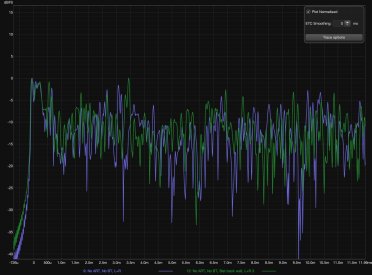
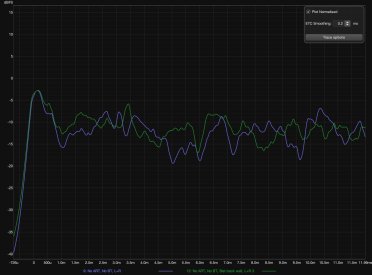
The Energy-Time Curve (ETC) shows the decay of sound after the main impulse. I chose "ARC L+R" (I presume you mean ART). Ideally, you want all specular reflections (thinner arrows) to be more than -15dB to your main impulse within the first 20ms (I drew the target in blue). Your "No ARC, No BT, L+R" looks even worse. You can work out where the reflections are coming from by calculating the distance with the speed of sound, d = c * t/1000 (c = speed of sound 1125 ft/s, t = time in milliseconds). Pick any reflection, and it had to travel an extra distance d to reach the microphone.

From your photo, the obvious culprits are your coffee table and the rear wall (behind the listening position). If you really wanted to reduce the reflections, you need to get rid of the coffee table and put something at the rear wall. But you have a gorgeous room there, it would be a real pity to ruin the aesthetics by installing foam.
 
Happy new year.

View attachment 88921

This is your RT60 with upper and lower tolerance curves calculated for your room volume (112m^3) and target of 500ms. This tells you what frequencies are within target and what you need to do. You are fortunate in that you probably don't need more bass trapping. It's the freqs above 470Hz that you need to work on, and this is relatively easy. This is "ARC L+R".

View attachment 88923

The Energy-Time Curve (ETC) shows the decay of sound after the main impulse. I chose "ARC L+R" (I presume you mean ART). Ideally, you want all specular reflections (thinner arrows) to be more than -15dB to your main impulse within the first 20ms (I drew the target in blue). Your "No ARC, No BT, L+R" looks even worse. You can work out where the reflections are coming from by calculating the distance with the speed of sound, d = c * t/1000 (c = speed of sound 1125 ft/s, t = time in milliseconds). Pick any reflection, and it had to travel an extra distance d to reach the microphone.

From your photo, the obvious culprits are your coffee table and the rear wall (behind the listening position). If you really wanted to reduce the reflections, you need to get rid of the coffee table and put something at the rear wall. But you have a gorgeous room there, it would be a real pity to ruin the aesthetics by installing foam.
Keith, thanks so much for taking the time to do this analysis and to write up your findings! I am now much better informed about what to do. I am curious though about your comments regarding: the coffee table. I was assuming since the reflection from the table has such a small additional delay, it won't be as bothersome as the reflections from the ceiling, which travels a lot further, no? Would you leave ceiling alone then? Also, do you have thoughts about dispersion vs absorption on back wall? Thanks again and in advance.
 
Hi Nicol, I suggest you purchase and read Floyd Toole's book to gain an understanding of what those measurements mean, and whether you should absorb or diffuse. Essentially, early reflections are perceptually fused with the main signal and have the effect of smearing the sound if they are early and loud enough - the Haas fusion window. I generally use "no reflection within the first 20ms should be greater than -15dB" as my threshold, but some people think it should be -20dB. Whatever it is, it is evident that your room is too reflective.

I should add that many of those reflections will be coming from your microphone position as well, for e.g. if you used a mini tripod and perched your mic on your sofa, you will see a heck of a lot of early reflections like this. You would be measuring a highly local phenomenon and not your actual room.

Dr. Toole's book says that the optimal RT60 can be obtained with room furnishings alone, albeit at the higher end of tolerance. To push the RT60 into the lower end of tolerance, you will need absorbers and not diffusers. Note that there is some disagreement whether you want to absorb, or how much you should absorb. Some people like Dr. Toole believe that some reflections are necessary to provide ambience. Some others believe that reflections are detrimental to the sound, e.g. Ethan Winer's book. I'm not going to open that can of worms here. All I will say is that from your measurements, it appears as if you have too many reflections. What you choose to do with that information is up to you ... sorry.
 
Hi Nicol, I suggest you purchase and read Floyd Toole's book to gain an understanding of what those measurements mean, and whether you should absorb or diffuse. Essentially, early reflections are perceptually fused with the main signal and have the effect of smearing the sound if they are early and loud enough - the Haas fusion window. I generally use "no reflection within the first 20ms should be greater than -15dB" as my threshold, but some people think it should be -20dB. Whatever it is, it is evident that your room is too reflective.

I should add that many of those reflections will be coming from your microphone position as well, for e.g. if you used a mini tripod and perched your mic on your sofa, you will see a heck of a lot of early reflections like this. You would be measuring a highly local phenomenon and not your actual room.

Dr. Toole's book says that the optimal RT60 can be obtained with room furnishings alone, albeit at the higher end of tolerance. To push the RT60 into the lower end of tolerance, you will need absorbers and not diffusers. Note that there is some disagreement whether you want to absorb, or how much you should absorb. Some people like Dr. Toole believe that some reflections are necessary to provide ambience. Some others believe that reflections are detrimental to the sound, e.g. Ethan Winer's book. I'm not going to open that can of worms here. All I will say is that from your measurements, it appears as if you have too many reflections. What you choose to do with that information is up to you ... sorry.
Again, really appreciate your effort to write this up, your insightful comments and the references. I'll take a look. Since I have a number of panels, I'll try to mount in such away as to play around and measure differences. I suspect this project might keep me busy a while. My gut feeling was I don't want a dead room, so I got 50/50 diffuse/absorb. FWIW the mic was on a proper mic stand, ear hight. Cheers!
 
It's your room, you can do what you want. But if it was me, and if I wanted to preserve my room's aesthetics, I would pull the sofa closer to the speakers. That will have the effect of delaying rear wall reflections. On the rear wall, I would put some bookshelves. You could modify some IKEA bookshelves with some absorbent foam and put indoor pot plants on the shelves to hide the foam.

It looks as if the problem frequencies are 500Hz and up. Foam needs to be 1/8 as thick as the longest wavelength you want to absorb (as a rule of thumb). A 500Hz wavelength is 686mm, so the foam needs to be 86mm (3.4") thick. That is quite achievable in most rooms.

If you want to see the effect of the coffee table, take measurements with and without it and compare the ETC. Use REW's "overlays" for a direct comparison.
 
+1 for the potted plants... Stands of bamboo in big pots filled with earth... Pot of earth for the lows and the bamboo for diffusion...
 
A few quick updates after first stage of treatment. Pics included. Unfortunately I didn't measure between each change, so the impact is a bit conflated.

I moved MLP couch 1' fwd, which is all I can do. It's clearly delayed some reflections (like back wall) in the ETC.

I added GIK Slatfuser 8'x8' panel behind listening position. It's quite a job to align them, but esthetically I thought it made a fairly boring wall less so. The slats achieved a decent improvement in the decay, as evident in the RT60 curve, thanks @Keith_W for the advice on what to look for.

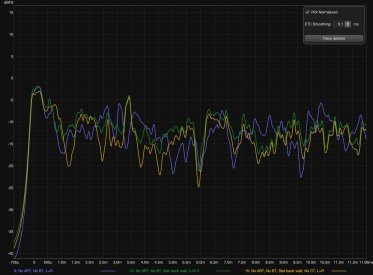
It did not do much in the ETC (yet). Two impulses difficult to see in overlay so I added some smoothing. I'll add some absorption to see what that does.

I cleaned up the .mdat project file a bit and also tried a quick measurement with two thick blankets on the coffee table (look for "No CT" in the name). That did have a pronounced impact, but not what I expected - it didn't remove one reflection, but instead lowered a whole bunch. I interpret that as repeats, hence I'm wondering about the ceiling again.

I have some acoustic absorbing panels and bass traps on the way still, and now I will consider bamboo plants too :-)
 

Attachments

  • Proper Measurement 01-03.mdat
    Proper Measurement 01-03.mdat
    9 MB · Views: 3
  • IMG_3945.jpeg
    IMG_3945.jpeg
    638.9 KB · Views: 9
  • Flat vs slatted rear wall ETC no smooth.jpg
    Flat vs slatted rear wall ETC no smooth.jpg
    289.6 KB · Views: 7
  • Flat vs slatted rear wall ETC 0.2ms smooth.jpg
    Flat vs slatted rear wall ETC 0.2ms smooth.jpg
    226.9 KB · Views: 5
  • Flat vs slatted rear wall RT60.jpg
    Flat vs slatted rear wall RT60.jpg
    302 KB · Views: 6
  • Impact of coffee table. .jpg
    Impact of coffee table. .jpg
    255.5 KB · Views: 9
It looks like you are making some progress... :T I wonder about the difference between the new Slatfusers with and without the picture in the middle... You might consider placing some absorption behind the couch, more of less out or sight, Soffit traps? Maybe a bigger, thicker throw rug?

We will be interested in where you put your new absorption and traps when they arrive...
 
Last edited:
I hate to tell you, but your diffusers have done diddly squat.

1767507042396.png


That's the ETC of before (orange) and after (purple). I used the left speaker with no bass traps, the only variable being the slats. I wouldn't say one is better than the other. Maybe some of the reflections in the 4-6ms range are improved.

1767507201379.png


There is a marginal improvement in the RT60.

I did say that you would be better off with absorbers.
 
Problem for me was in my room because on frequency between 60-250 hz i get strange feeling in ear as speaker is out of phase. only with my current foam i can say it is 100% gone and i can very long hear music and much more songs sound great now, also youtube songs which only have 128 kbits . also the sweet spot is much larger now. when move head or sit more or less in front of desktop did only very little hear diffrences. without foam was lots more

I notice most important and without much noticable optical problems is foam the ceiling with 10-12 cm basotect or other melamin. Either white which is more expensive or light gray which is cheaper. I think light grey is good and bright enough. bastect have better results on low bass also as other foam. I use small tiles and some tiles are not glued. for glue i use Pattex Montage Super Power, because of small tiles (20 cm - 30 cm some 50 cm) i need only 2 1 qcm glue area. bass traps i have buy before so i use them but measure with and without make near no diffrence. with foam can also get some 2-3 db low bass FR enhancement . but all in all it do not much in FR. mostly it reduce decay time and from what hear this bring the huge sound enhancement. also speakers with no EQ sound good now and much more clarity and good in compare to headphone. the side foam is more for save heating costs. only after i add foam to left ceiling sound enhancement get much better. before i thought i need only on top of speakers foam and a little in side. later i notice foam the whole ceiling is more important than side

i do this over long time, change some weeks nothing and when i have fun i change placement of foam and measure again. this is what i currently have. it seem the mass of the foam count and between floor and ceiling is the shortest distance so reflections happen more than on side walls. so if your wife is happy with only basotect ceiling it bring alot. only problem is, it is not cheap. cost me over 1000$ and i have only cheap speakers. foam the room is more important than have expensive speakers.

the left speaker is excellent now, below 230 ms at 40 hz, right speaker even if there is the basstrap and more foam on side not so good. left speaker distance to side wall (0,6 meter) is same as right speaker to wall


d3v L rt60 .jpg

d3v right rt60.jpg


My room is L size and 5,3 meter x 3,9 meter. ceiling is between 2,2 meter and 2,9 meter.

foam ceiling_1.JPG


foam left side_1.JPG


foam right side_1.JPG
 
I hate to tell you, but your diffusers have done diddly squat.

View attachment 89066

That's the ETC of before (orange) and after (purple). I used the left speaker with no bass traps, the only variable being the slats. I wouldn't say one is better than the other. Maybe some of the reflections in the 4-6ms range are improved.

View attachment 89067

There is a marginal improvement in the RT60.

I did say that you would be better off with absorbers.
I didn't, and still don't, disagree with your last statement - In fact fully I agree, and I still plan on adding substantial absorbers. I already have 8x of the 2x4' and 4x of 2x2' panels ready to install - recall it was only ever a question of how many of what and where to start....

The esthetics made me try the diffusers in the middle (as a start). And I was worried about deadening the room, but clearly that's not happening. But I am still planning to put diffusers next to them on both sides.

I can also still reasonably easily swap them for the absorbers in the middle, but annoyingly the GIK 2x4 diffuser and the GIK 2x4 absorber are not exactly the same size, so I might make more holes (drywall, no big deal). TBC, the slat diffusers have 2" foam behind them, so there is (supposed to be) a good bit of absorption in there too. Their graphs are very close to the absorber panels'.

Still curious about any insights into my Q about the coffee table with blanket measurements. It was two thick fussy blankets, should aborb well I think.

As always appreciate you taking the time to run the analysis and write up your views. Hope to keep you along for the journey, it may be a while still!

Cheers
Nicol
 
Just for comparison, my listening room is approximately the same size as yours - 7.5m x 6m x 2.7m (vol 121m^3). Or 24ft x 20ft x 8.9ft in freedom units. As you can see from the picture, there is minimum room treatment, just some foam absorbers behind the loudspeakers (the black panels). I am able to achieve the target RT60 whilst keeping a pretty clean look. Of course my room isn't as beautiful as yours.

1767575577710.png
1767575443170.png
 
Just for comparison, my listening room is approximately the same size as yours - 7.5m x 6m x 2.7m (vol 121m^3). Or 24ft x 20ft x 8.9ft in freedom units. As you can see from the picture, there is minimum room treatment, just some foam absorbers behind the loudspeakers (the black panels). I am able to achieve the target RT60 whilst keeping a pretty clean look. Of course my room isn't as beautiful as yours.

View attachment 89087View attachment 89086

can you please show RT60 decay from REW ?. the other is much too unprecise, maybe show too much or too few. normaly the more less the frequency go the longer reverb time you get. keep in mind from floor to ceiling in your room is 2,7 meter. soundspeed is ~343 meter per sec. this mean with a decay time of 500 ms sound travel 171,5 meter. 171 : 2,7(your room height) =63. this mean sound is reflect 63 times near untreaded between ceiling and floor. between the 6 meter it bounce only 28,5 and between 7,5 meter bounce 22,8 times.

maybe you can show compare with and without acoustic panels with rt 60 decay from REW. if you use other measure software as REW you can export the impulse response and load it in in rew.

and btw the secret wy speakers sound so great in shop and at home not so good even if hearing room is simular in left and right have mostly the reason because the cyling on hifi shop rooms is higher. so when you want hear speakers in a shop look that room height is simular to your room height. you have luck that your room height is 2,7 meter, most rooms in germany have only 2,2 meter height
 
can you please show RT60 decay from REW ?

1767619127123.png


maybe you can show compare with and without acoustic panels with rt 60 decay from REW. if you use other measure software as REW you can export the impulse response and load it in in rew.

I have those measurements somewhere in my collection. I know that they don't do very much because I don't have many panels, and I put them in a part of the room where they are least likely to have much effect. I bought them when I was living in a previous home. I don't need them any more but I can't be bothered selling them.
 
Just for comparison, my listening room is approximately the same size as yours - 7.5m x 6m x 2.7m (vol 121m^3). Or 24ft x 20ft x 8.9ft in freedom units. As you can see from the picture, there is minimum room treatment, just some foam absorbers behind the loudspeakers (the black panels). I am able to achieve the target RT60 whilst keeping a pretty clean look. Of course my room isn't as beautiful as yours.

View attachment 89087View attachment 89086
That is a pretty room!! And a pretty good graph. Not to mention the wicked setup.

You have a few built in advantages over me, notably no large windows next to your speakers, no coffee table, further from rear wall, and I think the wooden floor better than my tiles. I also suspect you listen "sidewise" over your dimensions whereas I'm lengthwise? I do wish I cold move couch or speakers closer, but the room won't let me.

Another interesting point about my setup. Since my speakers are on that stupid little step, that is ~1' raised, the top mounted tweeters are 1' above the listening position. I wonder if I should point them down just a little, by screwing out rear feet. This will make table reflections worse, but wall and ceiling reflections better, no ?

Thanks as always.
 
1767653713515.png


I didn't show you my ETC. I think it looks close to ideal. Nice sharp main impulse, then rapid decay. All reflections are more than -20dB except for one, and even that reflection is more than -15dB. The 2ms delay of that main reflection suggests it's either floor or ceiling.

The speakers are set up on the long wall, and you can see that I pushed the listening position closer to the speakers. This listening position was found by measurement. I took sweeps at different distances and chose the best one. I looked for the position with the best bass response (fewest nulls) and the best looking ETC. Masking tape marks the position of speakers and listening position so I don't have to keep repeating the exercise. I do have a coffee table, it just so happens that I placed it to the left of the listening chair. It has a model ship on it.

Anyway, the point is: all this is possible in your room with a few little tweaks. Place your mic at the listening position and sweep. Move your mic towards your speakers in 30cm (1ft) increments and keep repeating sweeps. Then examine all your measurements. You want the best possible ETC as a priority, and as few bass nulls as possible as a secondary priority. This is because a bad ETC can not be fixed unless you do physical things - install diffusers, absorbers, reposition listening position, etc. And a bad ETC is very audible - it smears the sound. Bass nulls are relatively inaudible, except when they are wide and deep. You want to find a position where there is NO confluence of multiple nulls because this will produce an extra wide and deep null which is can't be fixed except to deploy more subwoofers. You especially want to avoid wide and deep nulls between 100-300Hz because that is even more difficult to fix. It's too high for subs, and too low for absorbers unless it is very thick.
 
this are the impulse of room above in my posts.I use right speaker because this is the speaker with the longer rt60 decay. left speaker look better

impulse d3v.jpg


d3v R foam desk.jpg


the desktop have many influence so the higher end solution on desktop is only this :jump:
foam on desk.JPG

maybe thinner foam work too, because it now damp a little low bass. this are 20x20x10 cm light gray tiles . 1 tile cost 4 eur i buy them in this size. qm price is much lower as wood panels, only because i need many qm to get good sound i am happy, it cost over 1000 eur. if the price of panels is worth it(maybe have more effect per qm), i can not compare, because i have no panels. I only know that other acoustic foam is worser and need more depth. but it is cheaper. so i mean qm price for same result is maybe same. other foam as basotect also stay not white. Stack of 2 5 cm foam to get 10 cm results, also did not work. I use the foam on desktop not, sound is also without it great. I see more errors in FR. the DIP at 600 hz is wider. without foam it is smaller and can not hear much when use note frequencies. but with foam on desktop is no 1,5 khz dip


FR compare desktop foam.jpg


here is also a 1 khz decay . left and rigt speaker is near same
1 khz decay.jpg


EDIT: additional i do measures from distance 2m microphone to speaker with the adam d3v. normaly on desktop is distance 0,8 m co speaker, but i do a measure now, what happen when i move microphone to hearing position middle 2 meter away. now i get a peak at 46 hz in bass which is really great but the bad thing is left and right speakers are in upper bass very diffrent upto 300 hz. the rt60 decay is worser too, but increase not so much. I have no subwoofer and i want none, because i hear location of low bass when it come from diffrent place of subwoofer. Or i need a subwoofer that
can put under the display . for measure i use no foam on desktop, because of the distance it have very few influence i think

d3v R 2m distance.jpg


FR 2 m distance.jpg

impulse 2m distance.jpg
 
Last edited:
Back
Top