






nicol_verheem
New Member
Thread Starter
- Joined
- Feb 17, 2020
- Posts
- 11
Hi All.
First time in a long time here. Please pardon the long post.
I recently decided to treat my family room, within reasonable esthetic limits. I would love some suggestions from you all, as this is my first time treating.
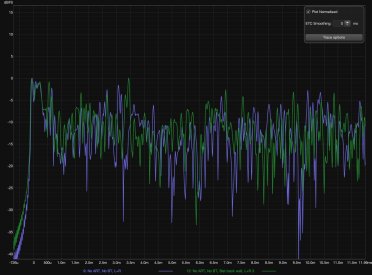
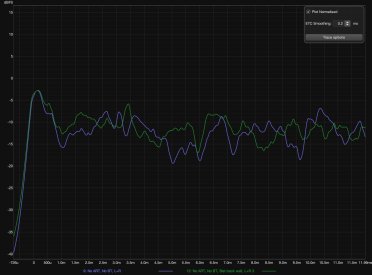
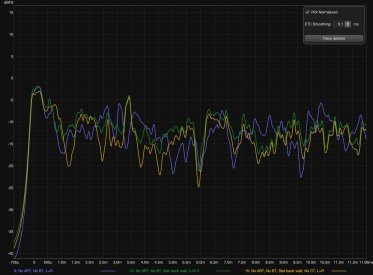
I attached .mdat file that included 3 sets of measurements, (1) without any treatment, (2) with bass trap (BT) in right rear corner, and (3) with the BT and Dirac Active Room Treatment enabled, ART did a reasonably good job of smoothing the nulls from room modes in SPL plot, but (obviously) couldn't do much for decay times.
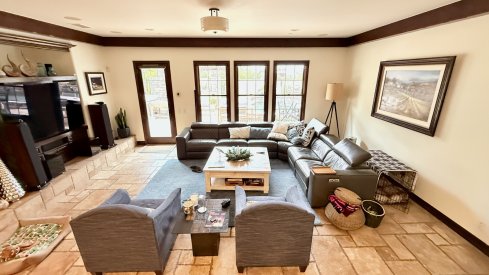
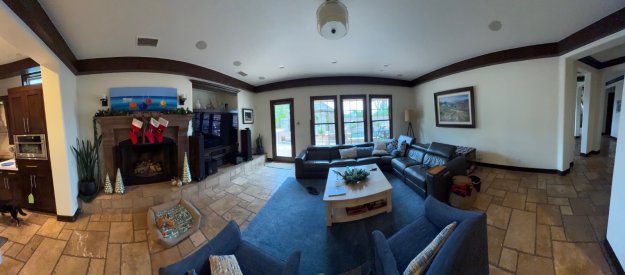
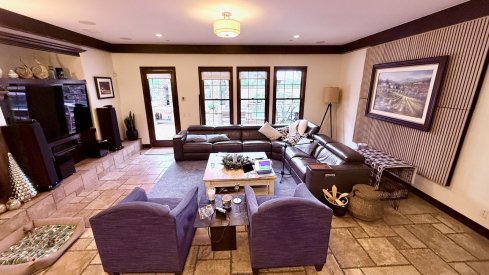
I attach two pics showing the room, taken from the kitchen, which has a 12'x12' opening where the left wall would have been. There is a hallway entrance diagonally in the left rear corner. The room is fairly large, 22x18x10'. The listening position middle of back coach. BTW all dimensions accurate in the Room Sim. I treated the opening to kitchen as room as high absorbance. The room sim off by quite bit tho, I could not figure that out. Wall is drywall with very flat, hard, painted surfaces.
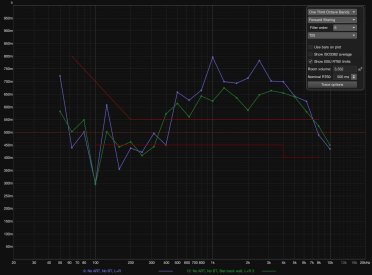
Not shown in the pics is with 2'x8' round bass trap tower that I had in the right rear corner, but as can be seen in the included measurements, the BT did not do a whole lot, except for in the RT decay you can see a little quicker decay in the low frequencies.
Note I can't do anything about speaker placement due to room design (the step in front of TV and the door position). Going from one sub to two had less of an impact than I hoped, probably because they are too close to each other, so basically act as one?
I'm sure if can't convince her of curtains, there are already electric blinds within each window. Unfortunately I didn't measure with them down...
I'm thinking I can get away to treat the rear wall and ceiling, and that should be a good start, possibly even enough. The goal is to make vocals (mostly jazzy music but also TV) clearer. There's bass to spare, and the Dirac ART can stay close to my preferred Harman house curve. So frequency response decent, room decay, not so much.
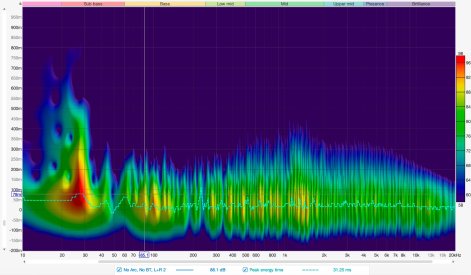
Spectrogram clearly shows bass lingers, and I need traps. Big ones.
But I also suspect an RT60 decay of up to 700ms between 1-2kHz is problematic. Any thoughts welcome.
I'm thinking lots of absorption. And about as much dispersion. I already have quite a few of the 2'x4' absorbers and 2x4' slatted wood diffuser panels courtesy of GIK's Black Friday sale. But I'm still undecided where to put them and how much of it.
I think absorbers for 1st reflection and just in front and above listening position on ceiling, so basically 4 panels symmetrically around the ceiling light. And then mostly dispersion on rear wall, since I'm 6' away from back, and the wooden slats esthetically pleasing. Any thoughts?
I'm still waiting on the matching wood bass trap for right rear corner. The measurements makes me think they won't be adequate, so I might do one in right front corner too, or try to air gap.
Appreciate any input from the community, and Happy new year!
Thanks in advance!
Cheers
Nicol
First time in a long time here. Please pardon the long post.
I recently decided to treat my family room, within reasonable esthetic limits. I would love some suggestions from you all, as this is my first time treating.
I attached .mdat file that included 3 sets of measurements, (1) without any treatment, (2) with bass trap (BT) in right rear corner, and (3) with the BT and Dirac Active Room Treatment enabled, ART did a reasonably good job of smoothing the nulls from room modes in SPL plot, but (obviously) couldn't do much for decay times.
I attach two pics showing the room, taken from the kitchen, which has a 12'x12' opening where the left wall would have been. There is a hallway entrance diagonally in the left rear corner. The room is fairly large, 22x18x10'. The listening position middle of back coach. BTW all dimensions accurate in the Room Sim. I treated the opening to kitchen as room as high absorbance. The room sim off by quite bit tho, I could not figure that out. Wall is drywall with very flat, hard, painted surfaces.
Not shown in the pics is with 2'x8' round bass trap tower that I had in the right rear corner, but as can be seen in the included measurements, the BT did not do a whole lot, except for in the RT decay you can see a little quicker decay in the low frequencies.
Note I can't do anything about speaker placement due to room design (the step in front of TV and the door position). Going from one sub to two had less of an impact than I hoped, probably because they are too close to each other, so basically act as one?
I'm sure if can't convince her of curtains, there are already electric blinds within each window. Unfortunately I didn't measure with them down...
I'm thinking I can get away to treat the rear wall and ceiling, and that should be a good start, possibly even enough. The goal is to make vocals (mostly jazzy music but also TV) clearer. There's bass to spare, and the Dirac ART can stay close to my preferred Harman house curve. So frequency response decent, room decay, not so much.
Spectrogram clearly shows bass lingers, and I need traps. Big ones.
But I also suspect an RT60 decay of up to 700ms between 1-2kHz is problematic. Any thoughts welcome.
I'm thinking lots of absorption. And about as much dispersion. I already have quite a few of the 2'x4' absorbers and 2x4' slatted wood diffuser panels courtesy of GIK's Black Friday sale. But I'm still undecided where to put them and how much of it.
I think absorbers for 1st reflection and just in front and above listening position on ceiling, so basically 4 panels symmetrically around the ceiling light. And then mostly dispersion on rear wall, since I'm 6' away from back, and the wooden slats esthetically pleasing. Any thoughts?
I'm still waiting on the matching wood bass trap for right rear corner. The measurements makes me think they won't be adequate, so I might do one in right front corner too, or try to air gap.
Appreciate any input from the community, and Happy new year!
Thanks in advance!
Cheers
Nicol


 I wonder about the difference between the new Slatfusers with and without the picture in the middle... You might consider placing some absorption behind the couch, more of less out or sight, Soffit traps? Maybe a bigger, thicker throw rug?


 . If anyone has thought on how to reverb proof a painting, PLMK.