





Gobo Panel as an Option for long Home Theater?

Jefferad

Member
Thread Starter
Joined
Jul 18, 2022
Posts
21
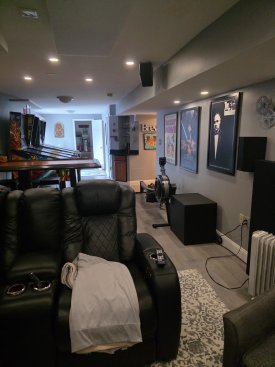
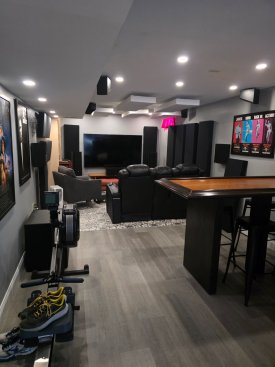
I've setup my home theater in one end of a very long and narrow rectangle space in my basement - for simplicity, think 12'x40' ish. I have a ton of panels in the space between my seats and the screen including walls and ceilings which was a HUGE improvement. But, hearing ambient noise from HVAC and sounds coming down the hall from upstairs drives me crazy. And, my wife would appreciate any decrease at all in sound making it's way upstairs. While a permanent wall would be the best solution, I'm not sure I want to make that leap as it blocks off the screen from the rest of the space which is often used for entertainment while watching the screen from a distance. But, I'd love to block as much sound as possible. Any thoughts on maybe building 3 movable bogo panels on wheels to help reduce sound bleeding from the space? And, since I'm trying to block as much sound as possible, my questions include:
  • should I build with a thin solid plywood backing or center (or even a pegboard with little holes) vs just cloth over Rockwool which I did for the panels on the walls and ceiling?
  • If I do use a solid backing / center, is there any benefit to leaving an air gap between the solid panel and the insulation (similar to the gap I put when mounting other panels)?
Googling and searching YouTube shows many different approaches that seem often to be contradictory, so input is appreciated.
 
Since you are trying to "block as much sound as possible"... I assume wide band... I would go with a solid backing maybe up to half inch, if you go thick, an air gap as much as you can do given your limits... Use MLV at the back... Pegboard for a center, with rock wool or the pink stuff at the front... And if your looking to keep some high frequencies in the room try some butcher paper on the front... Wrap the thing with your favorite acoustic cloth and your golden... :cool:

You might search the internet for a copy of Master Handbook of Acoustics by F. Alton Everest & Ken C. Pohlmann... There are several types and methods of acoustic absorbers described in this book... What I describe above is a hybrid of a few different systems...
 
Last edited:
Is this what you are talking about Jeff?

1764894703758.png
 
Those look nice @Todd Anderson and @Jefferad will need something much thicker for his application... I would suggest 12 inches thick at a minimum...
 
Maybe… I guess my concern is that you’re going to have a few issues.

One, every time you position them, they’re going to be different. How will that impact your Dirac room correction? You’re essentially changing your room every time they’re moved.

Two: leakage. You’re going to have sound finding its way around all of the openings on the top, bottom, and sides.

Something about this solution doesn’t feel right to me.

Have you thought about building a folding wall?
 
Thanks @ddude003 . I was thinking 8, but good to know that I should go even thicker. @Todd Anderson Yes I was thinking about the impact to room correction. Maybe I need to research if I can actually make a folding wall that applies a lot of the same concepts. Assume a lot of the same principles of design would be applicable. And yes, I know that a solid wall would be best. 😜
 
I bet Scott would have some ideas on how to build a folding wall. Might make for a very viable option.

I guess you could always look to seal your entire long room with a door at the side. Have you looked into that?
 
Yeah, will look into the folding options as I can see that that would give the most predictable and stable room correction. You had previously suggested a permanent wall w/ a door, but again, when I have people over, they often sit at the bar or play pinball and still want to be able to watch the football game. So, I'd love to have an option to clear the line of site but put it back up for those times when it's just me watching a movie in the theater portion (most of the time!).
 
Low bass travels through normal walls, you would need concrete barriers surrounding your basement to seal if off from being heard above. One less expensive solution to keep the wife happy is to listen with headphones, its immersive and brings the dialog right into your ears with no room interference. With today's wide dynamic range, the soft sounds are softer and the loud sounds are louder than ever before. If you adjust the volume for dialog clarity, you get blasted by the special effects, making it hard to get both just right all the time. Sennheiser offers the best solution, with adjustable volume control for each listener. https://us.sennheiser-hearing.com/collections/hearing/products/rs-5200 These make my wife the happiest and as we know, happy wife = happy life. :)
 
A diagram would really help, showing stairs, doors, and other features including location of your mechanical room.

Isolation is a different (and usually much bigger) problem than controlling reflections using acoustic panels. The panels can help with higher-frequency sounds, but even then as mentioned above sound can easily sneak around the panels, and low bass travels through walls and ceilings despite the panels (which help somewhat but not so much for low bass). There is also transmission through HVAC ducts. Isolation usually requires heavy hanging walls and ceiling (plus floor if not at ground level) and duct mitigation (either baffle or remove and use an independent air system -- I used a minisplit for the media room so no ducts to the rest of the house). I attached a file showing what I did when they built our media room; not sure what or how much you want to do now. If you could wall off the area, or at least install a heavy (exterior with weather seals) door to the upstairs, that might help.
2008 Media Room Diagrams reduced.jpg
 
You would place the gobo absorbers where you want them and then do the room correction... Place tape or sticky dots or magic marker where the footers for the gobos are... Move the gobos aside for what ever other purpose you want to open the room for... When done, place the gobos back to where the markers are... :justdontknow: Hey, its a domestic room not a professional studio...
 
A diagram would really help, showing stairs, doors, and other features including location of your mechanical room.

Isolation is a different (and usually much bigger) problem than controlling reflections using acoustic panels. The panels can help with higher-frequency sounds, but even then as mentioned above sound can easily sneak around the panels, and low bass travels through walls and ceilings despite the panels (which help somewhat but not so much for low bass). There is also transmission through HVAC ducts. Isolation usually requires heavy hanging walls and ceiling (plus floor if not at ground level) and duct mitigation (either baffle or remove and use an independent air system -- I used a minisplit for the media room so no ducts to the rest of the house). I attached a file showing what I did when they built our media room; not sure what or how much you want to do now. If you could wall off the area, or at least install a heavy (exterior with weather seals) door to the upstairs, that might help.
View attachment 88359
Good job Don, did this contain the lowest octaves of bass within the room, no leakage?
 
OK, I'm getting more help than I expected (and it's appreciated). 🙏 @ddude003 The tape does sounds like a practical solution to provide repeatable room correction. 👍

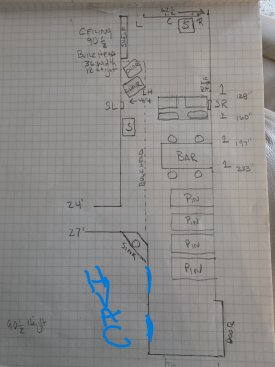
@DonH57 Wasn't going to ask folks to review that level of detail, but since you asked....😁, see attached drawing (1 block = 1 ft) and photos. Note, things have shifted just a bit since I made this drawing. I got rid of 1 chair, added 1 pinball machine, and put up 2 more height channels which shifted the placement of the 2 in the drawing as a result. The photos are current.
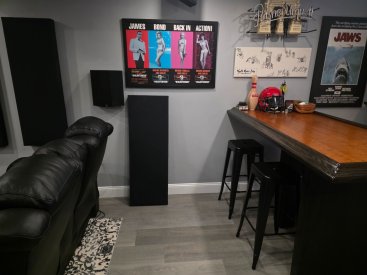
ALL: I probably just need to clarify my objective a bit. I'm aware that I'm working with a non-ideal space (won't be knocking down walls to change the broader layout that includes other rooms) and am realistic that even with a solid wall & door, sound will still travel through the floor, vents, etc. My goal is not to stop all the sound between upstairs / downstairs or between the theater and the HVAC. I just want to "knock the edge" off the casual sound that comes from people speaking upstairs and to not hear the hvac fan cycling on and off as much. I do have moving blankets covering the inside of the louvered doors marked in blue (don't worry, there's plenty of airflow to there via other means). Even just that is a bit helpful. I have also thought about putting a permanent door down the hallway where the "Brew" light is in the photo. That hallway leads eventually to the stairs where sound goes up and down between the floors. That would help a lot I'm sure, but won't address the white noise from the HVAC fan or the general openess of the sound from the large space behind you when watching a movie. Thanks!
 

Attachments

  • Basement showing space between the bar and theater seats.jpg
    Basement showing space between the bar and theater seats.jpg
    193.9 KB · Views: 10
  • Basement looking from back of room to tv.jpg
    Basement looking from back of room to tv.jpg
    200.6 KB · Views: 6
  • Basement looking from tv to back of room.jpg
    Basement looking from tv to back of room.jpg
    229.5 KB · Views: 9
  • Basement Layout Graph Paper Drawing.jpg
    Basement Layout Graph Paper Drawing.jpg
    209.9 KB · Views: 10
Good job Don, did this contain the lowest octaves of bass within the room, no leakage?
Thanks! I'm not sure I would say "no" leakage but almost none (I'm an engineer so tend to shy from absolutes). I'd have to dig for the SPL measurements I took, but I only have a C-weighted SPL meter so falls off below 30 Hz, and I am not sure I ever did broadband measurements (using my Earthworks mic and setup good to <5 Hz -- or now REW and UMIK-1) since nobody heard anything outside the room. Definitely no "boom-boom". My younger son's bedroom is on the other side of the wall and he said he couldn't hear anything, ditto my wife upstairs. At loud'ish (kid's) volume there's just a little to his room, and almost none to the room above. Interestingly, vexingly, heavy footfalls from the room above seem to get through somewhat even though bass from the media room doesn't really reach up there. Eliminating the duct to the rest of the house is a big help for higher frequencies, and I minimized holes in the walls (mainly outlets (caulked), used floor lamps, one wall sconce well-caulked). Code required outside airflow so there's a duct from the outside and another with a quiet fan (switchable) to force air in when needed. These are surrounded by insulation in the ceiling, and fortunately we live on 2.5 acres in a quiet area so outside sound is minimal, plus I close them off with insulation at times (mainly when it's very cold!)

The builder and drywallers really liked the clips; very similar to normal drywall construction, so no issues installing them and hanging drywall. The inside mini split unit is hanging on the floating wall.
 
OK, I'm getting more help than I expected (and it's appreciated). 🙏 @ddude003 The tape does sounds like a practical solution to provide repeatable room correction. 👍

@DonH57 Wasn't going to ask folks to review that level of detail, but since you asked....😁, see attached drawing (1 block = 1 ft) and photos. Note, things have shifted just a bit since I made this drawing. I got rid of 1 chair, added 1 pinball machine, and put up 2 more height channels which shifted the placement of the 2 in the drawing as a result. The photos are current.
ALL: I probably just need to clarify my objective a bit. I'm aware that I'm working with a non-ideal space (won't be knocking down walls to change the broader layout that includes other rooms) and am realistic that even with a solid wall & door, sound will still travel through the floor, vents, etc. My goal is not to stop all the sound between upstairs / downstairs or between the theater and the HVAC. I just want to "knock the edge" off the casual sound that comes from people speaking upstairs and to not hear the hvac fan cycling on and off as much. I do have moving blankets covering the inside of the louvered doors marked in blue (don't worry, there's plenty of airflow to there via other means). Even just that is a bit helpful. I have also thought about putting a permanent door down the hallway where the "Brew" light is in the photo. That hallway leads eventually to the stairs where sound goes up and down between the floors. That would help a lot I'm sure, but won't address the white noise from the HVAC fan or the general openess of the sound from the large space behind you when watching a movie. Thanks!
Adding a door to the upstairs would help; use an exterior (heavy solid-core) door with weather seals to block the most sound. It might be easier to put it at the top of the stairs than the bottom. One thing I have done that helps is to put up a shower (spring-loaded) curtain bar at the entrance to the hallway and hang heavy drapes or blankets from floor to ceiling. I had that issue in a previous house and used two thick, heavy blankets, one on each side of a 2~3" curtain rod, with a strip of wood at the top along the underside of the rod to keep them apart and create an air gap. Just to be I stuck a cloth-covered foam stopper at the top of the rod, wedged between rod and ceiling. I made mine from tubular foam covered in cloth from an old sheet, but one of those round door draft blockers (for the bottom of a door) would work as well.

For the HVAC room, you can also change to a heavy exterior door with seals if the door is not vented to meet code (hope not! -- check with your HVAC guy). We have a hi/lo ducts that provide enough area so we did not need a louvered mech room door (whew!) You can also add insulation in the walls and ceiling of the mech (HVAC) room (that's what we did and it helped) and finish the interior with drywall (which we did not do because we would have had to remove furnace, water heater, and such and it would have been generally painful and expensive). The furnace is fairly loud in our son's room but you can't hear it in the media room. We tend to run our fan all the time (most thermostats have a fan ON position for that) and I suggest trying that when you are in your media room (area). The constant sound is likely less distracting than it cycling on and off.

You asked about an air gap behind absorbers on the wall; that is always helpful in terms of improving their absorption and increasing their effective area. Absorbers are velocity-based things, turning the velocity of the sound into heat (not enough that you would ever notice) and dissipating it in the panels. Velocity right at the wall is zero (for a completely solid/inelastic wall, closest would be concrete) while pressure is highest, so putting in a small 2"~4" air gap makes the absorbers work much better since the velocity of the sound waves is higher for more of the panel's thickness. There are charts on the Kinetics and many other sites showing the difference, as well as in the previously-mentioned Everest handbook IIRC.

I have used masking tape for years to mark locations but a better idea is paint tape or gaffer's tape. The latter two don't leave a (or as much) a mess when removed. I recently got a little Bosch laser measuring device that is handy for setting up speakers and listening positions.

HTH - Don
 
Yeah, will look into the folding options as I can see that that would give the most predictable and stable room correction. You had previously suggested a permanent wall w/ a door, but again, when I have people over, they often sit at the bar or play pinball and still want to be able to watch the football game. So, I'd love to have an option to clear the line of site but put it back up for those times when it's just me watching a movie in the theater portion (most of the time!).
I was thinking of a door next to your wet bar… at the turn to the steps.

You’d essentially be sealing your fate of having one long room, but it would help with sound transmission to the up stairs
 
Back
Top