






Advise to interpret REW measurements

Marian10

Registered
Thread Starter
Joined
Jan 24, 2026
Posts
8
Hi,
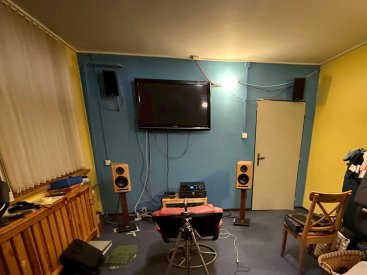
I moved my listening room to basement and spent some time to find the right place for speakers and listening position, using REW measurements.
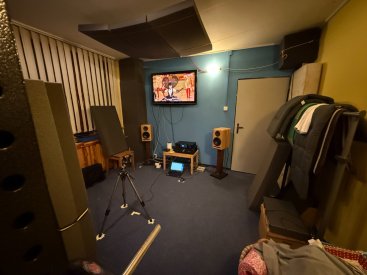
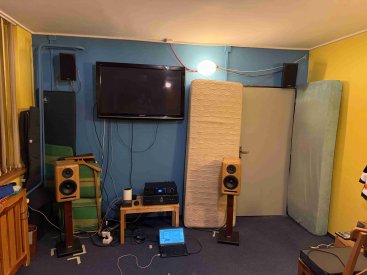
Now I think about some acoustic treatment of the room and I tried to use some available material (e.g. old matrices) to improve RT60 in front corners.
I measured before and after, and there is quite nice RT60 improvement.
Nevertheless, I am not able to interpret some results
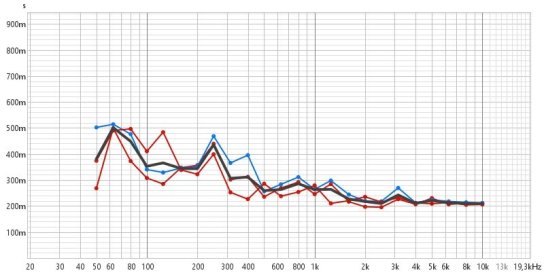
1. There are some ETC peaks at 2, 5 ,9,7 ms. Is it possible to guess the causes?
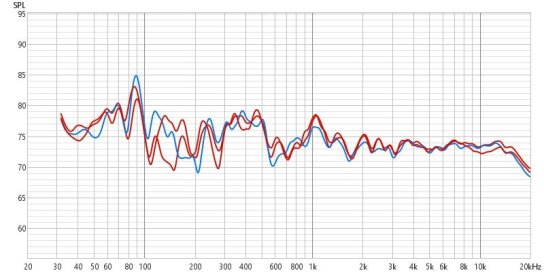
2. SPL for 80-100Hz is nicely compensating in L+R measurement compared to individual channels, while for 10k Hz it is the opposite, L+R create dip. Any reasons?
3. Any suggestions for acoustic treatment?
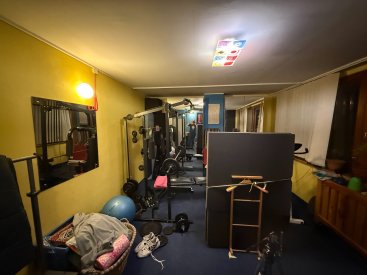
I plan bass trap to front left corner and panel to front right corner with doors. Something on front wall and front ceiling. Probably curtain over windows. Not sure what to do with rear wall.

My room is 5x3,7x2,5 meters, most of left side are windows.
Speakers are 60 cm from left wall, 90 cm from front wall, 180 cm aside. Listening position is 230cm from front wall and 150 cm from left wall.

Any help is highly appreciated, as I am not able to find out more, even with AI help :-(

Measurement and photos are enclosed.

Many thanks

Marian
 

Attachments

  • 230 90 60 before after.mdat
    230 90 60 before after.mdat
    3.7 MB · Views: 18
  • After front.jpg
    After front.jpg
    267.3 KB · Views: 38
  • Before front.jpg
    Before front.jpg
    221.4 KB · Views: 35
  • Back.jpg
    Back.jpg
    226.7 KB · Views: 36
2. SPL for 80-100Hz is nicely compensating in L+R measurement compared to individual channels, while for 10k Hz it is the opposite, L+R create dip. Any reasons?

I don't have a lot of time right now, but i'll answer this question first. The answer is: measurement artefact from an improperly centred microphone. This is the proof:

1770019240216.png


This is a comparison of the vector sum of L+R ("before treatment") in purple, and the actual measurement in red. We can see that the vector sum does not have the 8-10kHz dip. This means it is not some weird phase issue in one speaker (e.g. a tweeter wired out of phase in one speaker). So let's look a bit more closely.

1770019394182.png


If you look at the impulse response of your actual measurement, you can see two peaks, indicating left and right speakers. You can also see that REW has placed t=0 at the dip with the greatest magnitude, meaning that one speaker is "early" and one is "late". The question is which speaker is early.

1770019600824.png


It's not the right speaker, because the both impulses align at t=0.

1770019688412.png


So the culprit has to be the left speaker. And sure enough, we can see that the reflection I circled is not aligned. I could also prove the same thing by looking at the main impulse, but there are a lot of chaotic spikes in there and it would be more difficult to see. Nevertheless, after I align them, you will be able to see the main impulse more clearly. Anyway, the left speaker is arriving early.

1770019778315.png


I measured the time gap between the two peaks in the reflection and determined it was 80us. So I shifted the left speaker (blue) to the left - now it is time aligned. You can see how the two impulse responses follow each other very nicely. Then we sum L+R.

1770019830651.png


You can see that the summation (blue) is identical to your measurement (red). This proves that the dip is due to improper microphone centering.

You can convert time to distance with the formula d = c * t (d = distance in mm, c = speed of sound, t = time in ms). So an 80us time-gap equals a distance of 27.44mm.

Lesson: centre your microphone properly. REW does not have a microphone centering tool, but I have invented two ways to centre your microphone. See my eBook.
 
Last edited:
Dear Keith,

Thanks a lot for your fast response. I am reading your ebooks (excellent!) and I will correct my measurements.

If you find some time for other topics, I will very appreciate.

Thanks
 
You should be able to answer your own questions by reading that eBook. Re: the ETC peaks, read the section on ETC to see what they mean, determine whether they are a problem, and how to work out what is causing the peak.

As for your other measurements, here is something rather interesting:

1770040673793.png


This is a comparison of your L/R speakers (green/blue) vs. the vector sum of both (purple). I have staggered the vector sum for clarity.

Look at the area I highlighted. You can see that the L and R speakers individually have peaks in the 60Hz - 120Hz region, yet they sum to a very nasty dip.

1770041016549.png


... and this is the reason why. You have some kind of nasty reflection corrupting the phase of both curves.

1770041219871.png


Sure enough, if we extract excess phase and look at the Group Delay, we can see two nasty non-minimum phase peaks. In the left speaker (blue) it's at 70Hz, in the right speaker (purple) it's at 85Hz.

The eBook contains a procedure for diagnosing the cause of a dip. It involves moving speakers and re-measuring. If you are unable to solve your issues with better loudspeaker placement alone, you will need DSP. A time reversed all-pass filter can shift the phase of that narrow band of phase rotation and remove the cancellation. This is why linear-phase DSP has an advantage here.

In the same Google Drive where you downloaded that REW eBook, there are also two free books on how to use Acourate. Download "100. Acourate for DSP Controlled Active Speakers with Subwoofers", and read the section on Acourate's "ICPA" (Interchannel Phase Alignment) feature. I think there's a section in there on how to design your own time-reversed AP filter using Acourate procedures, but it's easily translated to REW + rePhase.

I am sorry I have to use all this jargon, but that's why I wrote the book. So that I don't have to type really long replies explaining what all these things mean all the time! I don't expect you to understand all this at once, I assure you it took me months of reading everything I could get my hands on to understand. Read that book, look at these measurements, and you'll eventually get it.

And BTW, it's probably not my place to criticize, but your TV is mounted way too high. You want your TV to be at eye level.
 
Last edited:
Hi,

I have done some temporary/testing acoustic treatment and made new measurements.

I aligned the speakers with +/- 1mm precision.

There are bass-traps in corners, some ceiling and first reflection treatment and the back wall treatment is via free standing panel.

I am quite happy with improvement of RT60 (could be better but not so bad).

SPL is mostly within +/-5 dB, with peak on 90Hz, which can be limited by DSP.

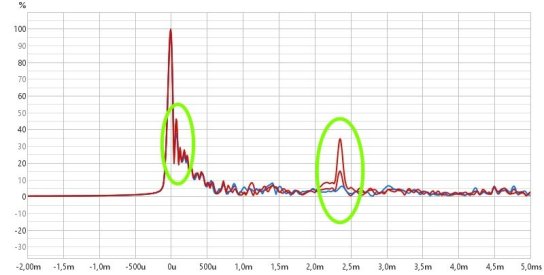
I am still puzzled by ETC. I have no idea of peak on 74 micro sec (=2,5cm). Could it be reflection from Microphone stand?
Or some measurement error, I use 90 degree miniDSP MIC position with appropriate calibration file, 75 dB level for measurement.

There is also peak of left speaker on 2,4ms (82cm) which I was not able to identify.

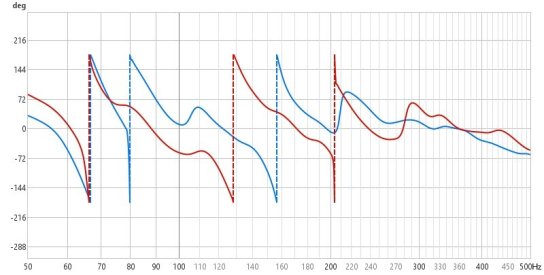
As with the previous measurement, there is also "out-of-phase" within 65-200Hz.

Would you have any idea on ETC and Phase?

Thanks a lot

Marian
 

Attachments

  • 193 80 50 165 last.mdat
    193 80 50 165 last.mdat
    1.9 MB · Views: 10
  • ETC.jpg
    ETC.jpg
    48.2 KB · Views: 18
  • Phase L vs R.jpg
    Phase L vs R.jpg
    52.5 KB · Views: 14
  • RT60_T20.jpg
    RT60_T20.jpg
    67 KB · Views: 9
  • SPL.jpg
    SPL.jpg
    62.7 KB · Views: 15
  • IMG_2409.jpeg
    IMG_2409.jpeg
    214.3 KB · Views: 18
  • IMG_2410.jpeg
    IMG_2410.jpeg
    215.6 KB · Views: 20
Good work on your latest set of measurements, it looks as if you have learnt a lot. Keep it up!

I am still puzzled by ETC. I have no idea of peak on 74 micro sec (=2,5cm). Could it be reflection from Microphone stand?

If you are using your mic at 90 degrees, as you said you are, it seems unlikely to be due to the microphone stand although I guess it could still be possible. It is also possible that it is an internal reflection from your loudspeaker, or poor time alignment between drivers. I wouldn't worry too much about it.

There is also peak of left speaker on 2,4ms (82cm) which I was not able to identify.

From your photos it is likely to be your left wall.

As with the previous measurement, there is also "out-of-phase" within 65-200Hz.

Yeah, this is a problem. Take a look at this:

1772019954880.png


Red = L+R. Faint blue = left, faint green = right. We can see that when the speakers are playing individually they are about 3-4dB louder, but when playing together there is phase cancellation.

1772020174556.png


The phase curve tells you why. You can see that <70Hz and >200Hz, the speakers are in-phase with each other. But in that band in between, they are about 45deg out-of-phase.

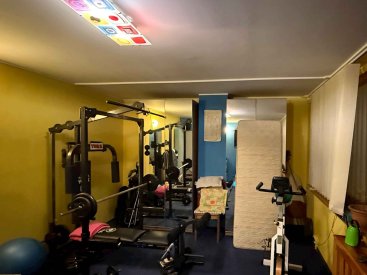
Unfortunately that is going to be a room issue, most likely because your speakers are set up asymmetrically in your room. It doesn't look like you can do much about it because there is a door there. Perhaps if you reverse the layout of your room - speakers against the other short wall on the opposite side of your room (i.e. against the mirrored wall), and gym equipment near the entrance - you can achieve better symmetry.
 
Hi,
I moved my listening room to basement and spent some time to find the right place for speakers and listening position, using REW measurements.
Now I think about some acoustic treatment of the room and I tried to use some available material (e.g. old matrices) to improve RT60 in front corners.
I measured before and after, and there is quite nice RT60 improvement.
Hi Marian, nice dual purpose room, I'm envious of your exercise equipment ;-).
I very often see threads like these on forums, so I'm curious, when you first placed the speakers and set up equipment, did you listen and hear how it sounded, prior to measuring and treating? Apologies if I missed this above. Do you have 1m gated measurements of the speakers themselves, possibly with a spliced nearfield of the woofer? To see what the speaker is radiating prior to your in room/listening position measurements.
How does is sound now with all the "treatments"? I will confess to not having read Keiths book, but based on your FR measurements, it seems enough trend to suggest pulling down 90hz and 140hz a bit, in increments (not one shot), listening each time with familiar tracks to hear the results. Sorry I'm a bit old fashioned in still relying a bit on human binaural perception :).
AVSF Marian measurements.jpg
 
Good work on your latest set of measurements, it looks as if you have learnt a lot. Keep it up!


If you are using your mic at 90 degrees, as you said you are, it seems unlikely to be due to the microphone stand although I guess it could still be possible. It is also possible that it is an internal reflection from your loudspeaker, or poor time alignment between drivers. I wouldn't worry too much about it.


From your photos it is likely to be your left wall.


Yeah, this is a problem. Take a look at this:

View attachment 90508

Red = L+R. Faint blue = left, faint green = right. We can see that when the speakers are playing individually they are about 3-4dB louder, but when playing together there is phase cancellation.

View attachment 90509

The phase curve tells you why. You can see that <70Hz and >200Hz, the speakers are in-phase with each other. But in that band in between, they are about 45deg out-of-phase.

Unfortunately that is going to be a room issue, most likely because your speakers are set up asymmetrically in your room. It doesn't look like you can do much about it because there is a door there. Perhaps if you reverse the layout of your room - speakers against the other short wall on the opposite side of your room (i.e. against the mirrored wall), and gym equipment near the entrance - you can achieve better symmetry.
Hi Keith,

I try to test some other set up and I will see if there is an imrovement.

Thanks for fast reply.

M.
 
Hi Marian, nice dual purpose room, I'm envious of your exercise equipment ;-).
I very often see threads like these on forums, so I'm curious, when you first placed the speakers and set up equipment, did you listen and hear how it sounded, prior to measuring and treating? Apologies if I missed this above. Do you have 1m gated measurements of the speakers themselves, possibly with a spliced nearfield of the woofer? To see what the speaker is radiating prior to your in room/listening position measurements.
How does is sound now with all the "treatments"? I will confess to not having read Keiths book, but based on your FR measurements, it seems enough trend to suggest pulling down 90hz and 140hz a bit, in increments (not one shot), listening each time with familiar tracks to hear the results. Sorry I'm a bit old fashioned in still relying a bit on human binaural perception :).View attachment 90510
Hi,

I tested by hearing and by measurement many positions.

Different distances from front/left walls, different spacing between speakers.

Main focus was to get "best" behaviour of basses, preferably shifting issues to higher frequencies.

I relied more on measurements as I can´t hear minor changes in sound, but I was hearing the promising set ups.

I know speaker measurements from official testing but anyway you can´t rely on it below 200Hz where the room is playing bigger role.

My focus is rather on reverb time RT60/T20 then on SPL. I can easily correct peaks via DSP but I feel some loss of "dynamic" with DSP.

So, I am now reasonably happy with the sound but I will play a bit with set up before I take it as a final one.

M.
 
My focus is rather on reverb time RT60/T20 then on SPL. I can easily correct peaks via DSP but I feel some loss of "dynamic" with DSP.

So, I am now reasonably happy with the sound but I will play a bit with set up before I take it as a final one.

M.
Decay and FR are interrelated. Reducing the peak will simultaneously reduce the decay. However, perceptually, a high Q "sharp" peak like that around 80-90hz can give the speaker a more "punchy"/dynamic sound. There's at least one manufacturer who deliberately does this, albeit at 80Hz, not 90. Close enough ;-).
If you are enjoying the sound, that's all that matters..
cheers
AJ
 
Hi, I thought I am making some progress but I am totally confused from new measurement.

I wanted to measure some new options, so I started with my latest setup "as a base"

The results seemed rather strange and different to previous ones with the same setup.

I measured one speaker several times and the results were quite different, except for SPL.

So I made new set of 3 times repeated measurement, with 15 sec delay to leave the room.

Again, the RT60, Phase, Impulse, EDC were quite different for each measurement.

No change in setup, same volume, quiet cellar room, I left the room, etc.

Do you have any idea how to interpret the results when they differ so much?

Thanks
 

Attachments

Oh boy, what a head scratcher. I don't think I can figure this one out.

1772840406938.png


First we look at your frequency response graphs. Here are three measurements of your left speaker. They are mostly the same.

1772840329453.png
1772840351201.png


Now we evaluate measurement quality by looking at the waterfall and extending the time window to 1000ms to look at the noise floor. Here are two measurements of your left speaker. You can see that the measurement on the right has been contaminated by external noise. In fact, all your measurements are contaminated by noise to a certain degree. But I don't think that noise is enough to explain what we see next:

1772840742545.png


These are all 3 impulse responses of the left speaker. We can see where REW has placed t=0. The pattern of reflections is very different. In fact, it almost looks like a measurement of two speakers instead of one, with different microphone positions between each measurement. Also, none of the measurements have a time reference.

1772863548176.png


If we look at the "tail" of the step response, we can see that the room response to the impulse is staggered by 5-10ms in all 3 measurements.

1772863717399.png


After I align them ...

1772863751157.png


... the impulse response no longer makes any sense. I thought that we might be looking at a similar situation to this other guy on ASR but I can see that this is one sweep and not four. Whatever it is, it's bizarre and I don't understand what is going on either.

Please do this:

1. Put your mic on a microphone stand and centre it between the two speakers. DO NOT TOUCH THE MICROPHONE between measurements.
2. In REW's "Measure" window, make sure the "Use acoustic timing reference" option has been selected.
3. Double and triple check that you are measuring ONE speaker and not two.
4. Choose a 512k or 1M measurement to suppress the noise floor.
5. Repeat this measurement set (3 of left, 3 of right, and 3 of both) and post the results here.
 
In fact, it almost looks like a measurement of two speakers instead of one
I thought the same thing. Listen carefully when the sweep sounds. If you specified in REW that the sweep should be from one channel, for example, L, somehow the sweep goes to both L and R. The receiver may be doing this because it is performing some kind of setting that is not disabled. Windows can do this, for example, if the spatial audio setting is enabled.
 
Hi,

I repeated the measurements based on your advice.

I am definitely not touching the setup and I measure the single speakers (and then both) - checked by ear, SPL and visible on file names

- increased SPL from 75 to 80dB - noise in Waterfall seems OK
- change to "Use acoustic timing reference", zero offset and trim - is it correct ??
- change of "Timing reference output" from "opposite" to "same" speaker - is it correct ??
- change to 5 measurements, long delay. I am leaving the room and have a coffee :cool:

Measurements are still not consistent but I can select the "same" ones based on curves and starting at 0 ms.
There were 3 for R, 2 for L and 1 for L+R
Is that normal to have so many "false" measurements or is there any error in setup?

Also I centred the speakers +/- 1mm using laser meter, but there is delay even using the same reference speaker. L+R ETC seems OK - any idea?

The last point, I made some EQ filters, are the parameters reasonable?

I enclose 1) all 5 measurement, 2) my selection + EQ, 3) pdf with setup

Any advise is highly appreciated

Thanks

M.
 

Attachments

All right, I definitely can not figure this one out. Hopefully @John Mulcahy or someone smarter will have a suggestion. This is the problem:

1773141417998.png


Here are 5 measurements of your right speaker. You can see that there are clearly two types of impulse response. One predominantly upgoing (positive polarity) and the other predominantly negative polarity. If you look at this, you would think "this guy has measured his left speaker, and then measured his right speaker, and then labelled all of them as right speaker by mistake. Let me confirm that to see if there is a similar pattern in his left speaker".

1773141556159.png


And here are 5 measurements of your left speaker. Once again, there are clearly 2 patterns of impulse response. Let's see whether the broader, upgoing polarity impulse labelled "left speaker" is the same as the right.

1773141827058.png


Look at that, two of your measurements labelled "right speaker" is more or less the same as three of your measurements labelled "left speaker". So at this point I should get on the forum and accuse you of mislabelling graphs, right?

1773141927253.png


... except that the SPL graph of all your measurements labelled "right speaker" are exactly the same. Not even 0.1dB apart. This basically makes it impossible for a mislabelled left speaker to be in this collection.

This is bizarre. How can 5 measurements with exactly the same SPL response have two different impulse responses? There is no acoustic explanation that I can think of. It's almost as if REW mixed up the impulse responses but grouped all the frequency responses together. This should basically be impossible, unless there was some bug mixing the display of measurements? The mystery doesn't end here. If we look at the measurement of L+R, we once again see the SPL response is exactly the same, but there are THREE different impulse responses. Short of a bug in REW, I have no explanation. Sorry.
 
How can 5 measurements with exactly the same SPL response have two different impulse responses?
Clock adjustments are all over the place, anywhere from -3 ppm to -255 ppm. That will alter the shape of the IR but won't change the energy, so the frequency response is not affected. Difficult to say why the adjustments are varying, perhaps there are dropouts in replay or capture.
 
Would you have any idea about ETC peak around 80 micro sec?

Assuming this is not a typo and you actually mean 80 MICRO seconds (and not 80 milliseconds). 80us in which measurement? If the peak is in the L+R measurement and not in the individual measurements, then it's a non-centred microphone.

If it's 80us in an individual speaker measurement (i.e. it is occurring VERY early), possibilities include: improper driver time alignment, ringing from one of the drivers (this is normal), internal cabinet reflection, etc.

I wouldn't worry about it.

Anyway, it's very interesting that the long USB cable was the culprit. I didn't know it could do such a thing. Can you please clarify if the long USB cable was on the microphone, or to the DAC? And also, how long was the cable?
 
Last edited:
Back
Top