






robbnj
Member
Thread Starter
- Joined
- Oct 24, 2022
- Posts
- 76
More
- Preamp, Processor or Receiver
- Denon
- Main Amp
- B&O icePower
- DAC
- Denon
- Computer Audio
- JRiver
Hi all.
Doing some fiddling with my main speakers today. and wanted to get a set of sweeps to save and tinker with.
I did a measurement of each main speaker independently, then a measurement of them both playing. I noticed that the bas dropped off quite a bit when I measured both at the same time.
I thought "could I possibly have had a woofer out of phase for who knows how long?!", so I disabled the mids/tweets (just to have a clean test) and tested the bass modules alone (the speakers consist of a fully independent bass module, and mid/tweet module, and can be bi-amped).
First left, then right, then together.
Then, I reversed the wiring polarity on just the right speaker, and tested them both together again.
You can see in the first pic how having both speakers playing at the same time kills the bass.
Same thing in the second pic, yet the responses are similar in or out of phase, even though you can see the phase "shift" when looking at peaks and troughs between the two L+R tests..
There is no EQ or any type of processing enabled for these tests, and it happens across multiple mic positions.
The speakers are 24" from back wall, 36" from side wall, 96" apart.
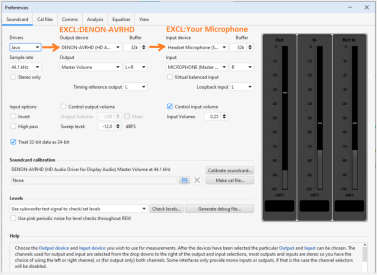
I'd throw a guess that something is happening in REW when I use L+R versus just L or just R, but I cannot even fathom a guess as to how I am losing bass by having two woofers playing, regardless of whether they are in phase or out of phase with each other.
Any ideas?
The loss of bass is pretty extreme when testing both speakers at once:

The loss of bass is the same even when the wiring on one bass module is reversed and both are tested together.

EDIT TO ADD:
When I do a vector average with REW of the separate sweeps (#19 in gold), it shows the bass loss.
If I use the "invert" function and do another average (red), the bass loss is fixed. BUT, this does not work when I electrically invert the signal by switching the wiring.
Color me even more confused.

Doing some fiddling with my main speakers today. and wanted to get a set of sweeps to save and tinker with.
I did a measurement of each main speaker independently, then a measurement of them both playing. I noticed that the bas dropped off quite a bit when I measured both at the same time.
I thought "could I possibly have had a woofer out of phase for who knows how long?!", so I disabled the mids/tweets (just to have a clean test) and tested the bass modules alone (the speakers consist of a fully independent bass module, and mid/tweet module, and can be bi-amped).
First left, then right, then together.
Then, I reversed the wiring polarity on just the right speaker, and tested them both together again.
You can see in the first pic how having both speakers playing at the same time kills the bass.
Same thing in the second pic, yet the responses are similar in or out of phase, even though you can see the phase "shift" when looking at peaks and troughs between the two L+R tests..
There is no EQ or any type of processing enabled for these tests, and it happens across multiple mic positions.
The speakers are 24" from back wall, 36" from side wall, 96" apart.
I'd throw a guess that something is happening in REW when I use L+R versus just L or just R, but I cannot even fathom a guess as to how I am losing bass by having two woofers playing, regardless of whether they are in phase or out of phase with each other.
Any ideas?
The loss of bass is pretty extreme when testing both speakers at once:
The loss of bass is the same even when the wiring on one bass module is reversed and both are tested together.
EDIT TO ADD:
When I do a vector average with REW of the separate sweeps (#19 in gold), it shows the bass loss.
If I use the "invert" function and do another average (red), the bass loss is fixed. BUT, this does not work when I electrically invert the signal by switching the wiring.
Color me even more confused.
Last edited: