






-
AUDIO VIDEO PROCESSING, SETUP & ENVIRONMENTOfficial REW (Room EQ Wizard) Support Forum Audiolense User Forum Calibration Equipment Auto-EQ Platforms / Immersive Audio Codecs Video Display Technologies / Calibration AV System Setup and Support Listening Room / Home Theater Build Projects Room Acoustics and Treatments AV Showcase Movies / Music / TV / Streaming
-
AUDIO VIDEO DISCUSSION / EQUIPMENTHome Theater / Audio and Video - Misc Topics Essence For Hi Res Audio AV Equipment Advice and Pricing Awesome Deals and Budget AV Equipment AV Receivers / Processors / Amps UHD / Blu-ray / CD Players / Streaming Devices Two Channel Hi-Fi Equipment DIY Audio Projects Computer Systems - HTPC / Gaming HD and UHD Flat Screen Displays Projectors and Projection Screens AV Accessories Buy - Sell - Trade
Navigation
Install the app
How to install the app on iOS
Follow along with the video below to see how to install our site as a web app on your home screen.
Note: This feature may not be available in some browsers.
More options
You are using an out of date browser. It may not display this or other websites correctly.
You should upgrade or use an alternative browser.
You should upgrade or use an alternative browser.
FSAF (Fast subband adaptive filtering) measurement
- Thread starter John Mulcahy
- Start date


John Mulcahy
REW Author
Thread Starter
- Joined
- Apr 3, 2017
- Posts
- 9,388
No.
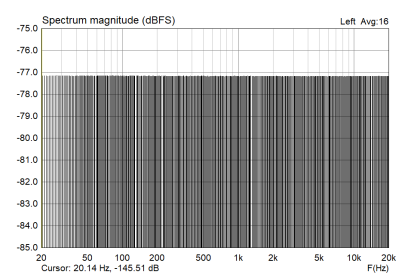
I'm a fan of M-Noise for general noise stimulus that resembles audio spectrum, a lot better than pink noise anyway. I think Stoneeh's trying to compare result of FSAF to a multitone IMD type of measurement, so needs to keep the magnitude spectrum and crest factor similar or it's not a very equal comparison.
The only reason for the existence of simplified tests like sine sweep and multi-tone IMD tests is their low computational load. Their interpretation in terms of music is ... debatable. Many self-proclaimed experts claim that by looking at FR, harmonics, and spinograms, they can predict how a loudspeaker will sound in a given room. Others call it snake oil.
FSAF comes from the opposite direction. It allows you to separate distortions from the original, on the music you listen to. Then you are free to come up with simplified tests that are consistent with your perception of the distortions that are meaningful to you (because each person is unique hearing-wise). Not vice versa.
FSAF comes from the opposite direction. It allows you to separate distortions from the original, on the music you listen to. Then you are free to come up with simplified tests that are consistent with your perception of the distortions that are meaningful to you (because each person is unique hearing-wise). Not vice versa.
It allows you to separate distortions from the original, on the music you listen to
what does "original" refer to here please?
What level of explanation do you need? PhD or 5 years old?
The "original" does not refer to master tapes or acoustic fields in the recording studio. It refers to the digital recordings available to the end-user. It is not a problem to equalize your acoustic system to a picture-perfect, ruler-flat FR (say, 1m on the axis, integrated over a sphere by an omnidirectional mic). This signal is supposed to be a linear-time-invariant (LTI) transformation of the digital recordings - but it is not. The differences from the LTI are what FSAF sees as distortions. Does this explanation suffice?
The "original" does not refer to master tapes or acoustic fields in the recording studio. It refers to the digital recordings available to the end-user. It is not a problem to equalize your acoustic system to a picture-perfect, ruler-flat FR (say, 1m on the axis, integrated over a sphere by an omnidirectional mic). This signal is supposed to be a linear-time-invariant (LTI) transformation of the digital recordings - but it is not. The differences from the LTI are what FSAF sees as distortions. Does this explanation suffice?

I guess 5 years old is my level, since @dcibel made me understand lol
thanks to both
now this was very usefull, thanks
thanks to both
is not a problem to equalize your acoustic system to a picture-perfect, ruler-flat FR (say, 1m on the axis, integrated over a sphere by an omnidirectional mic). This signal is supposed to be a linear-time-invariant (LTI) transformation of the digital recordings - but it is not. The differences from the LTI are what FSAF sees as distortions. Does this explanation suffice?
now this was very usefull, thanks
"misuse and abuse" is exactly what I am looking for.
I think I could be this guy.
Can impulses be used as a source? My first idea for a misuse would be to hear my room reverberation isolated
John, if the FSAF measurement was done from a file, what would the TD+N distortion graph show, the sum of all distortions plus noise? If the signal received by the microphone differs from the file, how can I highlight this difference on the graph? Maybe the TD+N graph is the difference graph?
Distortion graph for FSAF is a spectrum of the residual. So its total distortion + noise for the duration of the audio, regardless of what the input audio is. For more detailed analysis, listen to the residual audio, and/or "load FSAF residual", then view in spectrogram.




Popular tags
20th century fox
4k blu-ray
4k uhd
4k ultrahd
action
adventure
animated
animation
bass
blu-ray
calibration
comedy
comics
denon
dirac
dirac live
disney
dolby atmos
drama
fantasy
hdmi 2.1
home theater
horror
kaleidescape
klipsch
lionsgate
marantz
movies
onkyo
paramount
pioneer
rew
romance
sci-fi
scream factory
shout factory
sony
stormaudio
subwoofer
svs
terror
thriller
uhd
ultrahd
ultrahd 4k
universal
value electronics
warner
warner brothers
well go usa