If you want to keep it that way, measure each sub separately. Far sub as is, near with MSO delay, using acoustic synchronization over the same speaker with the tweeter. Then do the addition of the measurements in REW. You will get the measurement of the combined sub. Second option. Turn on both subs together, the far one as is, the near one with an MSO delay. Make measurements with acoustic synchronization over the same speaker with tweeter: combined sub, left front, right front. 3 measurements. Next will be job on choosing the crossover frequency.MSO calculated the delay to put on closer subwoofer.







-
AUDIO VIDEO PROCESSING, SETUP & ENVIRONMENTOfficial REW (Room EQ Wizard) Support Forum Audiolense User Forum Calibration Equipment Auto-EQ Platforms / Immersive Audio Codecs Video Display Technologies / Calibration AV System Setup and Support Listening Room / Home Theater Build Projects Room Acoustics and Treatments AV Showcase Movies / Music / TV / Streaming
-
AUDIO VIDEO DISCUSSION / EQUIPMENTHome Theater / Audio and Video - Misc Topics Essence For Hi Res Audio AV Equipment Advice and Pricing Awesome Deals and Budget AV Equipment AV Receivers / Processors / Amps UHD / Blu-ray / CD Players / Streaming Devices Two Channel Hi-Fi Equipment DIY Audio Projects Computer Systems - HTPC / Gaming HD and UHD Flat Screen Displays Projectors and Projection Screens AV Accessories Buy - Sell - Trade
Navigation
Install the app
How to install the app on iOS
Follow along with the video below to see how to install our site as a web app on your home screen.
Note: This feature may not be available in some browsers.
More options
You are using an out of date browser. It may not display this or other websites correctly.
You should upgrade or use an alternative browser.
You should upgrade or use an alternative browser.
Crossover, speaker alignment, room equalization - what do I start with?
- Thread starter Lid9497
- Start date

Lid9497
Member
Thread Starter
- Joined
- May 23, 2025
- Posts
- 34
More
- Preamp, Processor or Receiver
- Sound Blaster X4
- Main Amp
- Fosi Audio V3-48V
- Front Speakers
- Denon SC-M41
- Subwoofers
- SVS PB-1000 Pro
Thx! another question if you wouldn't mindYes, with timing reference as you did for MSO and yes to XO in place.
 what is the correct way to measure subwoofer when using acoustic timing reference? do I set measurement frequency range to operating range of the subwoofer? SVS is 260hz -+3db, do I measure that range? or full range? there is a difference in the delay measured with full range being about 1-1,5ms more, that is quite significant.
No reason to go beyond a few hundred Hertz with the sub.Thx! another question if you wouldn't mind
I don’t understand the delay being different relative to the timing channel with either full range or partial.
Yes. I have not encountered such a thing.I don’t understand the delay being different relative to the timing channel with either full range or partial.
Lid9497
Member
Thread Starter
- Joined
- May 23, 2025
- Posts
- 34
More
- Preamp, Processor or Receiver
- Sound Blaster X4
- Main Amp
- Fosi Audio V3-48V
- Front Speakers
- Denon SC-M41
- Subwoofers
- SVS PB-1000 Pro
No reason to go beyond a few hundred Hertz with the sub.
I don’t understand the delay being different relative to the timing channel with either full range or partial.
Took measurements using 200, 500, 20000hz range, 1,2ms difference, also included mdat file, why is this happening? Mic position is unchanged, only changed frequency measurement range.Yes. I have not encountered such a thing.
Attachments
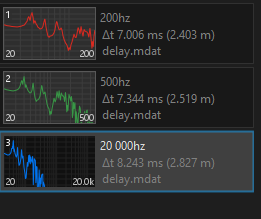
The difference is not 1.2 ms, but 0.14 ms. The measurements of 200 and 500 are almost the same. The 20k measurement differs by 0.14ms. The Umik-1 microphone does not have its own clock oscillator. It takes the clock rate from the USB bus. Therefore, each new measurement is slightly different from the previous one. This is a well-known fact.
Lid9497
Member
Thread Starter
- Joined
- May 23, 2025
- Posts
- 34
More
- Preamp, Processor or Receiver
- Sound Blaster X4
- Main Amp
- Fosi Audio V3-48V
- Front Speakers
- Denon SC-M41
- Subwoofers
- SVS PB-1000 Pro
Where are you calculating these values from? 7ms with 200hz vs 8.2ms with 20000hz is 1.2ms? Or is that the wrong delay shown and there is some other place to read the delays?The difference is not 1.2 ms, but 0.14 ms. The measurements of 200 and 500 are almost the same. The 20k measurement differs by 0.14ms. The Umik-1 microphone does not have its own clock oscillator. It takes the clock rate from the USB bus. Therefore, each new measurement is slightly different from the previous one. This is a well-known fact.
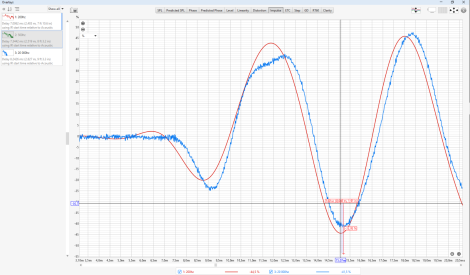
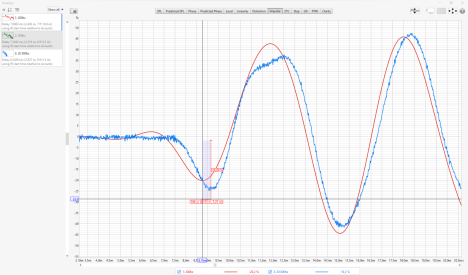
I'm not looking at the numbers you're looking at. I look at the source, at the graphs. Between the first peaks there are 386 microseconds, between the second peaks the time cannot be determined, because the second peak of 20k did not work out. The first and second peaks may not reflect the correct information because subs develop peaks slowly. Therefore, let's look at the third peaks. There is a difference of 0.14 ms. But, if you take another microphone, even Umik-2, there will be no difference.
Attachments
Lid9497
Member
Thread Starter
- Joined
- May 23, 2025
- Posts
- 34
More
- Preamp, Processor or Receiver
- Sound Blaster X4
- Main Amp
- Fosi Audio V3-48V
- Front Speakers
- Denon SC-M41
- Subwoofers
- SVS PB-1000 Pro
OK I got it, but that still doesn't tell me which of the delays is the correct one, I assume MSO will be working with that absolute value, so which one I feed to MSO?I'm not looking at the numbers you're looking at. I look at the source, at the graphs. Between the first peaks there are 386 microseconds, between the second peaks the time cannot be determined, because the second peak of 20k did not work out. The first and second peaks may not reflect the correct information because subs develop peaks slowly. Therefore, let's look at the third peaks. There is a difference of 0.14 ms. But, if you take another microphone, even Umik-2, there will be no difference.
To answer, you have to take 4 measurements. Left main, right main, near sub, far sub. All 4 with acoustic synchronization by, for example, the left main.so which one I feed to MSO?
I think @Lid9497 has used MSO to already set the subwoofers as a group and at this point needs to set subs group to the mains.To answer, you have to take 4 measurements. Left main, right main, near sub, far sub. All 4 with acoustic synchronization by, for example, the left main.
I assume MSO will be working with that absolute value, so which one I feed to MSO?
If I’m correct with the first comment, the answer is neither of them. Use the Alignment Tool to align the phase of the subs and the mains at the XO that you would have taken your measurements with. The Alignment tool will provide the needed delay.
Here’s a couple of posts that may help if needed.
Post in thread 'Regarding multi-sub alignment, sub to main alignment and EQ set up'
https://www.avnirvana.com/threads/r...-main-alignment-and-eq-set-up.6107/post-45987
Post in thread 'MiniDSP Sub Setup'
https://www.avnirvana.com/threads/minidsp-sub-setup.6128/post-46617
And a lengthy thread if needed:
Thread 'REW Alignment tool - Guides or Manual?'
https://www.avnirvana.com/threads/rew-alignment-tool-guides-or-manual.6814/
Lid9497
Member
Thread Starter
- Joined
- May 23, 2025
- Posts
- 34
More
- Preamp, Processor or Receiver
- Sound Blaster X4
- Main Amp
- Fosi Audio V3-48V
- Front Speakers
- Denon SC-M41
- Subwoofers
- SVS PB-1000 Pro
I meant what measurement range do I use for MSO for subs only optimization purposes, I am not using it for mains eq. Thx for the links, will read through.I think @Lid9497 has used MSO to already set the subwoofers as a group and at this point needs to set subs group to the mains.
If I’m correct with the first comment, the answer is neither of them. Use the Alignment Tool to align the phase of the subs and the mains at the XO that you would have taken your measurements with. The Alignment tool will provide the needed delay.
Here’s a couple of posts that may help if needed.
Post in thread 'Regarding multi-sub alignment, sub to main alignment and EQ set up'
https://www.avnirvana.com/threads/r...-main-alignment-and-eq-set-up.6107/post-45987
Post in thread 'MiniDSP Sub Setup'
https://www.avnirvana.com/threads/minidsp-sub-setup.6128/post-46617
And a lengthy thread if needed:
Thread 'REW Alignment tool - Guides or Manual?'
https://www.avnirvana.com/threads/rew-alignment-tool-guides-or-manual.6814/
It shouldn’t matter, but there’s no point in capturing a lot of noise. A few hundred Hz should be fine.I meant what measurement range do I use for MSO for subs only optimization purposes,
To verify all is working properly, use the make measurement from aligned sum button on the tool and then take an actual measurement. The two should be the same.
Home from vaca and looked at the .mdat. I'm not knowledgeable enough to explain the differences in the delay calculations. I would suggest using the EXCL labeled drivers to bypass the windows mixer when measuring. With the 200Hz (Red) measurement delay you can see pre-ringing starting the IR that isn't present in the other 2 measurements. Also take a look at what is preceding the main impulse in the 20-20kHz (Blue) measurement. I believe this is a result of capturing only noise in the HF range, but I'm not 100% on this.

If you'd like to also include a measurement of the each main channel with the XO in place it would be possible for myself or someone else to also look at alignment with the alignment tool.
( REW's trace arithmetic can be used to add the left and right together and to add 6dB to the sub measurement so the Alignment tool can be used with accurate relative SPL of subs group and mains)
Question for @John Mulcahy , are different calculated delays expected when measuring a sub and keeping all else the same other than the frequency range of the sweep? If so, what would be best practice for capturing a subwoofer measurement to use with mains measurement and the alignment tool?
If you'd like to also include a measurement of the each main channel with the XO in place it would be possible for myself or someone else to also look at alignment with the alignment tool.
( REW's trace arithmetic can be used to add the left and right together and to add 6dB to the sub measurement so the Alignment tool can be used with accurate relative SPL of subs group and mains)
Question for @John Mulcahy , are different calculated delays expected when measuring a sub and keeping all else the same other than the frequency range of the sweep? If so, what would be best practice for capturing a subwoofer measurement to use with mains measurement and the alignment tool?

John Mulcahy
REW Author
- Joined
- Apr 3, 2017
- Posts
- 9,387
Not particularly, but it is best to capture the bandwidth of the driver being measured and for this sub there is still significant output at 200 Hz so stopping it there is truncating the response and the recovered IR is affected by that. The 500 Hz measurement looks like a more accurate capture of the sub's behaviour.are different calculated delays expected when measuring a sub and keeping all else the same other than the frequency range of the sweep?
John Mulcahy,
The blue graph has a shaky look. See post #33. What is the cause for this phenomenon?
John Mulcahy
REW Author
- Joined
- Apr 3, 2017
- Posts
- 9,387
Everything above 500 Hz or so is noise as the sub has no output there.
Lid9497
Member
Thread Starter
- Joined
- May 23, 2025
- Posts
- 34
More
- Preamp, Processor or Receiver
- Sound Blaster X4
- Main Amp
- Fosi Audio V3-48V
- Front Speakers
- Denon SC-M41
- Subwoofers
- SVS PB-1000 Pro
Hey, back with an update. I've finally found a good listening position where MSO has the most to work with. I measured two completely corner-loaded subwoofer placements (as far into the corners as possible) and at 75cm from both walls, using 4 mic positions arranged front-to-back and left-to-right, 60cm apart. Measurements were taken from 17-400Hz in exclusive mode.
MSO performed similarly with both placements, though the 75cm position looks slightly better. However, that dip around 55Hz persists. It can be reduced somewhat by adding one or two filters per sub channel, but I'm not sure if it's worth it. I'm currently using 10 filters (excluding all-pass filters). Would you be satisfied with this result? What's your upper limit for filters per sub?
I haven't tested the EQ yet since I'm not home—just experimenting with MSO for now. I've included a zip file with the MSO and REW files if you'd like to try running an optimization yourself.

MSO performed similarly with both placements, though the 75cm position looks slightly better. However, that dip around 55Hz persists. It can be reduced somewhat by adding one or two filters per sub channel, but I'm not sure if it's worth it. I'm currently using 10 filters (excluding all-pass filters). Would you be satisfied with this result? What's your upper limit for filters per sub?
I haven't tested the EQ yet since I'm not home—just experimenting with MSO for now. I've included a zip file with the MSO and REW files if you'd like to try running an optimization yourself.
Attachments
Lid9497
Member
Thread Starter
- Joined
- May 23, 2025
- Posts
- 34
More
- Preamp, Processor or Receiver
- Sound Blaster X4
- Main Amp
- Fosi Audio V3-48V
- Front Speakers
- Denon SC-M41
- Subwoofers
- SVS PB-1000 Pro
Hello, back with another update. I think I am finally finished, after 3 arduous months of positioning, measuring, optimizing - not a lot of free time  - I think I am finally done. System sounds amazing, punchy mid-bass, extremely good low-end, I always had problems with the very low-end energizing left side of my room, with dual subs this is gone, finally all the bass is centered, it was always shifted slightly to the left, no more, yay. I used 20-40hz boost curve, felt like that region was a little weak with flat 75db, in movies especially.

The only thing that's left is proper treatment - bass traps, and I need to treat first reflections from mains as well, but the system as is sounds amazing.
So thanks for all your advice and help, couldn't do it without you all (and your amazing programs like REW and MSO).
- I think I am finally done. System sounds amazing, punchy mid-bass, extremely good low-end, I always had problems with the very low-end energizing left side of my room, with dual subs this is gone, finally all the bass is centered, it was always shifted slightly to the left, no more, yay. I used 20-40hz boost curve, felt like that region was a little weak with flat 75db, in movies especially.
The only thing that's left is proper treatment - bass traps, and I need to treat first reflections from mains as well, but the system as is sounds amazing.
So thanks for all your advice and help, couldn't do it without you all (and your amazing programs like REW and MSO).
Lid9497
Member
Thread Starter
- Joined
- May 23, 2025
- Posts
- 34
More
- Preamp, Processor or Receiver
- Sound Blaster X4
- Main Amp
- Fosi Audio V3-48V
- Front Speakers
- Denon SC-M41
- Subwoofers
- SVS PB-1000 Pro
Here is my mdat fileYour graph is too zoomed out to see anything at all. Please show a 50dB vertical scale.
Attachments
Happy to hear it all came together!Hello, back with another update. I think I am finally finished, after 3 arduous months of positioning, measuring, optimizing - not a lot of free time
View attachment 87583
The only thing that's left is proper treatment - bass traps, and I need to treat first reflections from mains as well, but the system as is sounds amazing.
So thanks for all your advice and help, couldn't do it without you all (and your amazing programs like REW and MSO).
I’ll have a look at the mdat if @Keith_W doesn’t get to it first. One thing to keep in mind with treating side wall 1st reflection points is that it shrinks the perceived sound stage. Some prefer it, some don’t.

Keith_W
Member
- Joined
- Apr 3, 2018
- Posts
- 138
Why wait for me?  You saw it first! Anyway let's have a look.

Here is a more sensible zoom of your FR with subwoofer (red) and mains together (green). There are two issues:
1. Too much bass, about 10dB too much. To be fair, some HT guys prefer a bass response like this. It makes explosions and T-Rexes sound big and scary. It might also make some types of music sound better. But for acoustic instruments, I would prefer a flatter bass response. There is no strict "right" or "wrong" for this one (although some people would argue for more of a flatter curve), IMO it's your preference.
2. What happened to the treble above 14kHz?

I was curious about that dip above 14kHz, so I summed your L and R RTA's together (magenta) and compared it with "LR", which I assume is a single sweep taken from the main listening position (green). If the RTA was done correctly it should be a closer representation of what you hear. What we see is a +7dB upper bass peak and a treble peak at 14kHz in the RTA, and the two curves are obviously not the same. So I have to ask you - what area did you sweep with your RTA? Small area around where your head is? Or a large area encompassing several listening positions? I am guessing it's the latter.

Next, step response. I have also shown the step response of "LR" alone (in faint green) and the subwoofer (in faint magenta). I have shown it twice - zoomed in (on the left) and zoomed out to show the entire impulse response. The reason I show the zoomed out view is to prove that I have aligned the subwoofer impulse correctly.
Look at the black curve first - this is both speakers together with the subwoofer. Before the main impulse at t=0, the response should be flat. It isn't. You can see a substantial amount of pre-ringing that starts about 100ms (!!!) before the main impulse. Some of it is due to the subwoofer (see the zoomed in view), but I have no idea what is causing the rest of it. If you are using a poorly optimized linear-phase filter, it can certainly create a lot of pre-ringing - but you are using minphase IIR aren't you?
It may or may not be audible. The audibility threshold for pre-ringing is about 20ms, and yours well exceeds that. The ideal test track for audibility would be a huge transient with a lot of bass preceded by silence. I suggest Track 1 of this album. You should hear the thwack and boom of the drum together. But if the boom precedes the thwack, then you have a problem.

You saw it first! Anyway let's have a look.
Here is a more sensible zoom of your FR with subwoofer (red) and mains together (green). There are two issues:
1. Too much bass, about 10dB too much. To be fair, some HT guys prefer a bass response like this. It makes explosions and T-Rexes sound big and scary. It might also make some types of music sound better. But for acoustic instruments, I would prefer a flatter bass response. There is no strict "right" or "wrong" for this one (although some people would argue for more of a flatter curve), IMO it's your preference.
2. What happened to the treble above 14kHz?
I was curious about that dip above 14kHz, so I summed your L and R RTA's together (magenta) and compared it with "LR", which I assume is a single sweep taken from the main listening position (green). If the RTA was done correctly it should be a closer representation of what you hear. What we see is a +7dB upper bass peak and a treble peak at 14kHz in the RTA, and the two curves are obviously not the same. So I have to ask you - what area did you sweep with your RTA? Small area around where your head is? Or a large area encompassing several listening positions? I am guessing it's the latter.
Next, step response. I have also shown the step response of "LR" alone (in faint green) and the subwoofer (in faint magenta). I have shown it twice - zoomed in (on the left) and zoomed out to show the entire impulse response. The reason I show the zoomed out view is to prove that I have aligned the subwoofer impulse correctly.
Look at the black curve first - this is both speakers together with the subwoofer. Before the main impulse at t=0, the response should be flat. It isn't. You can see a substantial amount of pre-ringing that starts about 100ms (!!!) before the main impulse. Some of it is due to the subwoofer (see the zoomed in view), but I have no idea what is causing the rest of it. If you are using a poorly optimized linear-phase filter, it can certainly create a lot of pre-ringing - but you are using minphase IIR aren't you?
It may or may not be audible. The audibility threshold for pre-ringing is about 20ms, and yours well exceeds that. The ideal test track for audibility would be a huge transient with a lot of bass preceded by silence. I suggest Track 1 of this album. You should hear the thwack and boom of the drum together. But if the boom precedes the thwack, then you have a problem.

ddude003
Senior AV Addict
More
- Preamp, Processor or Receiver
- PrimaLuna Dialogue Premium TubePre (2 channel+sub)
- Main Amp
- McIntosh MC152 SS Amp (2 channel)
- Additional Amp
- Yamaha RX-A850 Pro (the other 5 channels lol)
- DAC
- Chord Electronics Ltd. Qutest
- Computer Audio
- MacBook Pro, Custom i7 7700k De-lid 2xAsus1080ti GFX, Audirvana Studio, Hang Loose Convolver+FIR, Tone Projects Michelangelo, Pulsar Massive & 8200, LiquidSonics, SoX with Million Tap mod
- Universal / Blu-ray / CD Player
- Sony UBP-X700 /M Ultra HD 4K HDR & PS5
- Streaming Equipment
- Netgear Nighthawk S8000 Streaming Switch
Lumin U1 Mini Streamer Transport
- Streaming Subscriptions
- QoBuz Studio Premier, Amazon Prime & Netflix
- Front Speakers
- Martin Logan ElectroMotion ESL
- Center Channel Speaker
- Martin Logan Motion C2
- Surround Speakers
- Martin Logan Motion 4
- Surround Back Speakers
- Martin Logan Motion 4 (yes, another set of these)
- Subwoofers
- SVS SB-1000 Pro
- Screen
- Elite Screens Aeon CLR3 0.8 Gain 103-inch
- Video Display Device
- Samsung The Premiere LSP7T UST Laser Projector
- Remote Control
- PrimaLuna, Lumin iApp, Samsung & Yamaha
- Other Equipment
- Cifte 12AU7 NOS & Genalex Gold Lion Tubes in Pre
ThrowRug, SaddleBlankets, WideBand & Bass Traps...
Good job @Lid9497... After you add the "proper acoustic treatments" you will need to rerun all your measurements and settings... I always suggest acoustic treatments first then digital room corrections...Hello, back with another update. I think I am finally finished, after 3 arduous months of positioning, measuring, optimizing - not a lot of free time
View attachment 87583
The only thing that's left is proper treatment - bass traps, and I need to treat first reflections from mains as well, but the system as is sounds amazing.
So thanks for all your advice and help, couldn't do it without you all (and your amazing programs like REW and MSO).
Lid9497
Member
Thread Starter
- Joined
- May 23, 2025
- Posts
- 34
More
- Preamp, Processor or Receiver
- Sound Blaster X4
- Main Amp
- Fosi Audio V3-48V
- Front Speakers
- Denon SC-M41
- Subwoofers
- SVS PB-1000 Pro
Thanks, I listened to the first track (Rikimaru?) first in my headphones to get a good reference point, I then played in on my speakers and I couldn't tell the difference, it sounded basically identical, even pushed to uncomfortable listening levels, it was loud, but still sounded fine. Do you have any more tracks to test for this issue?Why wait for me?
View attachment 87604
Here is a more sensible zoom of your FR with subwoofer (red) and mains together (green). There are two issues:
1. Too much bass, about 10dB too much. To be fair, some HT guys prefer a bass response like this. It makes explosions and T-Rexes sound big and scary. It might also make some types of music sound better. But for acoustic instruments, I would prefer a flatter bass response. There is no strict "right" or "wrong" for this one (although some people would argue for more of a flatter curve), IMO it's your preference.
2. What happened to the treble above 14kHz?
View attachment 87605
I was curious about that dip above 14kHz, so I summed your L and R RTA's together (magenta) and compared it with "LR", which I assume is a single sweep taken from the main listening position (green). If the RTA was done correctly it should be a closer representation of what you hear. What we see is a +7dB upper bass peak and a treble peak at 14kHz in the RTA, and the two curves are obviously not the same. So I have to ask you - what area did you sweep with your RTA? Small area around where your head is? Or a large area encompassing several listening positions? I am guessing it's the latter.
View attachment 87608View attachment 87613
Next, step response. I have also shown the step response of "LR" alone (in faint green) and the subwoofer (in faint magenta). I have shown it twice - zoomed in (on the left) and zoomed out to show the entire impulse response. The reason I show the zoomed out view is to prove that I have aligned the subwoofer impulse correctly.
Look at the black curve first - this is both speakers together with the subwoofer. Before the main impulse at t=0, the response should be flat. It isn't. You can see a substantial amount of pre-ringing that starts about 100ms (!!!) before the main impulse. Some of it is due to the subwoofer (see the zoomed in view), but I have no idea what is causing the rest of it. If you are using a poorly optimized linear-phase filter, it can certainly create a lot of pre-ringing - but you are using minphase IIR aren't you?
It may or may not be audible. The audibility threshold for pre-ringing is about 20ms, and yours well exceeds that. The ideal test track for audibility would be a huge transient with a lot of bass preceded by silence. I suggest Track 1 of this album. You should hear the thwack and boom of the drum together. But if the boom precedes the thwack, then you have a problem.
View attachment 87609
Honestly I don't know why it has only measured up to 14khz, but that was only for alignment purposes, I have already good EQ in place for mains from 45-20000hz from before.
Regarding sub boost - yes, I boost 20-40hz to feel the deep rumble better, it doesn't really have too much effect on a music, I could feel it in instrumental songs (movie/game soundtracks), but most importantly in a movies (explosions, implosions...)




Popular tags
20th century fox
4k blu-ray
4k uhd
4k ultrahd
action
adventure
animated
animation
bass
blu-ray
calibration
comedy
comics
denon
dirac
dirac live
disney
dolby atmos
drama
fantasy
hdmi 2.1
home theater
horror
kaleidescape
klipsch
lionsgate
marantz
movies
onkyo
paramount
pioneer
rew
romance
sci-fi
scream factory
shout factory
sony
stormaudio
subwoofer
svs
terror
thriller
uhd
ultrahd
ultrahd 4k
universal
value electronics
warner
warner brothers
well go usa