






Rolledmyown
Registered
Thread Starter
- Joined
- Apr 12, 2023
- Posts
- 14
More
- Preamp, Processor or Receiver
- Wadia Di122,,
- Main Amp
- Home made
- Computer Audio
- JRiver, Windows (Sony) laptop
- Front Speakers
- Home made, completely, except for drivers
- Subwoofers
- SVS PB1000
Hi folks, I'm a bit out of my depth here with some recent REW experiments - and audio in general!
Long story short, I've have a pair of kit speakers comprising Peerless 830668 woofers, Scanspeak 12MU/8731T00 mids and Classic D2905/930000 tweeters in a ported 70 L box. I made my own massive aircored chokes and crossovers back in the 90's and decided to modernise my outfit using a pair of Hypex FA123 plate amps to make active speakers.
I have spent quite a number of years testing my equipment with REW in order to optimize my listening position and sub integration but just by using SPL/phase plots. Now I have the opportunity to branch out and do some things that were not possible with my passive cross overs, specifically time align the drivers to optimize the speakers, then I was going to implement room EQ using MediaCenter as I've been doing for a while now.
Anyhow, my first attempt was to estimate the physical offsets of my 3 drivers and calculate delays to suit those measurements. I then tweaked those delay numbers and used SPL and phase plots by eye to 'find the best delay'. The optimized delays arrived at were 200 uS for the mid and 501 uS for the mid, which correspond to offsets of 69 mm and 172 mm, Those numbers sounded quite rational. Then I read some articles describing more sophisticated approaches - in particular the miniDSP article https://www.minidsp.com/applications/rew/measuring-time-delay. I chose to use my recording mike at 1 m from the midpoint between the mid and tweeter (one of the recommended setups) and then put a delay of 1 mS between the mid and tweeter in order to well-separate the impulses from the mid and the tweeter (then of course the 1 mS increment is subtracted from the measured impulse delays). From that approach I (eventually!!!) arrived at delays of 853 and 896 uS, which seemed way too big to me for the dimensions of my enclosure and the official drawings of the drivers! So today I did some experiments from my listening position with just one speaker and my sub turned off, using the delays of 853 and 896 together with several others of shorter delay but preserving the delay difference of about 43 uS between the mid and tweeter.
I checked the SPL and phase for each to see what was happening at the mid/woofer crossover (4th order LR at 250 Hz) and although there was some difference there was nothing startling showing even at delays as low as 100 and 143 uS. I then had a read of an excellent post on a Klipsch site https://community.klipsch.com/topic/182892-using-rew-to-determine-time-delays-between-drivers/. That made use of spectrograms in order to interrogate sweep data. I've attached a couple showing the plot from what I think are the unrealistically high delays (853 and 896 uS) and what I've thought to be the best of the other settings that I tested (500 and 543). I must admit, I'm a little concerned at the size and position of the peaks in the time energy plots. They make me think that maybe I should not cross over at 250 Hz?? But I'd like to hear the views from folks who are more adept than I at interpreting these plots.
I also had a gander at REW documents discussing excess group delay as a means of selecting delays, I've attached a couple of those plots below as well for the same delays as used in the spectrogram plots. The only thing that stands out to me is the size of the peak at 263 Hz, which is smaller in the 500/534 delay pair. For delays between 500/543 and 853/896 the size of that peak grows and others come and go too. What should I make of those graphs - again, the peak at 263 Hz alarms me somewhat. If it is an artefact such as a room reflection then maybe I shouldn't be placing the XO at 250, maybe closer to 200 or 300 would be better??? By the way, the woofer has a 4th order HP at 50, which should account for the other massive peak at lower frequency I suspect. I've also attached the mdat files. As I said, these were recorded from my listening position, which is about 2 m from the speakers, with no eq nor room treatments.
Any help would be gratefully received!
In any event, the 853/896 and original 200/501 delays all sound quite good to me when I've done some listening tests. Possibly a testament to my cloth ears rather than to my ability to pick the best numbers from the data!
PK
Long story short, I've have a pair of kit speakers comprising Peerless 830668 woofers, Scanspeak 12MU/8731T00 mids and Classic D2905/930000 tweeters in a ported 70 L box. I made my own massive aircored chokes and crossovers back in the 90's and decided to modernise my outfit using a pair of Hypex FA123 plate amps to make active speakers.
I have spent quite a number of years testing my equipment with REW in order to optimize my listening position and sub integration but just by using SPL/phase plots. Now I have the opportunity to branch out and do some things that were not possible with my passive cross overs, specifically time align the drivers to optimize the speakers, then I was going to implement room EQ using MediaCenter as I've been doing for a while now.
Anyhow, my first attempt was to estimate the physical offsets of my 3 drivers and calculate delays to suit those measurements. I then tweaked those delay numbers and used SPL and phase plots by eye to 'find the best delay'. The optimized delays arrived at were 200 uS for the mid and 501 uS for the mid, which correspond to offsets of 69 mm and 172 mm, Those numbers sounded quite rational. Then I read some articles describing more sophisticated approaches - in particular the miniDSP article https://www.minidsp.com/applications/rew/measuring-time-delay. I chose to use my recording mike at 1 m from the midpoint between the mid and tweeter (one of the recommended setups) and then put a delay of 1 mS between the mid and tweeter in order to well-separate the impulses from the mid and the tweeter (then of course the 1 mS increment is subtracted from the measured impulse delays). From that approach I (eventually!!!) arrived at delays of 853 and 896 uS, which seemed way too big to me for the dimensions of my enclosure and the official drawings of the drivers! So today I did some experiments from my listening position with just one speaker and my sub turned off, using the delays of 853 and 896 together with several others of shorter delay but preserving the delay difference of about 43 uS between the mid and tweeter.
I checked the SPL and phase for each to see what was happening at the mid/woofer crossover (4th order LR at 250 Hz) and although there was some difference there was nothing startling showing even at delays as low as 100 and 143 uS. I then had a read of an excellent post on a Klipsch site https://community.klipsch.com/topic/182892-using-rew-to-determine-time-delays-between-drivers/. That made use of spectrograms in order to interrogate sweep data. I've attached a couple showing the plot from what I think are the unrealistically high delays (853 and 896 uS) and what I've thought to be the best of the other settings that I tested (500 and 543). I must admit, I'm a little concerned at the size and position of the peaks in the time energy plots. They make me think that maybe I should not cross over at 250 Hz?? But I'd like to hear the views from folks who are more adept than I at interpreting these plots.
I also had a gander at REW documents discussing excess group delay as a means of selecting delays, I've attached a couple of those plots below as well for the same delays as used in the spectrogram plots. The only thing that stands out to me is the size of the peak at 263 Hz, which is smaller in the 500/534 delay pair. For delays between 500/543 and 853/896 the size of that peak grows and others come and go too. What should I make of those graphs - again, the peak at 263 Hz alarms me somewhat. If it is an artefact such as a room reflection then maybe I shouldn't be placing the XO at 250, maybe closer to 200 or 300 would be better??? By the way, the woofer has a 4th order HP at 50, which should account for the other massive peak at lower frequency I suspect. I've also attached the mdat files. As I said, these were recorded from my listening position, which is about 2 m from the speakers, with no eq nor room treatments.
Any help would be gratefully received!
In any event, the 853/896 and original 200/501 delays all sound quite good to me when I've done some listening tests. Possibly a testament to my cloth ears rather than to my ability to pick the best numbers from the data!
PK
Attachments
-
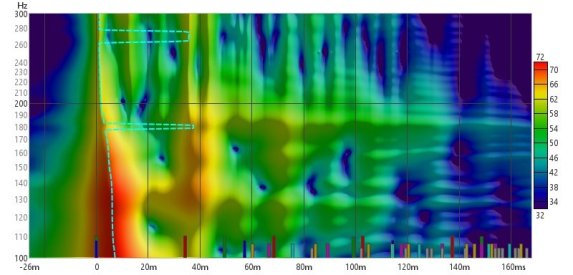 delays 853 and 896 mid and tweeter respectively SPECTROGRAM.jpg53.4 KB · Views: 7
 -
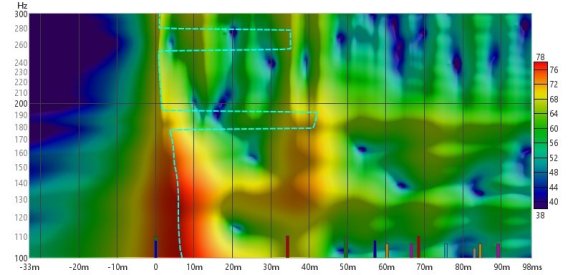 delays 500 and 543 mid and tweeter respectively SPECTROGRAM.jpg50.1 KB · Views: 4
 -
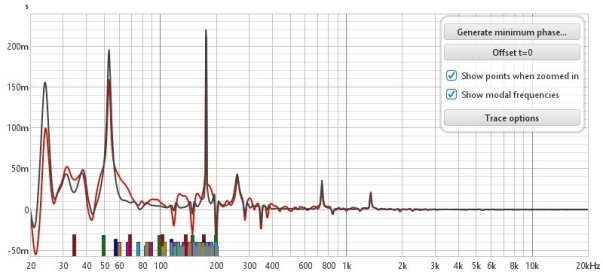 delays 500 and 543 mid and tweeter respectively EXCESS GROUP DELAY.jpg57.2 KB · Views: 7
 -
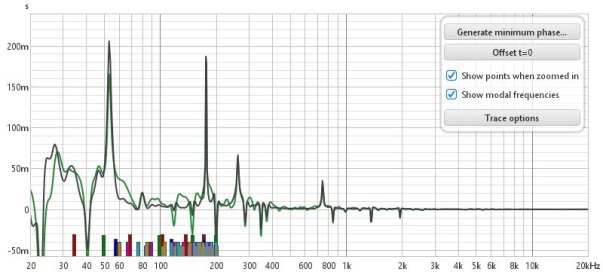 delays 853 and 896 mid and tweeter respectively EXCESS GROUP DELAY.jpg56 KB · Views: 5
 -
R Jan 18 listening position RHS after input of new delays expt to reduce mid delay a little 5...mdat653.3 KB · Views: 2
-
R Jan 18 listening position RHS after input of new delays expt to reduce mid delay a little 8...mdat653.3 KB · Views: 7