Please refer to the
REW help index and the
free REW eBook (you want Book 2) for general questions about how to use REW and how to interpret measurements.
What is the correct procedure within REW to
• calibrate input/output levels
REW check levels procedure
• run sweeps through the glasses
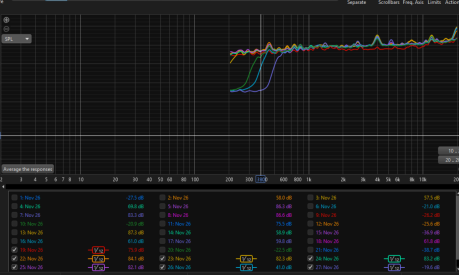
• capture speaker FR
Taking sweeps with REW
This will be more difficult. You will need (1) a calibrated omnidirectional microphone, (2) a speaker with a known flat anechoic response, (3) an audio interface, (4) some way to connect your mic to REW through the same interface. This is the procedure:
First, create the reference measurement:
1. Using a loopback timing reference, and your microphone at 1m from the speaker under anechoic conditions, sweep the speaker.
2. In REW, apply 1/6 or 1/12 smoothing.
Now measure the DUT:
3. Using a loopback timing reference, and your DUT at the exact same position from the speaker under anechoic conditions, perform a sweep.
4. In REW, apply 1/6 or 1/12 smoothing.
5. Align the two impulses using the loopback reference and do Trace Arithmetic A/B (A = DUT, B = reference).
6. Repeat the procedure for different angles of incidence to obtain a polar map.
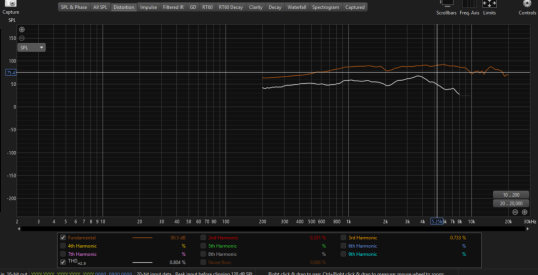
• capture THD
• capture impulse/ETC
REW Distortion measurement. Note that you are better off using a stepped sine wave to measure distortion, as per the REW manual.
ETC is in the "Impulse" tab. Click on ETC and change the view from % to dBFS.