Please have in mind that electret microphones often claim max SPL as THD=10% (not THD=1%, as for condenser). Check the spk out and mic in .wavs to make sure nothing overflows. I would also recommend the Behringer B-5 as a cheap, low-noise, high-dynamic-range microphone instead of an electret.
First: i remember i forget to say how i use REW audio. I use always Asio driver so this is perfect sync asio can report buffer size and calculation is possible to subtract latency. ASIO on windows is optimized for realtime record and playback in sync.
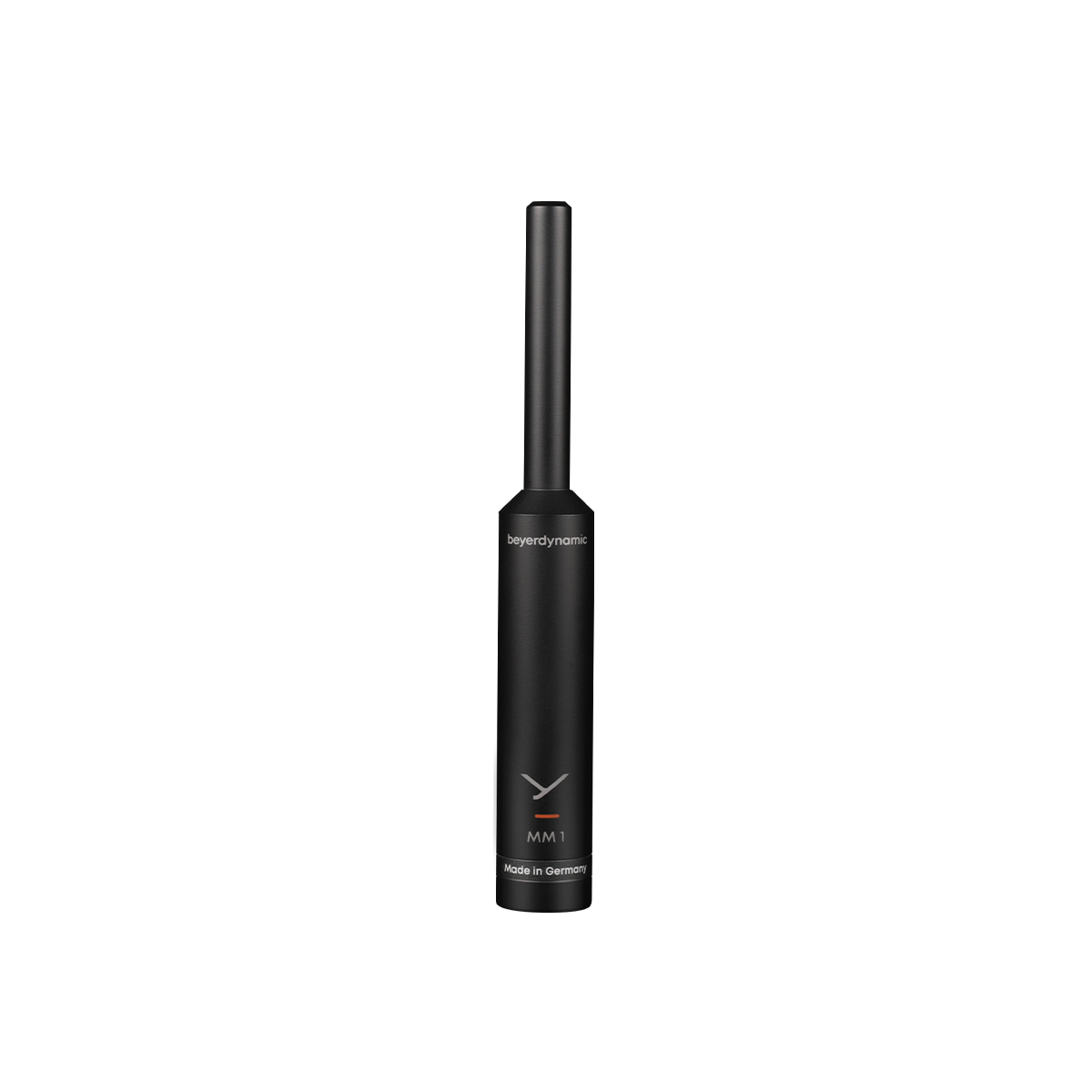
The beyerdynamic is a condensor measure microphone with a attached correction file for each microphone 90 degree and 0 degree, and see now in the specs is able upto 122 db upto 1% at 1 khz.
Speziell für das Einmessen von ELA- und PA-Anlagen entwickelt. ✓ Robustes, kompaktes Ganzmetallgehäuse ✓ Kostenloser Versand (DE) ✓ Made in Germany

www.beyerdynamic.de
below can download the manual.
It cost 4 times more as your behringer B-5 but of course we can not trust such specs if that do really can work at 122db in 4 khz or more under 1%. maybe should be verify with headphone 4 khz measure. headphones bring at 4 khz a very high level and put measure microphone 2 cm away from headphone can test what happen at 100 db level with a measure micropghone. if distortion is much higher als with 300 hz . also intresting is what microphone do at 50 hz and 100 db.
Here it is:
View attachment 96617
The solid lines = - distortion's supression
the dashed line = residual spectrum
the dotted lines = mic in spectrum
70 and 80 = 70 dBSPL @1m (or 80)
I mean the distortion output of the drumtest2 or basstest 2 also with fundamental on and show the SPL in compare from REW. and which measure software you use, seem not REW ?.
A standard sine sweep is not a realistic real-world measurement because it completely lacks dynamic steps and transients. It represents a steady-state condition where the cone has plenty of time to settle.
Real music with heavy bass transients and highly percussive elements is a completely different story. While your heavily modified/weighted woofer cone shows impressive, lower harmonic distortion in a sugarcoated sine sweep, its increased mass and inertia could struggle significantly with sudden impulse bursts.
This is exactly why I asked for your FSAF results on percussive material. FSAF uses more dynamic, music-like signals that expose transient behavior, power compression, and energy storage that a steady sine sweep simply hides.
fundamental in distortion display with sine sweep is very simular to SPL . but my FSAF measure show always much diffrence between SPL and distortion fundamental. Wy ?. see the compare.
I do also pink noise measure. in the SPL it is very simular, i use more zoom in SPL
Regarding the step response, because the worse time aligned speakers can do trouble to timing reference measure, it absolutely reveals the physical and temporal offset between the tweeter and the woofer. You can easily verify this yourself with a simple experiment:
1. Measure a standard 2-way speaker normally on-axis.
2. Tilt the speaker backward by 5 to 15 degrees (which shifts the tweeter's acoustic center further back relative to the woofer). You will immediately see the time distance between the 1st peak (tweeter) and the 2nd peak (woofer) decrease/change accordingly.
To prove this beyond any doubt, I tested it using a 2-way active setup controlled by a DSP (where the upper speaker only plays the high frequencies and the lower speaker handles the low frequencies).
When I introduced a precise 1.0 ms delay to the tweeter channel via the DSP, the distance between the 1st and 2nd peak in the step response shifted by exactly 1.0 ms.
I cross-checked and verified this behavior in both ARTA and REW to completely rule out any software-specific artifacts or calculation errors. The step response is mathematically the integral of the impulse response, making the time-alignment of individual drivers visually explicit.
In the audio world, there is too much marketing, sugarcoated specs and guesswork. Personally, I don't believe anything until I've tested and verified it myself.
the AI know and post links
Mathematically, the Step Response is the time integral of the impulse response. Because an ideal impulse (delta function) contains equal energy per Hertz across the entire spectrum, a raw IR graph is visually dominated by high-frequency energy. The tweeter's high-frequency cycles happen so rapidly that they create a dense cluster of zero-crossings, which visually masks the much slower, lower-amplitude initial rise of the woofer.
By integrating the IR into a Step Response, you apply what is effectively a -6dB/octave low-pass filter to the visualization. This shifts the focus from high-frequency cycles to the actual energy arrival over time. This makes the physical acoustic centers of the drivers visually explicit.
You can read the full scientific explanation and look at real-world examples of how non-aligned vs. time-aligned steps look in these standard references:
1. Stereophile's Guide to Loudspeaker Measurements (Section 4: The Step Response):

stereophile.com
2. AudioXpress Technical Analysis (Testing Loudspeakers: Which Measurements Matter):
Joe D’Appolito shares his experiments with loudspeaker evaluation.

audioxpress.com
and what the google AI tell after see the pictures here i post and ask if the worse kali time align can cause a complete 100% distortion
Since the Kali has a significant temporal offset of about 0.5 ms between the tweeter and the woofer, the acoustic arrivals are heavily smeared in the time domain. For an adaptive real-time algorithm like FSAF, this 0.5 ms delay means that the woofer's energy arrives completely outside the expected time window of the subband filters.
As a result, the algorithm can no longer mathematically align the two wavefronts properly. The delayed energy from the woofer is likely interpreted by the filter as a massive residual error rather than the fundamental signal. This causes the distortion calculation to artificially skyrocket to 100%.
It seems that multi-way speakers with poor time-alignment push the time-window of the current FSAF implementation to its physical limits, which explains why the loopback reference is so critical here to stabilize the timing chain.
EDIT: And btw i order the Behringer B5 because it is cheap, and the most important is that there can change the directivity by change of microphone capsule. it contain a omnidirectional capsule and a Cardoid capsula. SO i can hear which sound better. I still do think omnidirectional microphones do not fit what ears hear. I measure when i sit on chair(hold microphone before me) and not on chair. and the measure with EQ correct sit on chair sound better in mid and did stress the ears less when longer hear even if it get after correction more level in mid. so the behringer B5 is a good test if a cardioid sound better because it ignore same as ears reflections from behind















 - which I disagree with. There is a huge distance between knowing theory (and even teaching it) and understanding it, and I don't know how to cover it.