






First steps in REW and some uncertainty

propeller

Registered
Thread Starter
Joined
Sep 2, 2026
Posts
10
More  
Preamp, Processor or Receiver
Sony TA-AN 1000
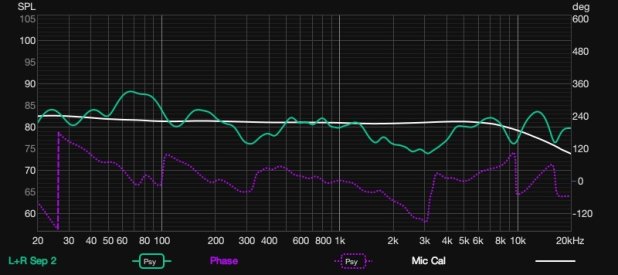
I have made my first measurements and I have difficulty to judge them. I am measuring in a living room 2 Klipsch RP 8000F and Klipsch SPL 120. Crossover is set at 80 Hz.

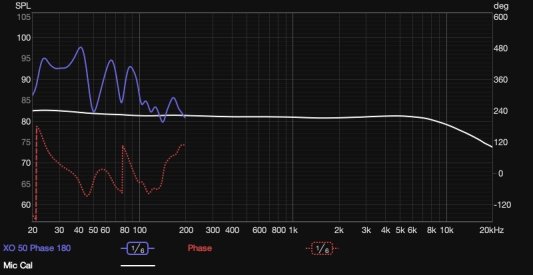
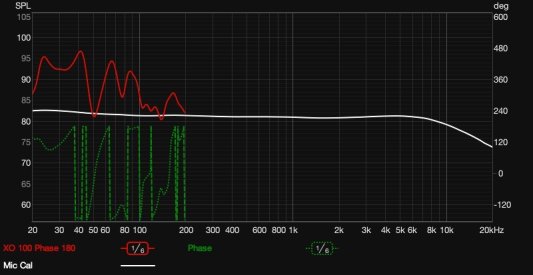
I first used psychoacoustic filters which made it look flat. But with var filters it looks more wild.

How do you interpret my measurements?
Is this considered normal?

I will add a second SPL 120 soon. Music and movies sound great, but I wanted to measure the levels to tune in the subwoofer and now I am even more unsure, if this is all good. :)

psy.jpg  .jpg
var.jpg
 
The info you need can be found in the REW manual - here. In a nutshell: psychacoustic smoothing (and ERB smoothing) reflect what you hear. Variable smoothing has more "resolution" in the lower frequencies and less in the upper frequencies, which is what you want if you are going to prepare your measurement for DSP.
 
Thanks and yes, I understand. But out of experience dies this look good or bad?

I will add anstehe subwoofer and find the appropriate Position using REW, but my possibilities using DSP are limited. The subwoofers for example are not possible to set timings for separately.
 
The first thing you should do is compare your measurement to published measurements. Luckily for you, Erin reviewed your speaker here. If you placed your mic at the listening position, then what you expect to measure is the PIR (Predicted In-Room Response). Scroll down a bit and it's here:

1788370680875.png


If you look closely, it's not quite the same. Your measurement has a broad dip between 1.5khz - 4kHz of up to 7-8dB. Erin's measurement has a dip between 1kHz - 2kHz. Note that the PIR has an error of +/- 1.5dB depending on your room (darker green band). Ask yourself why your measurement has that dip. It is usually because of improper measurement technique, e.g. if you used a mini tripod and perched it on top of furniture - i.e. it may be a measurement artefact.

Those bass anomalies in your measurement are expected and will be seen in every listening room.

For general viewing, most of us use 1/6 or 1/12 octave smoothing.
 
Thanks, I will redo the measurements. I used the tripod of the UMIK-1 on top of the seat.

When I tune in the subwoofer (level) is this part supposed to be a bit louder than the higher frequencies or as glat as possible?
Is the crossover at 80 Hz beneficial or should I aim lower?
 
Thanks, I will redo the measurements. I used the tripod of the UMIK-1 on top of the seat.

When I tune in the subwoofer (level) is this part supposed to be a bit louder than the higher frequencies or as glat as possible?
Is the crossover at 80 Hz beneficial or should I aim lower?

Firstly, I am not convinced that your measurements were taken properly - so what I am about to say is not the final word. ASSUMING that this graph was a proper, and real measurement of your scenario:

1788399806282.png


... understand that the purpose of subwoofers is to (1) fill nulls in the frequency response below 100Hz, (2) provide bass extension, and (3) provide more even bass coverage for a listening area.

This graph shows a couple of peaks in the freq response at about 65Hz and 85Hz, and some nulls below that. There is also pretty impressive bass extension for a pair of main speakers alone. So you only need to worry about (1) and (3).

For (1), I would recommend an XO point at about 55Hz or so. For (3), we don't have that measurement. You will need to either do an MMM or repeat the measurement at several points over a seating area, all with a timing reference. Then "Vector Sum" them in the "All SPL" tab.

Bear in mind that those mini tripods are close to useless, it would be better if it wasn't included at all and saved you a few dollars off the purchase price. If you haven't gotten yourself a proper mic tripod yet, you can do an MMM. Remember that your measurement needs to reflect reality, and you don't listen with your head 10cm above your seat.

As for how loud your subwoofers should be: that's up to you, really. Most of us prefer a -4dB to up to -10dB downward slope from bass to treble. See:

1788400679480.png
 
Before choosing 55 or 80 Hz, I would first make the measurement repeatable. Put the UMIK-1 capsule at actual ear height on a separate boom stand rather than on the seat, keep the same sweep level, and measure left, right and sub separately. Then compare a few crossover choices—such as 60, 80 and 100 Hz—with the microphone unchanged. Repeat the most promising setting at several nearby seating positions; a narrow dip that moves with the microphone is not a good EQ target. There is no universal requirement for the bass to be perfectly flat or a fixed number of decibels louder. First aim for smooth integration and consistent seat-to-seat bass, then adjust the overall bass level to preference. A second sub can improve coverage, but placement and the available common distance/phase controls still need to be aligned before judging the result.

(Potential A.I. response)
 
Sorry @Keith_W, That B&K, that I use, does not look right... Maybe you spaced these out so the differences can be easily seen... Traditional B&K are approximately +3db at 20Hz and -3db at 20kHz... See https://www.bksv.com/media/doc/17-197.pdf Page 4 figure 5...
 
Sorry @Keith_W, That B&K, that I use, does not look right... Maybe you spaced these out so the differences can be easily seen... Traditional B&K are approximately +3db at 20Hz and -3db at 20kHz... See https://www.bksv.com/media/doc/17-197.pdf Page 4 figure 5...

Given that I maintain that target curve collection that I make available for free publicly, I was concerned by your reply. So I checked:

1788483539087.png

1788483567166.png


It's about the same, but the published B&K curve is a bit more "rounded" than mine. It's a quirk of my target curve designer. But it does have that 6dB downward tilt as published by B&K. I copied my target curve directly from the same source you linked when I originally made it.
 
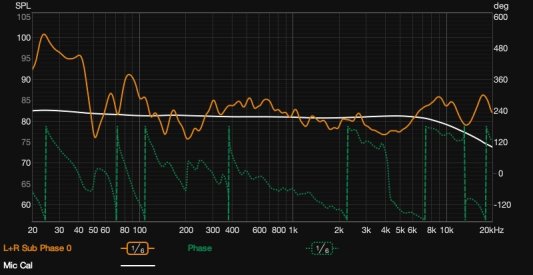
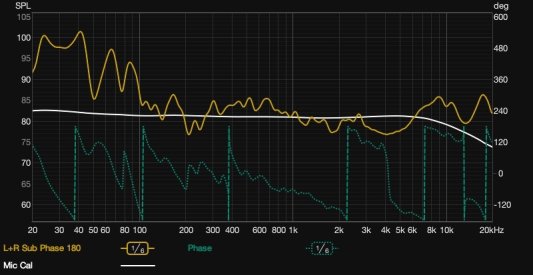
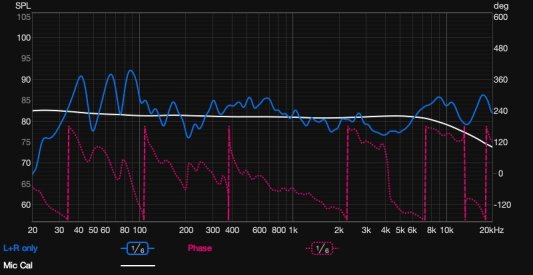
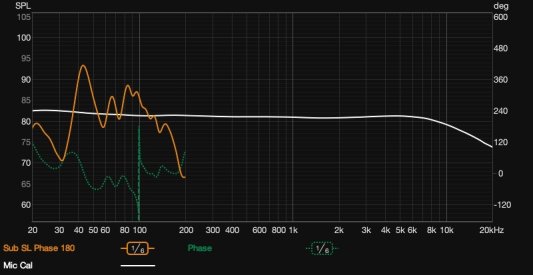
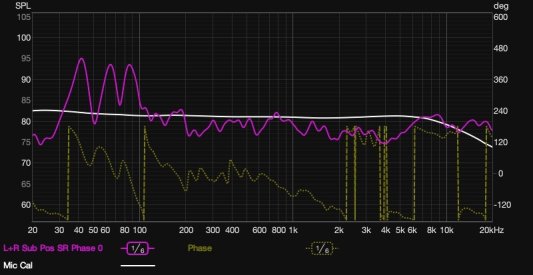
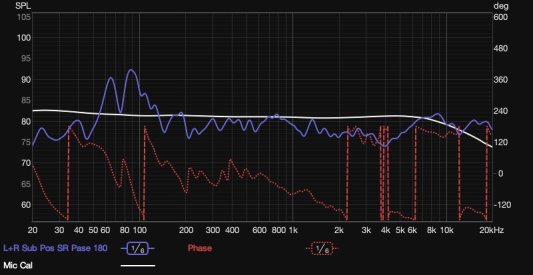
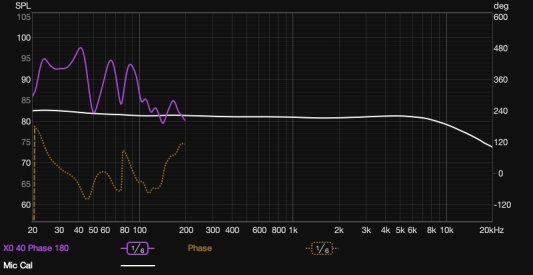
Ok, I have better measurements:

See titles at the bottom left
LR SUB Phase 0.jpg

LR SUB Phase 180.jpg

LR.jpg

I then moved the Sub to the back (Surround left and right (SL, SR)
SUB SL 180.jpg SUB SR 0.jpg SUB SR 180.jpg

And interestingly the XO doesn't really have an effect (measured at the front)

XO 40.jpg XO 50.jpg XO 100.jpg

This is all with the Klipsch SPL-120. It will be accompanied with a Klipsch PR-1000SW.

Especially at the back I almost don't get any volume from the sub. (no correction for that position applied).

I levelled all speaker to 75 dB(A) and the sub to 75 dB(C) using pink periodic noise.

What do you think?
 
Last edited:
1. Please download and read my REW measurements interpretation guide so that you can understand how to read the measurements yourself.

2. When comparing measurements, they should be overlaid. It is very difficult to look at one measurement, try to remember it, then look at another measurement to spot the differences.

3. You can easily see from your own measurement (when compared against that white line which I presume is some kind of target curve) that you have too much bass. Your bass isn't as smooth as it should be ... but then only so much can be done if you don't have DSP.

4. Why are you using dBA for the speakers and dBC for the sub? Just use pink noise (not periodic) and use dBC.

5. It is always best to upload an MDAT.
 
Thanks for all your valuable information and the amazing documents. I will read through them and report back with measurements including the second sub.

3. I may have to get a miniDSP 2x4 HD? for that, but also for the timing which cannot be corrected by my receiver - it only corrects one subwoofer, even if it has to outputs. This would enable me to adjust the subwoofers after Sonys room correction. I assume that if I set the Subwoofer to 0 m, I can override that setting with the DSP entirely. Finding the perfect position of the sub is probably impossible and I can already see some interactions with the fronts.

4. The problem is that there is also bad information in the internet. That was one of them.

5. Noted.
 
Ok I decided to go all in.

I have two Klipsch SPL 120 and one RP-1000SW available.

The miniDSP 2x4 HD will be used for corrections (PEQ, Level, Timing).

One of the SPL has a faulty amplifier (common issue).
I plan to replace it with a Fosi 240W Mono amplifier. This way I can get another one if the second sub breaks - or if the replacement turns out to be better.


Do you have any advice on that?

I need to set a band pass filter and a maximal level in the DSP to protect the driver. Anything else I should consider? Maybe EQ? Not sure what Klipsch in doing on that.
 
Last edited:
Before you buy your MiniDSP ... you said something which is concerning. You already have a receiver. Those things usually have crossover functions and basic DSP functions. Why do you need a MiniDSP? How are you going to connect it all up? Personally, I do not like connecting too many things in series. It makes everything unnecessarily complicated. It might make more sense to replace your receiver with a MiniDSP, in which case you might have to start thinking about what inputs and other functions you need. Or you could upgrade to a more capable AVR.
 
Thanks for pointing that out.

Well my receiver only adjusts one subwoofer - even though it has two connectors. This is why I want to fix the group of subwoofers separately and let the receiver adjust the group to the main speakers. The receiver will mostly do the timing correction. Crossovers will be measured in REW and set in the receiver (right now it sets all to large).

My current receiver is new and I like the sound it produces (Music and Movies). My only issue is the base management. It is also unclear if for example the Marantz Cinema 50 would do as well as manually optimizing the subwoofers. But it would cost me a lot of money and I still need to find a fix for the SPL repair fix.
 
OK. Just remember that mains usually need to be delayed to match the subs. Some receivers don't have very much memory and thus may not be able to delay the mains by very much. If you can not achieve sufficient delay, you will have trouble integrating the subwoofer. You should aim to have at least one period of the crossover frequency of delay - for e.g. if you plan to XO at 80Hz, you need a delay of 1/80 = 12.5ms minimum. Add to that any additional latency produced by the MiniDSP (which would delay your subs even further). I would want at least 30ms to feel comfortable.
 
Looks like the DSP introduces 3 ms:

Of course I don‘t know the total time needed.

But if I set the distance in the receiver larger I get negative time for the subs. Normally that is calibrated as 5.x meters (while actually 2.5 m). So it depends on that number, right?
 
But if I set the distance in the receiver larger I get negative time for the subs. Normally that is calibrated as 5.x meters (while actually 2.5 m). So it depends on that number, right?

I am sorry, I don't know what that means.

I don't like specifying delays in "meters". This is because delays are the cumulative sum of ALL the delays in your system, and not just the time-of-flight delay. It can be broadly categorized as (1) electronic latency, i.e. whatever time it takes for a signal to pass through electronics, (2) DSP delay, i.e. any delay deliberately introduced by DSP, and (3) time-of-flight delay, i.e. how long it takes sound to travel from the speaker to you. It's not just "take a tape measure, measure the distance, and use that as a delay".

In addition to that, the aim isn't actually time alignment. It's actually phase alignment. You want to adjust the delays until the dips in the frequency response are minimized.

Those receivers try to simplify DSP for common users. Each manufacturer has its own idea of what "large" means, and some (like Denon and Marantz) use 300m/s instead of 343m/s as the speed of sound - so if you set the delay in meters, you will get the wrong delay in milliseconds. Best to be precise when you speak so that there is no confusion.
 
If I want a negative timing I have to set the distance of the subwoofer(s) further away. Then I can deal with the subwoofer delays better.

I found a good tutorial on doing so. Might be worth a try:
 
If I want a negative timing I have to set the distance of the subwoofer(s) further away. Then I can deal with the subwoofer delays better.

Firstly, physically placing your subwoofer further away will delay them even more. If you want less delay, the subwoofers need to be closer to you. I mentioned earlier that subwoofers are usually already delayed compared to main speakers.

Now let's say you put a MiniDSP in between your receiver and your subwoofer, and your main speakers are driven directly by the receiver. Even without doing anything, the MiniDSP introduces 3ms of delay. Distance = speed of sound * time, this alone requires you to place your subs 1.029m closer to you than you would otherwise. And if you do that, it will change the pattern of room modes - it won't be optimal any more.

Do not attempt to compensate for delays by moving the sub closer or further away. In some cases, the delays are so long that even if you are sitting on top of the subwoofer you still haven't gotten rid of the delay. It is simple to dial in delays with DSP, and much more precise.
 
My receiver sets the distance, which of course is a phase shift. So if I manually set this distance larger (while the subwoofer stays) I get a negative phase shift (receiver fires subs earlier). From that I get +3ms and whatever I need to phase align the subs.

The first step will be to align all subs using miniDSP, then measuring XO and set manually, then let the receiver set the timing for all speakers and the sub(-array).

EQ is done in miniDSP for base only (probably 18-200/500 Hz). I might test the EQ suggested by the receiver.

That is my plan at least. Does this make sense?

Sorry for the confusion about moving the subs.
 
Back
Top