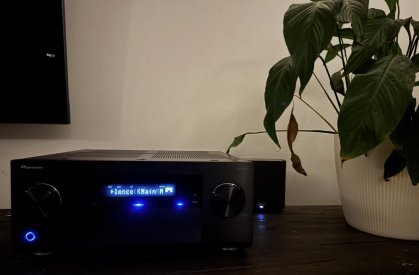






- Manufacturer & Model
- Pioneer Elite VSX-LX805 11.2 AV Receiver
- MSRP
- $2,999
- Highlights
- High-performance 11.2-channel capability; 150 Watts per channel; fully compatible with 8K/60Hz and 4K/120Hz video requirements; full-bandwidth Dirac Live room correction; Atmos, DTS:X, and Auro-3D onboard; dual independent subwoofer channels; Roon Ready and Works with Sonos; loads of connectivity options; excellent sound quality for movies and music at reference volume levels.
- Summary
- The Pioneer Elite LX805 is the flagship model in the Elite lineup, priced at $2,999. Packed with advanced technologies, the LX805 is a powerhouse for large home theater setups (up to 7.2.4 channels) or premium family room entertainment. Its robust Class A/B amplifier delivers 150 Watts per channel, complemented by dual independent subwoofer channels for precise bass management. Audio enhancements include full-bandwidth Dirac Live room correction with an optional Bass Control module, Roon Ready certification, and seamless integration with Sonos. On the video front, the LX805 supports all modern 4K and 8K requirements, including HDMI 2.1 compatibility. With its refined design, powerful performance, and flexibility, the Elite LX805 offers exceptional value for enthusiasts.

Today, we’re dipping our toes in the waters of Elite’s top-end VSX-LX805 AV receiver (MSRP $2,999) with an in-depth review, dissecting its build quality, performance characteristics, specialties, and – yes – a few warts. Much like Integra-branded receivers released in 2023, the LX805 was conceptualized by US-based design leads who were particularly tuned into the wants and needs of enthusiasts and custom integrators. They listened to those communities and pushed hard internally to ensure the LX805 and its mates hit the street with appeal and technical pizzazz.
The LX805 wasn’t originally intended to slot as Elite’s top model. That role belonged to another design that never made it to production. You wouldn’t know it, though, because this receiver proudly flexes plenty of flagship-level muscle. Take its four subwoofer outputs, for instance. Unlike many receivers, these are split into two independent channels, allowing for precise tuning and time alignment for truly flexible subwoofer placement. Pair that with its dual calibration options – Dirac Live with Bass Control and MCACC Pro – and you have a system that caters to advanced users as well as those seeking a simpler setup. Of course, there are many other tech features and physical elements… so let’s dive in.
Physical Look and Feel

Last year, we uploaded an unboxing video of the LX805, so if you’d like to hit pause and watch this beauty rise from its packaging, you can do so here. If you’re impatient and prefer to keep reading, know that the receiver arrives in grand fashion. My sample shipped triple-boxed in packaging designed from the ground up. The main box, adorned with striking graphics emphasizing the receiver’s advanced technology, contained a gloss-black Elite-branded accessories container—a fun nod to the brand’s iconic heritage – and the receiver, masterfully cocooned in custom styrofoam and protective wrap.
If you're a buyer who appreciates high-quality packaging, you'll be pleased.
The LX805 weighs nearly 50 lbs, making it hefty to lift. While it didn’t give me issues, you may want to recruit a friend for removal and placement. It’s also a sizeable piece of gear, standing at 7.3” tall and reaching 18.4” in depth. Be sure to read the measurement specs, add some extra space to account for any cables you plan to insert into the back, and confirm that the receiver will fit in your allotted space.
Much of the LX805’s weight comes from its Class A/B power section, which delivers 150W of power across 11 channels. That’s ten more watts per channel than Onkyo’s RZ70 and more than enough muscle to drive most tower and bookshelf speakers. Under the cover, the receiver’s internals drip with quality and organization. One feature you’ll immediately notice is four fanned heat sinks positioned on either side of the reference power transformer. These sinks are custom-molded and exclusive to some Elite and Integra models. For those of you wanting evidence of brand identity, Integra's sinks feature a sleek silver finish, while Elite's showcase a bold and striking black. While trivial, that kind of attention to detail is sure to appeal to hardcore fans of the brand.
To help with cooling, the LX805 has two oversized fans seated directly under its heat sinks. Fans, you say? Can't they get noisy? Yes, fans can, but it just so happens that the LX805's operate whisper-quiet, so there’s no need to worry about added noise.

With all that amplifier power and attention to airflow, you might wonder how warm the receiver gets during extended heavy use. To test, I placed a full-sized Trinnov processor on top of the LX805, pushed the receiver hard for several hours, and then took measurements. I found external surface temperatures of 102°F (top) and 82°F to 90°F (various areas on the front, back, bottom, and sides). So, things can get quite warm, but I found nothing concerning here. Do make sure you give the receiver room to breathe, though – I wouldn't suggest locking it away in a closed cabinet.
Physically speaking, the LX805 is a head-turner, sporting features like a throwback orange LED display, smooth lines along the edge of its body, and tight radiuses on its corners. You’ll also find a brushed metal faceplate, large machined knobs that turn with a weighted feel, and a soft-touch drop-down panel capped in brushed metal. Truth be told, this receiver aligns perfectly with my aesthetic preferences, offering a forward-facing appearance that’s refreshingly classy.
Unfortunately, physical feel goods don't extend to every aspect of the LX805. Looking closely, you’ll find areas where cost cuts were made. For example, the included backlit remote carries a faux brushed metal face and feels plasticky and cheap in the hands. The receiver’s feet are also molded plastic, though they nearly fooled me; I had to remove a foot to confirm its material makeup. While neither of these is a deal breaker, I was shocked to find standard black and red speaker posts mounted on the backside. Given the LX805’s flagship status, I’d expect something of higher quality.
Distinctive Features
Before we talk setup, let’s highlight some of the LX805’s more unique features that audiophiles may find appealing. To start, the receiver offers Elite's exclusive Precision Quartz for File-based Audio or PQFA. PQFA is used when media is sourced via network, USB, and Bluetooth. It stabilizes the clock signal during digital audio playback, purportedly reducing invasive jitter. This feature isn't found on Onkyo or Integra receivers.
The LX805’s AV Direct Mode also improves sound quality by limiting digital circuit activity associated with network, Bluetooth, and USB inputs. This can be engaged when listeners source audio from external devices connected to the LX805 via analog and digital inputs. In a similar vein, the receiver also has an HDMI Audio Exclusive Mode that shuts off the video side of the receiver’s HDMI Input 1 jack, eliminating another potential source of noise to the audio signals incoming through HDMI connections.
The Elite also carries two notable industry certifications that cater to audio functions. The first is Works With Sonos, which means the LX805 can integrate with an existing whole-home or single-speaker Sonos system. Essentially, the receiver can be added to and controlled through the Sonos app. So, the need to fidget with multiple apps is eliminated, and owners can make track selections and control volume levels all within Sonos' app architecture.
The other certification is Roon Ready, which means the receiver integrates seamlessly with Roon using the Roon Advanced Audio Transport (RAAT) protocol. This allows for bit-perfect playback, high-resolution audio support, multi-room synchronization, and complete control through the Roon app. Don't confuse Roon Ready with Roon Tested, which applies to devices verified to work with Roon but typically rely on alternative playback protocols like AirPlay or Chromecast – the LX805 gives you access to the good stuff.
Set-Up
The LX805 marks a new chapter in graphical user interface design for Elite products, introducing a clean and user-friendly layout. It looks great and doesn't take much effort to navigate. First-time users, particularly those new to AVRs, will appreciate the intuitive onscreen instructions that guide you through essential setup tasks, like connecting to WiFi and configuring a room’s speaker arrangement, and some of the minutiae like hooking up HDMI eARC and performing a sound check to ensure speakers are properly connected to the correct terminals—the latter of which caught a mistake I made as I wired a 7.2.4 speaker array. Yes, even seasoned pros can cross their wires!
For me, the Elite had Wi-Fi set up and running in about 40 seconds, aided by integration with my iPhone. Of course, we've all experienced maddening problems with Wi-Fi, and the LX805 has tools to ease the pain. Within the menu system, you'll find a built-in network connection check that verifies MAC and IP addresses, performs a gateway ping, and runs an internet service test— all handy tools that are lightning-fast in response times.
Owners have two calibration systems at their disposal to fine-tune audio performance: Pioneer’s proprietary MCACC Pro and the highly regarded Dirac Live. Both can be used with the microphone included with the LX805. However, if you want to extract the absolute best from Dirac Live, consider investing in a miniDSP UMIK-1 microphone and running the calibration on a PC or Mac. For this review, I tested both MCACC and Dirac Live, along with Dirac's optional Bass Control module, using the included mic and free Pioneer Remote app (iOS, Android) to get that "out-of-the-box" user experience.
MCACC is definitively the weaker of the two calibration options, making it best suited for a quick set-up focused on basic tasks like setting speaker distances and channel levels. Pre and post-MCACC measurements revealed that the software actually degraded my system’s overall response. Bass frequencies were left virtually untouched, while frequencies above 200 Hz exhibited less flatness after correction. On the channel leveling front, MCACC managed to align the front left, right, and center channels within half a decibel of each other but struggled with the remaining channels, many of which were off by two to three decibels from reference.
My advice: skip MCACC and proceed directly to Dirac.
Dirac Live is a standout feature and a significant selling point of this receiver. Surprisingly, you can actually achieve impressive results with the included microphone and the free app, not to mention running Dirac with these tools is reasonably accessible to first-time users. If you're a true green-to-the-core newbie, you might need to ask for help on our forum. But I'm fairly confident that most will trial and error their way to good results.
Out of the box, Elite provides the full-bandwidth version of Dirac Live, which enables frequency corrections beyond 500Hz. For those looking to take things to the next level, Dirac Live Bass Control is available for an additional $299. It offers precise control and optimization of your subwoofers and is a recommended investment for serious enthusiasts.
Note, if you’re considering the LX805’s less expensive sibling, the LX505, Dirac Live Bass Control is not available as an add-on option.
As you can see in the images below, I crafted an aggressive house curve using the free Dirac tools available within the app. For whatever reason, I had difficulty taming decibel levels in the 10 to 20Hz range, so if the receiver were staying in my rack, I'd use a calibrated microphone and a laptop to dial things in a bit better. That said, the core of my review profile delivered plenty of clean punch during demo sessions, so I was happy.


One of Dirac’s advantages is its ability to correct the impulse response of the audio system. This addresses time-domain issues like phase and timing errors, resulting in a more cohesive and accurate soundstage. As reflected in my before-and-after Room EQ measurements, Dirac effectively tightened up the response, enhancing clarity and coherence.
A notable limitation of the LX805 is its ability to save only three Dirac profiles derived from a single set of measurements. In addition, you can’t store both MCACC and Dirac profiles simultaneously, which is something I'd consider to be an "enthusiast inconvenience." Receivers capable of storing a broader range of profiles typically cost thousands more, so I wouldn’t brand this as a major drawback – most owners probably won't care.
Performance
So far, so good. Right? From unboxing to handling the receiver and running set-up procedures, the LX805 had practically won me over. It’s a device that strikes a perfect balance – offering enough complexity and advanced features to satisfy seasoned home theater enthusiasts while remaining approachable and intuitive for newcomers or those less tech-savvy. While I found a few spots in the menu system and user manual that could benefit from more detail, Elite’s design team truly knocked it out of the park from a usability standpoint.
That brings us to playback, where I'd like to begin by discussing an unsightly wart: the LX805’s built-in Bluetooth Transmitter. I have to admit, seeing "Bluetooth Transmitter" listed in the specs kicked my expectations into overdrive, leading me to assume I'd experience a process that was easy and reliable for both movies and music. I was expecting a lot, and in my case, those expectations were well off the mark.
The most significant issue was getting the LX805 to recognize my earbuds, which included Atlantic Technology’s TSW-1 and Bowers & Wilkins Pi8. The receiver became stuck in pairing mode during several attempts, effectively freezing and becoming unresponsive. The only remedy was to power down the unit, restart it, and try again.
Following one successful pairing attempt, I tried sourcing tunes through Spotify Connect. Activating Spotify instantly disconnected my earbuds, sending me back to the frustrating cycle of pairing. To make things worse, my system also lost all audio output capabilities after the buds went dark. To get everything working again, I had to power down the receiver, restart it, and then cycle between inputs before the speakers would play any sound.
It became complexly frustrating and not something I'd want those less technically inclined to troubleshoot.
Did I ultimately get the transmitter to work? At times, yes... with music, but I was never able to reliably stream movie audio. Any audio linked to video content was laggy and full of connection issues. So, from my experience, the Bluetooth Transmitter is a feature worth ignoring.
The rest of my time test-driving the LX805 was pure fun. For this review, the receiver drove a range of GoldenEar Technology speakers (Triton One.R mains, Triton Reference Center, Invisa in-walls for surround and rear) along with SVS Elevation height speakers and dual SVS SB16 Ultra subs. Sources included Apple TV 4K, Kaleidescape, and a Panasonic UB9000 universal disc player.
Movie content with the LX805 was exceptional, offering a deeply immersive audio experience. Lone Survivor (4K, DTS-HD MA 5.1) has become one of my demo films, and upmixing its audio track using the receiver's built-in Auro-3D Auromatic engine produced fantastic results. I focused on two standout scenes:
The first begins with actor Alexander Ludwig reciting the Frogman’s Ballad as helicopters arrive to pick up Navy SEALs and transport them into the mountains. This scene is packed with dynamic energy, and it really highlighted the correction capabilities of Dirac Live and Bass Control as compared to MCACC. While MCACC testing produced a serviceable audio experience, Dirac Live took it to another level, expanding the soundstage beyond the room’s boundaries and sharpening the center image with notable precision. Bass during this scene is widely varied, and the LX805 conducted a low-end presentation that was nuanced and impactful, seamlessly integrating into the mix.
The second scene, the opening moments of the battle in the mountains, reinforced the LX805’s ability to recreate incredible atmospherics. The speakers handled reference-level playback effortlessly, producing crystal-clear audio that filled the room with power and detail.
Next up was Devotion in 4K with Dolby Atmos. The final battle scene and subsequent plane crash are loaded with immersive activity, and the LX805 brought the scene to life. Sound pans were precise with pinpoint accuracy, and the film's action sequences filled the front soundstage with thunderous audio. Even the quiet, more subtle moments—like the whispers of wind or soft dialogue—were impressive. And let's not forget about the bass, which was exceptionally well-managed: impactful without feeling bloated, blending seamlessly with the rest of the sound.
I usually avoid reading other reviews before evaluating equipment, but a forum member pointed me toward one write-up that claimed the LX805 tended to render dialogue as flat. To investigate, I played one of the films mentioned in that review – Interstellar (4K, DTS-HD MA 5.1) – and found nothing objectionable. Dialogue clarity and texture sounded perfectly fine on my system.
To dig deeper, I turned to Pulp Fiction (4K, DTS-HD MA 5.1) and its iconic Jackrabbit Slim’s twist contest. From Vincent Vega chatting with Mia Wallace through her home's intercom system to conversation in the lively ambiance of the restaurant, dialogue came through rich and engaging. I couldn’t detect any issues here, either.
I suspect – but am not 100% sure – that any dialog complaints may have stemmed from differences in room correction and how it’s been applied. So, take that for what it's worth.
One limitation worth noting—and one that some potential owners might be curious about—is the playback and upmixing restrictions for Dolby-encoded content. With Dolby, you’re limited to native playback or Dolby modes, such as Dolby Surround or Dolby Atmos. In contrast, DTS-encoded content, including DTS-HD MA and DTS:X, is more flexible, allowing you to choose between Auro-3D or Dolby mixers.
I was pleasantly surprised to find in-depth onscreen audio and video details available by pressing the remote’s “Info” button. On the audio side, you can quickly identify how audio is being sourced, along with native codec, channel count, and resolution information. You can also see what, if any, processing is engaged, the output channel count, and what type of room correction is being used. Video details are equally impressive, showing source content resolution, frames per second, color depth, and high dynamic range information. I mention this because enthusiasts often want to confirm what kind of content is being sourced and how it’s being presented — the LX805 delivers on all fronts.
For stereo testing, I reached for John Bellion's The Human Condition, Norah Jones' Come Away With Me, Pink Floyd’s remastered Dark Side of the Moon, and a collection of favorite tracks ranging from bass-heavy electronica to the subtleties of ambient pieces like those from Aphex Twin. These reference tracks cemented my opinion of the LX805’s overarching competency with both 2-channel and multi-channel audio, with a positive nod toward Auro's Auromatic upmixing. It sounded great.
There were moments when music presentations appeared slightly crispy or subtly jagged on the higher end of frequencies. I switched between Dirac and native playback, and that trace signature remained, so I'm left to assume the LX805 has a taste of innate brightness to its sound. However, I'll be the first to admit that my observations may have been my ears and brain picking up on details that have always been present in some tracks. I certainly heard nothing cringeworthy, and the receiver is definitively built to sing boldly and proudly. In fact, the LX805 confidently pushed volumes to reference levels without running out of steam or succumbing to distortion.
This, folks, is one fine piece of equipment.
Conclusion
What we have in the LX805 is an impressive package that’s sure to please. Its design is thoughtful, its construction is impressive, and its performance factors are on full display the second you plug it in.
You want muscle? The LX805 can flex and push your system hard. You want modern technologies? The LX805 carries high-level AV connectivity and plays nicely with every immersive audio format on the planet. You want tuned sound? The LX805 hands you Dirac Live Full Version out of the box with an option for Bass Control. You want individuality? As I detailed, the LX805 has some characteristics you’d be hard-pressed to find elsewhere.
Priced at $2,999, the Elite VSX-LX805 isn’t an inexpensive purchase. So here’s my recommendation: If your budget is loose and you’re ready to buy, pull the trigger and enjoy this fabulous receiver today. You won’t regret it. For those with a tight budget or if $2,999 is well out of your range, be patient and watch for sales. Just before the holidays, the LX805 could be found for as little as $1,499 online. At that price, there isn’t a receiver on the market that can compete with this flagship offering.
Pioneer Elite VSX-LX805 Receiver Specifications
- Channels: 7.2.4 (11 amplified)
Power Output: 150 W x 11 (8 ohms, 20 Hz-20 kHz, 0.08% THD, 2-channel driven, FTC)
Amplifier Class: Class AB, all-new symmetric design - Audio Processing: Two precision 32-bit ESS ES9026PRO Hyperstream® audiophile DACs
- HDMI Inputs/Outputs: 7 In / 3 Out (eARC)
- HDMI Capabilities Across 6 Rear: 8K, 4K Ultra HD, HDMI 2.1, HDCP2.3, Dolby Vision, HDR10+
- Control: Ethernet, RS232, IR
- Audio Inputs: 7 x HDMI, 1 x XLR, 4 x RCA, 1 x RCA Phono, 3 x Optical, 2 x Coaxial
- Audio Outputs: 15 x Preamp RCA, 2 x Preamp XLR, Zone 2 Stereo RCA, Zone 3 Stereo RCA
- Room Correction: MCACC, Dirac Live Premium Version included, Dirac Live Bass Control Single/Multi-Sub available via user upgrade
- Surround Modes: Dolby Atmos, Dolby Surround, DTS:X, Neural:X, IMAX Enhanced, Auro-3D (FW update June 2023)
- Streaming Features: Roon Ready, Chromecast, AirPlay 2, Spotify, Amazon Music HD, Tidal, Deezer, Pandora, TuneIn, DTS Play-Fi
- Dimensions (H x W x D): 7.3 x 17.1 x 18.4 inches
- Weight: 47.4 pounds
- Warranty: 3 years (parts and labor)
Note, some links may provide AV NIRVANA with a small commission at no additional charge to you.
Last edited: