







Bob Rapoport
Music Reviewer
Thread Starter
- Joined
- Jan 29, 2018
- Posts
- 171
More
- Preamp, Processor or Receiver
- Essence HDACC II-4K
- Main Amp
- Essence DPA-440
- Universal / Blu-ray / CD Player
- Sony 4K
- Front Speakers
- Essence Electrostats
- Center Channel Speaker
- Essence
- Surround Speakers
- Essence
- Subwoofers
- Essence
- Screen
- Screen Goo painted screen, 4 coats
- Video Display Device
- Vizio M70
- Remote Control
- Essence
Why You Should Be Listening to the Uncompressed LPCM Soundtracks
Editorial by Bob Rapoport, May 2026
Why LPCM is the Standard, and why the surround codecs are the Options.
After 50+ years of chasing natural sound — from Pro Logic to discrete 5.1 to HDMI LPCM — I’ve learned one lesson that still matters: don’t chase the logo, follow the signal path.
Home theater buyers were taught to chase logos: Dolby TrueHD, Dolby Atmos, DTS-HD Master Audio, & DTS:X.
That framing missed the bigger truth.
The recording standard is LPCM.
On Blu-ray & 4K AV Streaming, Linear PCM is the uncompressed multichannel original soundtrack, the official RIAA recording and playback standard. It can carry up to 8 channels of High Res Audio and it doesn't need to be restored from a compressed but lossless codec or rendered by a metadata layer before playback. Dolby TrueHD and DTS-HD Master Audio are compressed but lossless delivery options. They have value. But they're still options wrapped around the soundtrack, not the original studio version itself.
Why that matters:
Dolby Atmos on Blu-ray and streaming rides inside Dolby TrueHD as meta-data, not as separate channels of sound but sent downstream into the Atmos processor, converted, scaled, and rendered by the AVR to add "height" channels in the main listening area of the room. DTS follows the same basic home-theater idea: a lossless delivery format, with an immersive extension available in DTS:X. In other words, the codecs are not the final sound. They're compression storage algorithms (5 Gb) that depend on downstream processing to complete the presentation.
My view:
If I want the closest thing to the unadulterated studio version, I start with uncompressed multichannel LPCM and I remain in control of the signal path. Bass management is fair game. Subwoofer integration is fair game. But I would rather choose those things deliberately than have them bundled into a branded surround presentation by default.
I’m chasing the most direct signal path and the highest native bit rate. On Blu-ray, uncompressed multichannel LPCM can run up to 27.6 Mbps, compared with up to 24.5 Mbps for DTS-HD Master Audio and up to 18 Mbps for Dolby TrueHD. People can make of those numbers what they will. To my ears, the LPCM version often sounds more natural, less compressed, and less processed — more like the studio version.
Dolby TrueHD. Dolby Atmos. DTS-HD Master Audio, DTS:X.
If one of those logos lit up, the message seemed obvious: you were hearing the best possible version of the soundtrack.
That was never the whole story.
What matters more than the badge is the signal path.
 I learned that lesson early. In the 70's & 80s, long before Dolby Pro Logic could turn 2 channels into 5.1 channels with a signal processor that never sounded natural to me, I preferred David Halfer's Dynaco QD-1 Ambience Retrieval system, which passively extracted the ambience from the stereo recording and sent it to the rear channels with no noise or compression, using power from the two front channels which made it affordable and easy to install.
 Years later, I carried that idea forward in the Chase Technologies HTS-1 by adding a line-level center-channel (A+B) output while preserving the passive ambience extraction that made the original concept so effective. It won a Design and Engineering Award at the 1994 CES and the USPTO awarded me a new patent for improving the prior art in 1996. I sold thousands of them worldwide at $99 and
 they're still available today on eBay for $95, over 33 years later. (See Footnote below Absolute Sound Review)
That experience taught me to listen past the marketing.
So when DVD and later Blu-ray arrived with a new generation of audio codecs, I kept asking the same question:
What's really happening to the soundtrack?
The answer is more simple than most consumers were ever told:
The original, uncompressed LPCM master soundtrack is the backbone of all the codecs.
Most people think the codec is the sound.
It's not.
The codec is the container.
The uncompressed LPCM backbone is what the soundtrack is restored to for playback from the disc.
After that, the AVR can still shape what you hear through EQ, bass management, steering, rendering, room correction, level control, and other downstream processing.
So when someone says, “I’m hearing Dolby Atmos,” that's only part of the story.
What they are really hearing is the restored LPCM backbone, plus whatever the AVR does next.
In home theater, honesty about the signal path matters more than a glowing light on the front panel. Dolby TrueHD and DTS MasterHD multichannel soundtracks include a flag that turns their circuits in the AVR on automatically, you simply have to manually set your AVR to use the LPCM playback. You'll hear the original LPCM version converted to analog by the onboard PCM DAC. You may find it sounds more natural, direct, and true to the original soundtrack.
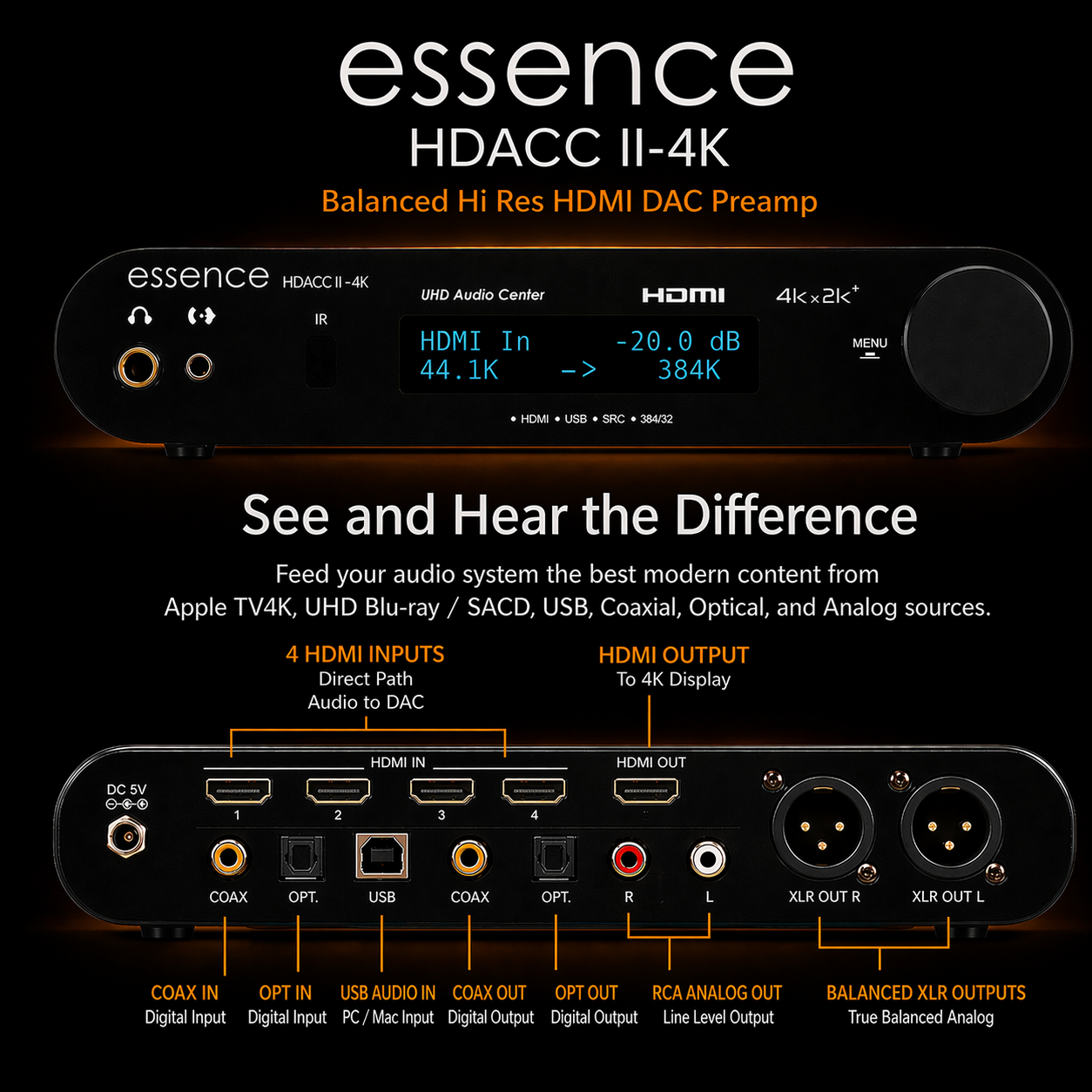
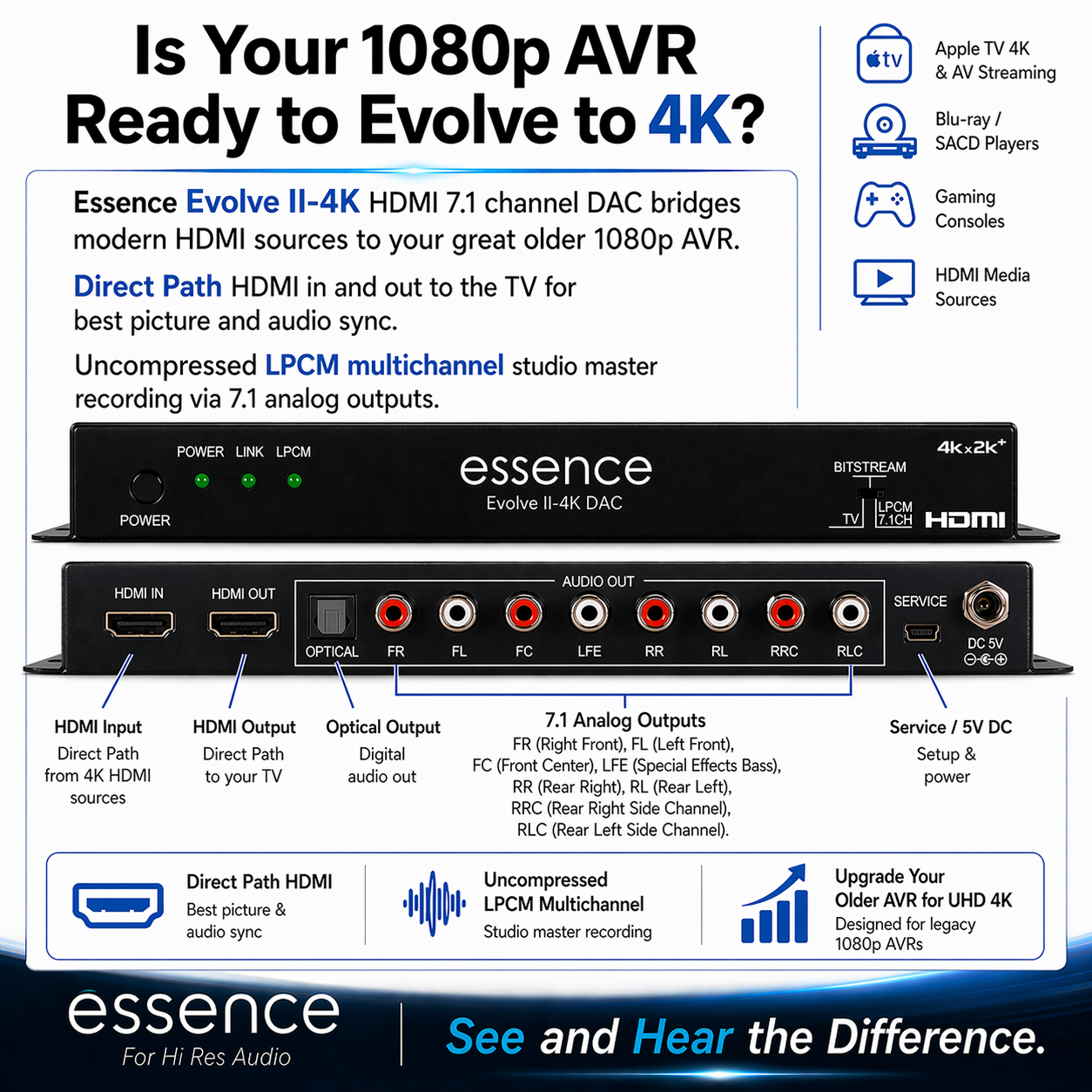
For owner's of vintage 2-channel and legacy 1080p AVRs, I make the bridge products that join modern HDMI sources to great vintage sound; the best-in-class 4K HDMI Direct Path LPCM DACs for stereo ( HDACC II-4K) and multichannel (Evolve II-4K) applications. Recently, a technical services director for one of the country’s top pro and home integration firms described what the Evolve II-4K did in his own system:
"Hi, Bob. I wanted to follow up on my impressions of the Evolve in my system. It’s been amazing. My signal chain goes Apple TV -> Evolve II-4K -> Symetrix DSP (w fader control) -> Crown DCi 8/300. It’s a monster! It’s gotta be the most aggressive & athletic system I’ve heard in a while. There’s a lot going on in the Symetrix DSP unit, but the Evolve made everything possible. Without it, I would have had to use an AVR or pre/pro for the HDMI DAC work and have a 2nd gain stage in the system"
Footnote: The Absolute Sound Review
In The Absolute Sound, Issue 124, p. 63, reviewer Scot Markwell wrote that he used the Chase Technologies HTS-1 passive Hafler-style ambience-extraction surround-sound decoder for music listening and found that he “cannot listen to music anymore without the realistic spatial contributions of this subsystem.” He added that its chief virtue was that he could not hear it until it was turned off, which collapsed the soundstage.
Editorial by Bob Rapoport, May 2026
Why LPCM is the Standard, and why the surround codecs are the Options.
After 50+ years of chasing natural sound — from Pro Logic to discrete 5.1 to HDMI LPCM — I’ve learned one lesson that still matters: don’t chase the logo, follow the signal path.
Home theater buyers were taught to chase logos: Dolby TrueHD, Dolby Atmos, DTS-HD Master Audio, & DTS:X.
That framing missed the bigger truth.
The recording standard is LPCM.
On Blu-ray & 4K AV Streaming, Linear PCM is the uncompressed multichannel original soundtrack, the official RIAA recording and playback standard. It can carry up to 8 channels of High Res Audio and it doesn't need to be restored from a compressed but lossless codec or rendered by a metadata layer before playback. Dolby TrueHD and DTS-HD Master Audio are compressed but lossless delivery options. They have value. But they're still options wrapped around the soundtrack, not the original studio version itself.
Why that matters:
Dolby Atmos on Blu-ray and streaming rides inside Dolby TrueHD as meta-data, not as separate channels of sound but sent downstream into the Atmos processor, converted, scaled, and rendered by the AVR to add "height" channels in the main listening area of the room. DTS follows the same basic home-theater idea: a lossless delivery format, with an immersive extension available in DTS:X. In other words, the codecs are not the final sound. They're compression storage algorithms (5 Gb) that depend on downstream processing to complete the presentation.
My view:
If I want the closest thing to the unadulterated studio version, I start with uncompressed multichannel LPCM and I remain in control of the signal path. Bass management is fair game. Subwoofer integration is fair game. But I would rather choose those things deliberately than have them bundled into a branded surround presentation by default.
I’m chasing the most direct signal path and the highest native bit rate. On Blu-ray, uncompressed multichannel LPCM can run up to 27.6 Mbps, compared with up to 24.5 Mbps for DTS-HD Master Audio and up to 18 Mbps for Dolby TrueHD. People can make of those numbers what they will. To my ears, the LPCM version often sounds more natural, less compressed, and less processed — more like the studio version.
Dolby TrueHD. Dolby Atmos. DTS-HD Master Audio, DTS:X.
If one of those logos lit up, the message seemed obvious: you were hearing the best possible version of the soundtrack.
That was never the whole story.
What matters more than the badge is the signal path.
That experience taught me to listen past the marketing.
So when DVD and later Blu-ray arrived with a new generation of audio codecs, I kept asking the same question:
What's really happening to the soundtrack?
The answer is more simple than most consumers were ever told:
The original, uncompressed LPCM master soundtrack is the backbone of all the codecs.
Most people think the codec is the sound.
It's not.
The codec is the container.
The uncompressed LPCM backbone is what the soundtrack is restored to for playback from the disc.
After that, the AVR can still shape what you hear through EQ, bass management, steering, rendering, room correction, level control, and other downstream processing.
So when someone says, “I’m hearing Dolby Atmos,” that's only part of the story.
What they are really hearing is the restored LPCM backbone, plus whatever the AVR does next.
In home theater, honesty about the signal path matters more than a glowing light on the front panel. Dolby TrueHD and DTS MasterHD multichannel soundtracks include a flag that turns their circuits in the AVR on automatically, you simply have to manually set your AVR to use the LPCM playback. You'll hear the original LPCM version converted to analog by the onboard PCM DAC. You may find it sounds more natural, direct, and true to the original soundtrack.
For owner's of vintage 2-channel and legacy 1080p AVRs, I make the bridge products that join modern HDMI sources to great vintage sound; the best-in-class 4K HDMI Direct Path LPCM DACs for stereo ( HDACC II-4K) and multichannel (Evolve II-4K) applications. Recently, a technical services director for one of the country’s top pro and home integration firms described what the Evolve II-4K did in his own system:
"Hi, Bob. I wanted to follow up on my impressions of the Evolve in my system. It’s been amazing. My signal chain goes Apple TV -> Evolve II-4K -> Symetrix DSP (w fader control) -> Crown DCi 8/300. It’s a monster! It’s gotta be the most aggressive & athletic system I’ve heard in a while. There’s a lot going on in the Symetrix DSP unit, but the Evolve made everything possible. Without it, I would have had to use an AVR or pre/pro for the HDMI DAC work and have a 2nd gain stage in the system"
Footnote: The Absolute Sound Review
In The Absolute Sound, Issue 124, p. 63, reviewer Scot Markwell wrote that he used the Chase Technologies HTS-1 passive Hafler-style ambience-extraction surround-sound decoder for music listening and found that he “cannot listen to music anymore without the realistic spatial contributions of this subsystem.” He added that its chief virtue was that he could not hear it until it was turned off, which collapsed the soundstage.
Last edited: