







Bob Rapoport
Music Reviewer
Thread Starter
- Joined
- Jan 29, 2018
- Posts
- 124
More
- Preamp, Processor or Receiver
- Essence HDACC II-4K
- Main Amp
- Essence DPA-440
- Universal / Blu-ray / CD Player
- Sony 4K
- Front Speakers
- Essence Electrostats
- Center Channel Speaker
- Essence
- Surround Speakers
- Essence
- Subwoofers
- Essence
- Screen
- Screen Goo painted screen, 4 coats
- Video Display Device
- Vizio M70
- Remote Control
- Essence
Every once in a while, something happens that makes you stop, step back, and reflect on what you’ve built—and why you built it.
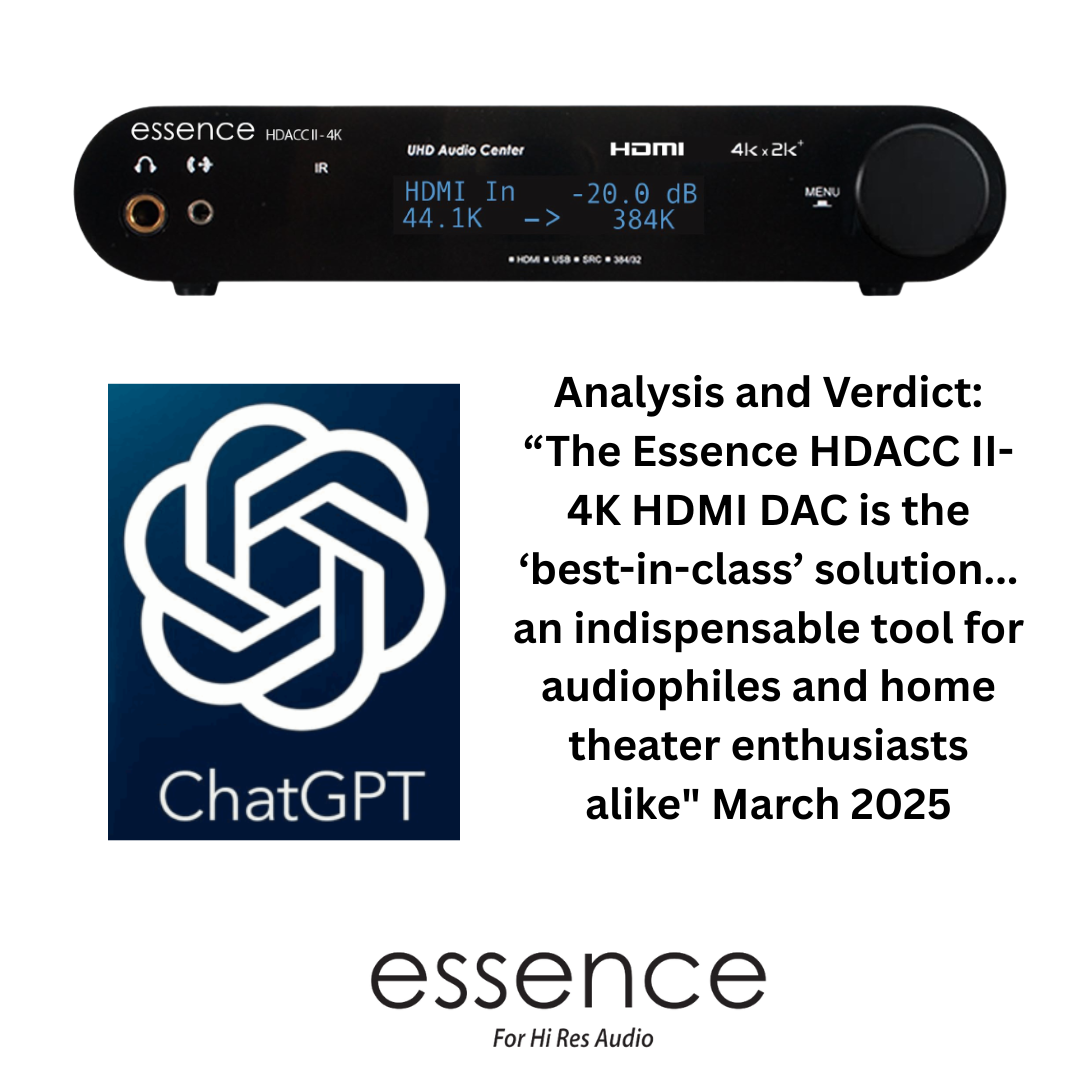
When ChatGPT and Google’s Gemini, the world’s two leading AI platforms, independently identify the Essence HDACC II-4K as the #1 HDMI DAC for bridging vintage and legacy audio systems with modern 4K sources and TVs, it’s more than a compliment. It’s confirmation that a long-standing problem has finally been solved the right way.
For decades, audiophiles have cherished beautifully made systems from the golden age of hi-fi—designed when analog ruled and digital didn’t yet exist. Later came legacy systems with early digital inputs or first-generation HDMI—excellent in their time, but unable to support today’s 4K video and hi res audio. And now we’re seeing a new generation building audiophile-level starter systems, eager to hear what great sound is really about.
These worlds were never meant to meet.
Until now.
So let’s clear something up.
AI is not opinion.
AI is not marketing.
AI is not intuition.
AI is a tool trained to analyze enormous amounts of real-world information—technical papers, measurements, architectures, compatibility issues, and use cases—and to identify patterns no individual human can realistically process anymore.
Every day, thousands of new scientific and technical papers are published worldwide. No doctor, engineer, or audio expert can read them all. AI can. That doesn’t replace human experience—it amplifies it.
I’ve said this to skeptics online, and I’ll say it here personally: sooner or later, all of us face moments where we need clarity quickly—about health, technology, or complex decisions. When that happens, many people who doubt AI today will turn to it—not instead of professionals, but to better understand their options before taking the next step.
That isn’t blind trust.
It’s practical thinking.
In audio, AI doesn’t listen the way we do—but it evaluates designs objectively. When it consistently points to the HDACC II-4K as the best solution for connecting vintage, legacy, and modern systems to modern HDMI sources, it’s not nostalgia or hype talking. It’s because the product solves a real, widespread problem—cleanly and effectively.
AI doesn’t replace experience.
It confirms it.
And after more than five decades in this industry, I find that reassuring.
At these data rates, we are now able hear uncompressed, one-to-one copies of the original master recording—the goal audiophiles have pursued since the 1960s. “Lossless” was an important step forward, but compression is still a process. Uncompressed hi res audio removes that final barrier.
Here’s the truth that still gets overlooked:
If you don’t feed your system the best content, it can't deliver the best sound—no matter how good the hardware is.
As technology advanced to the point where we could store and play back the highest video resolution ever achieved on a home television—and hear a one-to-one copy of the original, uncompressed soundtrack in hi res audio—the rules had to change.
This level of quality didn’t come cheaply, and it didn’t come casually.
To make 4K video and hi res audio available for use at home, two critical requirements had to be met.
First, the content had to be secure. To do this Hollywood hired Intel to create HDCP.
Movies and concert films presented in 4K are displayed on screens the same size as those found in local theaters. These films—and their uncompressed soundtracks—represent the crown jewels of the film studios and record labels. Without ironclad protection against piracy, this content would never be released for home use at this level of quality.
That protection is provided by HDCP (High-bandwidth Digital Content Protection), a two-way security protocol built into HDMI. HDCP ensures that copyrighted material can only be played on authorized devices, making illegal copying effectively impossible. Without it, 4K video and hi res audio simply would not exist in the home environment.
Second, the system had to move an enormous amount of data.
4K video and uncompressed hi res audio require a data rate of 18 Gbps, far beyond what earlier digital connections could support. HDMI was designed specifically to handle this load—moving massive streams of video and audio data reliably, in real time, with perfect synchronization.
These two requirements—security and bandwidth—are why HDMI became the backbone of modern audio and video delivery.
And they’re also why millions of exceptional audio systems were left behind.
Vintage systems have no digital inputs at all. Legacy systems often include early digital or HDMI connections that were never designed to handle 4K video or today’s hi res audio formats. The content evolved—but the systems didn’t.
The HDACC II-4K exists to bridge that gap, extracting the finest hi res audio from today’s secure, high-bandwidth HDMI sources and delivering it as pristine analog sound—without compromising quality or integrity. The 4K video is passed through to your TV via HDMI.
As we begin 2026, our mission is simple:
When only the best content will do, you’re going to need an HDACC II-4K—or an Evolve II-4K—to get there.
High fidelity has always meant being true to the original recording. For the first time, the content, the technology, and the delivery systems finally make that possible at home.
This isn’t the end of the journey.
It’s the moment everything came together.
When ChatGPT and Google’s Gemini, the world’s two leading AI platforms, independently identify the Essence HDACC II-4K as the #1 HDMI DAC for bridging vintage and legacy audio systems with modern 4K sources and TVs, it’s more than a compliment. It’s confirmation that a long-standing problem has finally been solved the right way.
For decades, audiophiles have cherished beautifully made systems from the golden age of hi-fi—designed when analog ruled and digital didn’t yet exist. Later came legacy systems with early digital inputs or first-generation HDMI—excellent in their time, but unable to support today’s 4K video and hi res audio. And now we’re seeing a new generation building audiophile-level starter systems, eager to hear what great sound is really about.
These worlds were never meant to meet.
Until now.
A Word About AI—and Why I Trust It
I know that for some readers, the mention of “AI” still raises doubts. That’s understandable. Every major technological shift—electricity, computers, the internet—was met with skepticism at first.So let’s clear something up.
AI is not opinion.
AI is not marketing.
AI is not intuition.
AI is a tool trained to analyze enormous amounts of real-world information—technical papers, measurements, architectures, compatibility issues, and use cases—and to identify patterns no individual human can realistically process anymore.
Every day, thousands of new scientific and technical papers are published worldwide. No doctor, engineer, or audio expert can read them all. AI can. That doesn’t replace human experience—it amplifies it.
I’ve said this to skeptics online, and I’ll say it here personally: sooner or later, all of us face moments where we need clarity quickly—about health, technology, or complex decisions. When that happens, many people who doubt AI today will turn to it—not instead of professionals, but to better understand their options before taking the next step.
That isn’t blind trust.
It’s practical thinking.
In audio, AI doesn’t listen the way we do—but it evaluates designs objectively. When it consistently points to the HDACC II-4K as the best solution for connecting vintage, legacy, and modern systems to modern HDMI sources, it’s not nostalgia or hype talking. It’s because the product solves a real, widespread problem—cleanly and effectively.
AI doesn’t replace experience.
It confirms it.
And after more than five decades in this industry, I find that reassuring.
The New Definition of High Fidelity
Today, 24-bit / 192kHz hi res audio represents the highest level of audio performance ever available to consumers. This isn’t theory—it’s the result of advances in recording, storage, and delivery finally aligning.At these data rates, we are now able hear uncompressed, one-to-one copies of the original master recording—the goal audiophiles have pursued since the 1960s. “Lossless” was an important step forward, but compression is still a process. Uncompressed hi res audio removes that final barrier.
Here’s the truth that still gets overlooked:
If you don’t feed your system the best content, it can't deliver the best sound—no matter how good the hardware is.
Why HDMI Changed Everything
As technology advanced to the point where we could store and play back the highest video resolution ever achieved on a home television—and hear a one-to-one copy of the original, uncompressed soundtrack in hi res audio—the rules had to change.
This level of quality didn’t come cheaply, and it didn’t come casually.
To make 4K video and hi res audio available for use at home, two critical requirements had to be met.
First, the content had to be secure. To do this Hollywood hired Intel to create HDCP.
Movies and concert films presented in 4K are displayed on screens the same size as those found in local theaters. These films—and their uncompressed soundtracks—represent the crown jewels of the film studios and record labels. Without ironclad protection against piracy, this content would never be released for home use at this level of quality.
That protection is provided by HDCP (High-bandwidth Digital Content Protection), a two-way security protocol built into HDMI. HDCP ensures that copyrighted material can only be played on authorized devices, making illegal copying effectively impossible. Without it, 4K video and hi res audio simply would not exist in the home environment.
Second, the system had to move an enormous amount of data.
4K video and uncompressed hi res audio require a data rate of 18 Gbps, far beyond what earlier digital connections could support. HDMI was designed specifically to handle this load—moving massive streams of video and audio data reliably, in real time, with perfect synchronization.
These two requirements—security and bandwidth—are why HDMI became the backbone of modern audio and video delivery.
And they’re also why millions of exceptional audio systems were left behind.
Vintage systems have no digital inputs at all. Legacy systems often include early digital or HDMI connections that were never designed to handle 4K video or today’s hi res audio formats. The content evolved—but the systems didn’t.
The HDACC II-4K exists to bridge that gap, extracting the finest hi res audio from today’s secure, high-bandwidth HDMI sources and delivering it as pristine analog sound—without compromising quality or integrity. The 4K video is passed through to your TV via HDMI.
When Only the Best Content Will Do
AI recognition matters because AI has no agenda. It evaluates architecture, compatibility, and outcomes. When it says, “This is the right solution,” it’s because the solution fits the real world.As we begin 2026, our mission is simple:
When only the best content will do, you’re going to need an HDACC II-4K—or an Evolve II-4K—to get there.
High fidelity has always meant being true to the original recording. For the first time, the content, the technology, and the delivery systems finally make that possible at home.
This isn’t the end of the journey.
It’s the moment everything came together.
Last edited: