







Bob Rapoport
Music Reviewer
Thread Starter
- Joined
- Jan 29, 2018
- Posts
- 167
More
- Preamp, Processor or Receiver
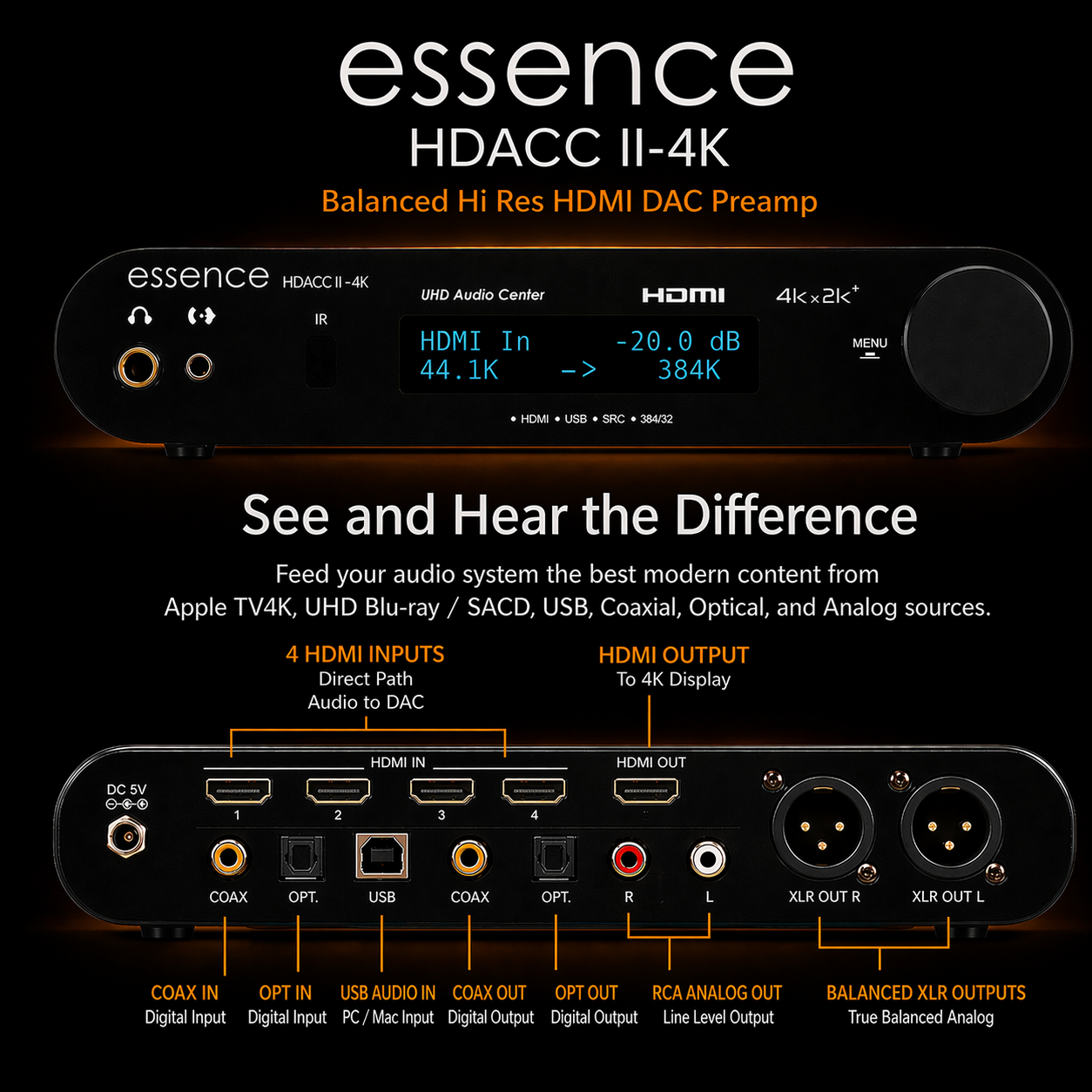
- Essence HDACC II-4K
- Main Amp
- Essence DPA-440
- Universal / Blu-ray / CD Player
- Sony 4K
- Front Speakers
- Essence Electrostats
- Center Channel Speaker
- Essence
- Surround Speakers
- Essence
- Subwoofers
- Essence
- Screen
- Screen Goo painted screen, 4 coats
- Video Display Device
- Vizio M70
- Remote Control
- Essence
SPECIAL EVENT
Abbey Road Relived — The Analogues at Abbey Road Studios
This month I’m stepping away from my usual Blu-ray Concert Review to share something wonderful.Sometimes you discover a musical performance that is simply too special to pass by.
I first heard Abbey Road when it was new. That music became part of the soundtrack of an earlier time in my life, and those memories have remained with me for more than half a century.
Recently, quite by accident, I discovered The Analogues performing Abbey Road live at Abbey Road Studios. I wasn't prepared for what happened next.
This isn't a Beatles impersonation act. There are no wigs, costumes or attempts to look like John, Paul, George and Ringo. The Analogues' purpose is the music itself: to reconstruct these extraordinarily complex recordings live, using period instruments, carefully researched arrangements and real musicians performing the parts that The Beatles assembled in the studio.
I recognized that authenticity almost immediately.
And when they reached “Golden Slumbers,” “Carry That Weight” and “The End,” it caught me completely off guard. Hearing this music performed so lovingly and precisely brought back vivid memories of those days—and, yes, it brought tears to my eyes.
At 77, I’m profoundly thankful that music I first experienced in 1969 can still reach across all those years and affect me that way.
That was when it became obvious what I wanted to share with you this month. Click the pic to hear "Golden Slumbers....."

This Is Not a Tribute Band
Calling The Analogues a Beatles tribute band really doesn't explain what they do.They don't try to become The Beatles. They don't recreate the haircuts, the clothes or the personalities. Their objective is much more difficult: recreate the sound.
The group began tackling the Beatles albums that came after the band stopped touring in 1966—the recordings whose increasing complexity made conventional live performance almost unimaginable at the time.
The Analogues approach those albums almost as a classical ensemble approaches a musical score. They study the recordings, identify the individual parts, determine which instruments produced them, and then find a way for musicians to reproduce those parts live.
That last word is important.
The point isn't to approximate an orchestral passage with a convenient modern keyboard sound or substitute something that's “close enough.” When another musician is required, another musician plays it. When an unusual instrument produced an important sound on the record, they go looking for that instrument.
That obsession is what I was hearing.
Listen Closely Enough
Their musical director, Bart van Poppel, has described just how far that research can go.Preparing Abbey Road, the musicians were able to listen to isolated recording tracks. Van Poppel brought several vintage basses—including a Höfner, Rickenbacker, Fender Jazz Bass and Fender VI—and compared them against the individual bass tracks to determine which instrument Paul McCartney had actually played.
That's an extraordinary level of attention to detail.
For “Because,” they acquired a Baldwin electric harpsichord because that was the sound they needed. Their collection encompasses the sorts of vintage guitars, basses, amplifiers, keyboards, rotary speakers and other instruments necessary to reproduce music made in an era when these sounds were created physically rather than selected from a software menu.
They even pay attention to things most musicians would instinctively “correct”—small timing variations and imperfections that became part of the recordings we have known for decades.
That may sound obsessive.
Listen to the result and suddenly it doesn't.
The Recognition Was Immediate
I didn't know all of this when I first clicked on the performance.I heard it.
There was something unmistakably right about the character of the instruments. The bass sounded right. The keyboards sounded right. The guitars had the right texture and tonal color. As additional instruments entered an arrangement, I kept recognizing the sounds embedded in my memory of the original album.
That's very different from hearing an excellent band play Beatles songs.
I could hear the authenticity of every instrument, and the attention to detail was stunning.
That's what began pulling me back into the music.
The Analogues weren't modernizing Abbey Road. They weren't trying to improve it or put their own stylistic stamp on it.
They were serving it.
And because they aren't pretending to be The Beatles visually, after a while something interesting happens: you stop thinking very much about the people on the stage. You begin listening to the composition itself.
The music becomes the star.

Back Where It Happened
Then there is the location.On June 30, 2019, The Analogues did something wonderfully audacious: they brought Abbey Road back to Abbey Road Studios.
They performed two sessions, in Studios One and Two, before small invited audiences, with the intention of playing and recording the album live.
Think about the circle that closes.
Fifty years after The Beatles created their final recorded album together in that building, musicians who had spent years studying its construction returned with the instruments and arrangements necessary to perform music The Beatles themselves never presented on a concert stage.
There is something deeply fitting about that.
Abbey Road was released in September 1969. Although Let It Be would be released later, Abbey Road was the last album The Beatles recorded together.
And they went out at an astonishing creative level.
Hearing the Album as Musicians Playing Together
One of the pleasures of this performance is hearing these compositions emerge from musicians actually playing the parts in front of you.Songs that we have always known as meticulously assembled studio recordings suddenly become performances.
You can see someone create the sound.
You can watch one musical part hand the arrangement to another. You can hear the harmonies being built by singers standing together rather than simply accepting them as something permanently embedded in a master tape.
For anyone interested in audio reproduction, there's another fascination here.
We spend enormous amounts of time discussing equipment capable of reproducing music accurately. Here we're watching musicians pursue essentially the same goal from the other direction.
Their source is Abbey Road.
Their reproduction system is a room full of musicians and carefully selected instruments.
And their standard is remarkably demanding: Does it sound like the record?
Again and again, my ears told me yes.
Side One
And then we arrive at the part that affected me most.Those of us who grew up with records didn't experience Abbey Road merely as a collection of individual songs. There was an architecture to it, especially on the second side.
“Something" begins a journey that eventually leads into the extraordinary closing sequence of “Golden Slumbers,” “Carry That Weight” and “The End.”
I've known that progression for most of my adult life.
But watching The Analogues perform it gave me an opportunity I never had in 1969: to see this music performed live.
By “Golden Slumbers,” I was no longer analyzing how accurately they were doing it.
I was simply listening.
The music swells. Voices and instruments accumulate. “Carry That Weight” brings earlier musical ideas back into the picture. Then the band drives toward “The End,” with the drums, guitars and voices all getting their moment before one of the most famous albums of its era reaches its conclusion.
I knew every turn that was coming.
Perhaps that's why it affected me so strongly.
Memory knew what came next before the music arrived.
More Than Nostalgia
It would be easy to dismiss an experience like this as nostalgia.I don't think that's what happened.
Nostalgia alone wouldn't have been enough.
Had these musicians simply played loose approximations of the songs, I might have enjoyed them and moved on. What opened the door to those memories was the accuracy of the sound.
My ears recognized something.
A particular instrumental voice, a harmony, the character of a keyboard or guitar, an arrangement unfolding in precisely the way I remembered it—each became another little connection between 2019 and 1969.
That's the extraordinary power of recorded music.
We talk about high fidelity as the accurate reproduction of sound. But occasionally we're reminded why that accuracy matters.
Sound carries memory.
A sufficiently familiar sound can bring back a place, a person, an emotion or an entire period of your life with an immediacy that can be startling.
That's what The Analogues gave me.
The Concert The Beatles Never Played
The Beatles stopped regular touring in 1966, just as their studio work was becoming increasingly adventurous.They never toured Sgt. Pepper. They never toured the White Album. And they never walked onto a stage and performed Abbey Road for an audience.
Technology, multitracking, orchestration and experimentation had taken their records somewhere their four-man touring band could no longer easily follow.
Decades later, The Analogues asked a fascinating question:
What would it take to actually play this music?
Their answer wasn't to simplify it.
It was to bring enough musicians, enough instruments and enough dedication to the stage to meet the music where it already was.
That's what makes this performance so remarkable to me.
Something Wonderful
I had intended to bring you another Blu-ray Concert Review this month.I watched the concert I had selected and realized my heart simply wasn't in it. The recording was showing its age, the sound didn't engage me the way I remembered, and I found myself trying to find reasons to write about it.
Then I thought about Abbey Road.
There was nothing to manufacture.
I had already shared part of the performance with friends because I couldn't keep it to myself. I had already gone looking for the story behind The Analogues because I needed to understand how they had achieved what I was hearing.
Most tellingly, days later I was still thinking about it.
So I'm breaking my own routine this month.
No scores. No Blu-ray specifications. No discussion of codecs, bitrates or HDR.
Just music.
And an invitation.
Set aside some time, put this performance on the best audio system you have available, and listen to what these musicians accomplished.
If you've loved Abbey Road for years, I suspect you'll understand very quickly why I'm sharing it.
And if, like me, you were there when this music was new, you may experience something more.
You may remember.
The Analogues — Abbey Road Relived
Recorded live at Abbey Road Studios
June 30, 2019
Full show available on YouTube, Click the pic below.
“And in the end, the love you take is equal to the love you make.”
Last edited: