






Bob Rapoport
Music Reviewer
Thread Starter
- Joined
- Jan 29, 2018
- Posts
- 171
More
- Preamp, Processor or Receiver
- Essence HDACC II-4K
- Main Amp
- Essence DPA-440
- Universal / Blu-ray / CD Player
- Sony 4K
- Front Speakers
- Essence Electrostats
- Center Channel Speaker
- Essence
- Surround Speakers
- Essence
- Subwoofers
- Essence
- Screen
- Screen Goo painted screen, 4 coats
- Video Display Device
- Vizio M70
- Remote Control
- Essence
Before separating fact from fiction, it’s important to understand what SACD actually is, why it was created, and how we arrived at today’s formats. Much of the confusion surrounding SACD exists simply because very few people were paying attention as digital audio and video evolved in real time.
But it was always a compromise.
A standard CD could store about 700 megabytes of data, enough for 16-bit / 44.1 kHz PCM audio, but far below the size of the original studio master recordings, which often exceeded 5 gigabytes. From the beginning, Sony understood that CD was not a true copy of the master—it was a practical delivery format.
a true, one-to-one copy of the original master recording.
That effort led to Super Audio CD (SACD), a second-generation optical disc with 5 GB of capacity, more than seven times that of a CD. To take advantage of this space, Sony developed Direct Stream Digital (DSD), a 1-bit, very high-speed sampling system intended to preserve timing accuracy and low-level detail more faithfully than conventional PCM.
From the start, SACD discs were designed as hybrid discs, containing:
This is where many of today’s SACD myths originated.
In 2001, Bob Stuart of Meridian introduced Meridian Lossless Packing (MLP), a lossless compression system that effectively doubled usable disc capacity, extending DVD playback time to approximately two hours without sacrificing audio quality. MLP was later licensed by Dolby and became the foundation of Dolby Digital Plus, replacing the earlier AC-3, which was highly compressed and lossy.
This was a turning point: long-form, high-quality audio and video were now practical for home playback.
For the first time, consumers could experience:
DSD is a digital recording format, not an analog signal. Like all digital audio, it must be converted to analog before it can be heard.
What often gets misunderstood is how the DSD data is handled in modern playback systems.
The native DSD64 data on an SACD remains intact as it is transported. It is encapsulated in a protective jacket, not altered, so it can be converted to analog outside the disc player. Encapsulation does not change the music—it simply packages it for transport.
This is where modern HDMI-based DACs change the conversation.
What matters is how and where the final digital-to-analog conversion occurs.
In this configuration:
For multichannel listeners, the 7.1 Channel Evolve II-4K HDMI DAC ($349) performs the same function while supporting 5.1 / 7.1-channel high-resolution playback, preserving the integrity of multichannel SACD content just as accurately.
What matters now isn’t chasing formats.
It’s being able to hear the highest fidelity to the original master recording at home.
The Limits of the Compact Disc
The Compact Disc, introduced in 1984 by Sony and Philips, was a major advance over vinyl and cassette. It delivered clean, durable playback and quickly became the dominant music format worldwide.But it was always a compromise.
A standard CD could store about 700 megabytes of data, enough for 16-bit / 44.1 kHz PCM audio, but far below the size of the original studio master recordings, which often exceeded 5 gigabytes. From the beginning, Sony understood that CD was not a true copy of the master—it was a practical delivery format.
Sony’s Push for a One-to-One Master Copy
Throughout the 1990s, Sony pursued a long-standing audiophile goal dating back to the 1960s:a true, one-to-one copy of the original master recording.
That effort led to Super Audio CD (SACD), a second-generation optical disc with 5 GB of capacity, more than seven times that of a CD. To take advantage of this space, Sony developed Direct Stream Digital (DSD), a 1-bit, very high-speed sampling system intended to preserve timing accuracy and low-level detail more faithfully than conventional PCM.
From the start, SACD discs were designed as hybrid discs, containing:
- A standard CD layer for compatibility
- A high-resolution DSD layer for SACD playback
- A PCM DAC to play the CD layer
- A dedicated 1-bit DSD DAC to play the SACD layer
This is where many of today’s SACD myths originated.
Why SACD Never Replaced the CD
SACD was intended to replace the CD, but it never did. While it offered genuine technical improvements, it required:- New hardware
- New discs
- And explanations most of the market never received
DVD, MLP, and the Expansion of Playback Time
Rather than abandoning high-quality audio, the industry pivoted to DVD, which also offered 5 GB per layer, but with the added benefit of video. DVD rapidly replaced VHS and became the standard for movies and concert releases.In 2001, Bob Stuart of Meridian introduced Meridian Lossless Packing (MLP), a lossless compression system that effectively doubled usable disc capacity, extending DVD playback time to approximately two hours without sacrificing audio quality. MLP was later licensed by Dolby and became the foundation of Dolby Digital Plus, replacing the earlier AC-3, which was highly compressed and lossy.
This was a turning point: long-form, high-quality audio and video were now practical for home playback.
Blu-ray Ends the Storage Debate
By 2008, Blu-ray arrived with 50 GB of capacity, extending playback time to 2.5 hours, and later 3 hours with 4K Ultra HD Blu-ray. At the same time, HDMI emerged as the digital transport capable of carrying copyright protected uncompressed high-resolution audio and high-definition video.For the first time, consumers could experience:
- A full length live concert
- In high-resolution 24/96K audio
- With high-definition 1080p video
- At home, without time or quality restrictions
The Biggest SACD Myths — and Why They Persist
With that history in mind, it becomes easier to understand why so many SACD myths still circulate. Most originated during the transition period, when SACD, DVD, and Blu-ray overlapped and digital audio was still poorly explained.Myth #1: “DSD Can Only Be Played Through a Native DSD DAC”
Fact:DSD is a digital recording format, not an analog signal. Like all digital audio, it must be converted to analog before it can be heard.
What often gets misunderstood is how the DSD data is handled in modern playback systems.
The native DSD64 data on an SACD remains intact as it is transported. It is encapsulated in a protective jacket, not altered, so it can be converted to analog outside the disc player. Encapsulation does not change the music—it simply packages it for transport.
This is where modern HDMI-based DACs change the conversation.
Encapsulation: The Missing Concept
Encapsulation means the original DSD data is preserved exactly as recorded while being moved through the digital signal chain. It is not resampled, re-quantized, or “downgraded.”What matters is how and where the final digital-to-analog conversion occurs.
Two Legitimate Playback Paths — By Design
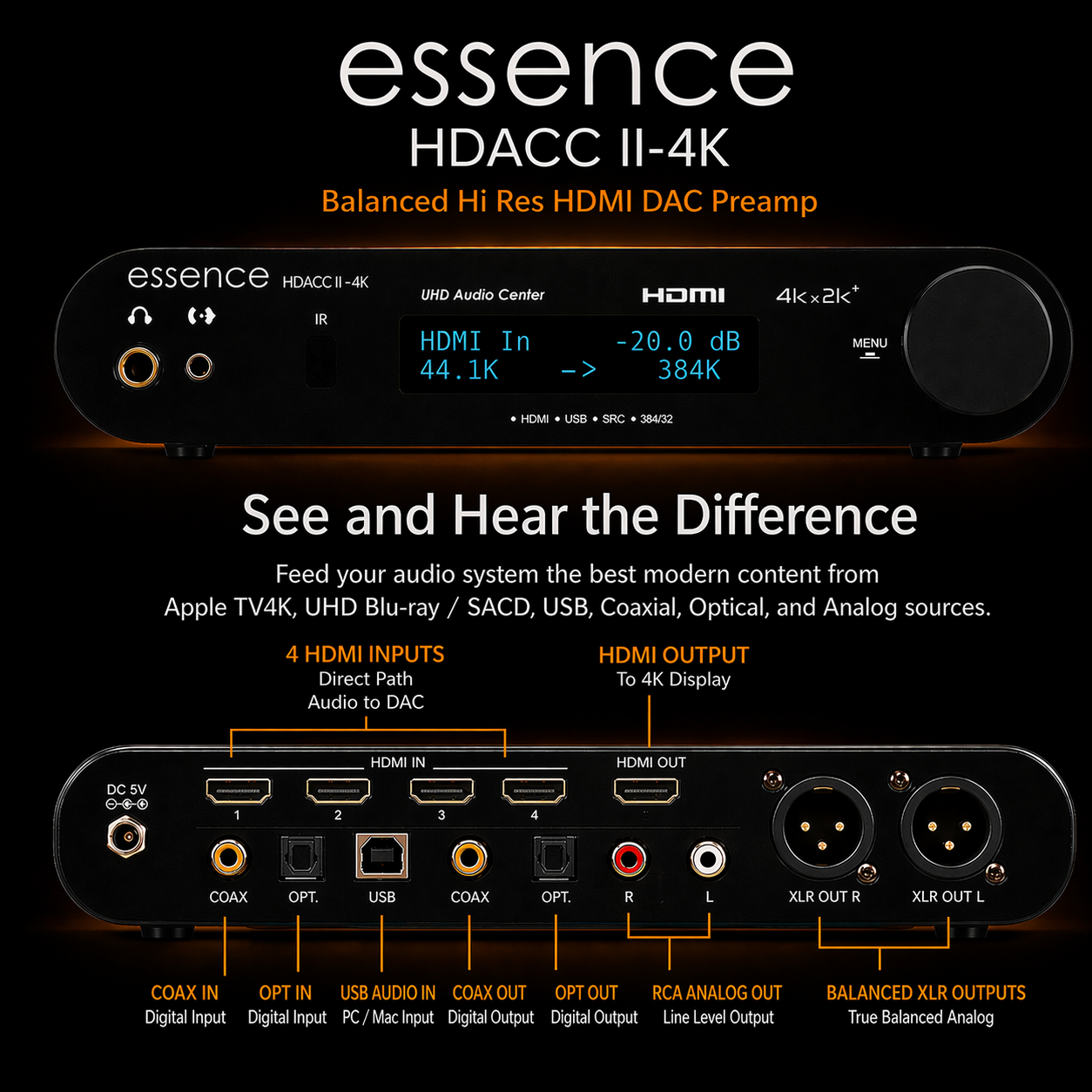
The 2-Channel Essence HDACC II-4K HDMI DAC / Preamp / Headphone Amp ($649) is intentionally designed to support two valid playback paths, depending on listener preference.Path 1: High-Resolution PCM Conversion
In this path:- The encapsulated DSD64 data remains intact
- It is converted to analog using a high-rate PCM equivalent (DSD64 ≈ 24-bit / 88.2kHz, DSD128 ≈ 24-bit / 176.4kHz).
- The conversion is transparent, precise, and audibly complete
Path 2: Native 1-Bit DSD for Purists
For listeners who prefer a true 1-bit DSD conversion topology, the HDACC II-4K also supports a second path.In this configuration:
- The HDACC II-4K bypasses the encapsulated DSD stream through untouched
- It is output via the coaxial digital connection
- Delivered downstream to a genuine native 1-bit DSD DAC
- Converted to analog only at that final stage
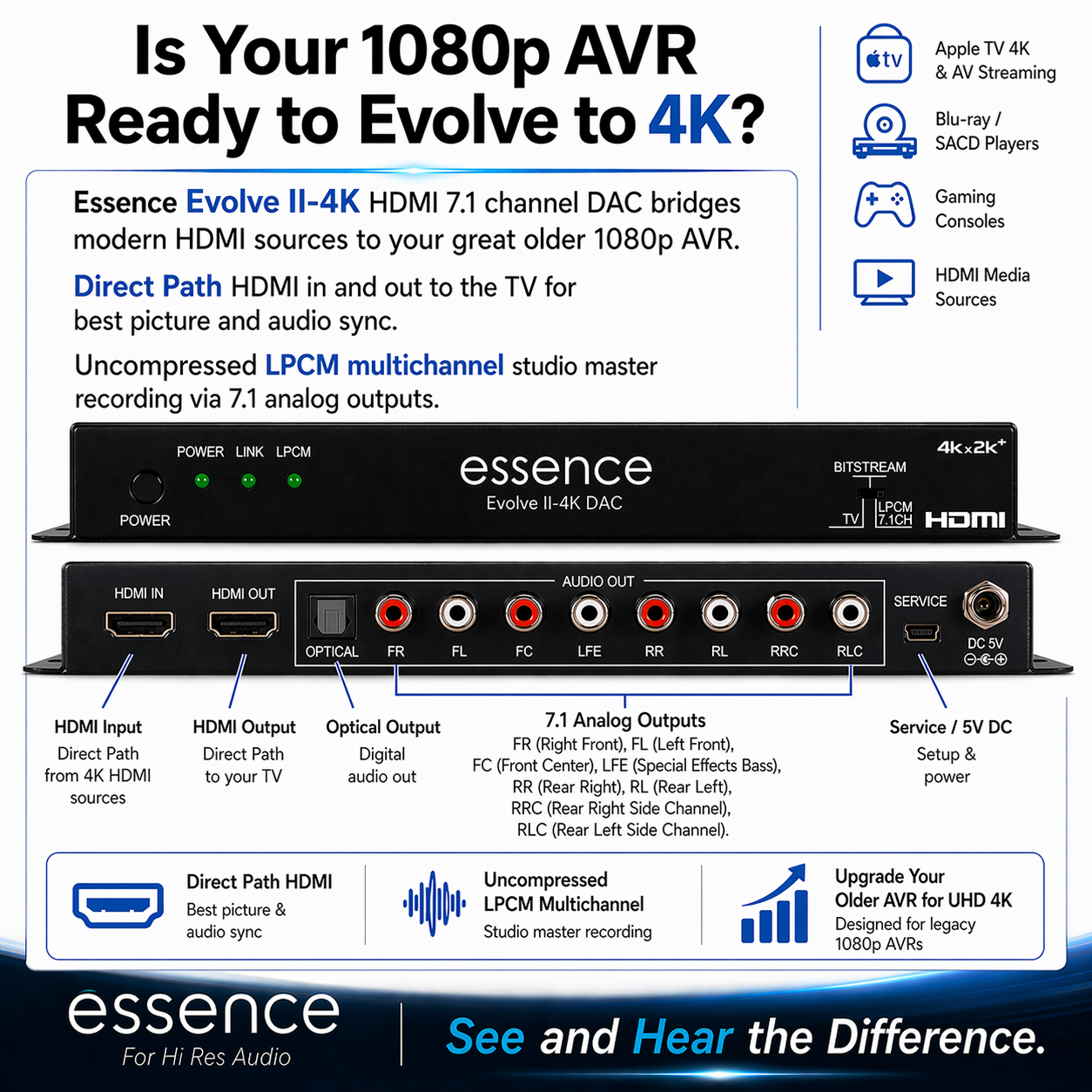
For multichannel listeners, the 7.1 Channel Evolve II-4K HDMI DAC ($349) performs the same function while supporting 5.1 / 7.1-channel high-resolution playback, preserving the integrity of multichannel SACD content just as accurately.
What Actually Matters
Once encapsulation and conversion are understood, many long-standing arguments disappear:- DSD is not “downgraded”
- PCM is not “inferior”
- Conversion is unavoidable
- DAC quality matters more than format labels
The Bigger Takeaway
SACD was never the end goal. It was a bridge—the first successful step toward delivering true high-resolution audio to the home. Blu-ray and HDMI completed that journey.What matters now isn’t chasing formats.
It’s being able to hear the highest fidelity to the original master recording at home.
Last edited: