







-
AUDIO VIDEO PROCESSING, SETUP & ENVIRONMENTOfficial REW (Room EQ Wizard) Support Forum Audiolense User Forum Calibration Equipment Auto-EQ Platforms / Immersive Audio Codecs Video Display Technologies / Calibration AV System Setup and Support Listening Room / Home Theater Build Projects Room Acoustics and Treatments AV Showcase Movies / Music / TV / Streaming
-
AUDIO VIDEO DISCUSSION / EQUIPMENTHome Theater / Audio and Video - Misc Topics Essence For Hi Res Audio AV Equipment Advice and Pricing Awesome Deals and Budget AV Equipment AV Receivers / Processors / Amps UHD / Blu-ray / CD Players / Streaming Devices Two Channel Hi-Fi Equipment DIY Audio Projects Computer Systems - HTPC / Gaming HD and UHD Flat Screen Displays Projectors and Projection Screens AV Accessories Buy - Sell - Trade
Navigation
Install the app
How to install the app on iOS
Follow along with the video below to see how to install our site as a web app on your home screen.
Note: This feature may not be available in some browsers.
More options
You are using an out of date browser. It may not display this or other websites correctly.
You should upgrade or use an alternative browser.
You should upgrade or use an alternative browser.
REW not displaying under 22hz
- Thread starter NBPK402
- Start date


AudiocRaver
Loved and Remembered Emeritus Reviewer
More
- Preamp, Processor or Receiver
- Onkyo TX-SR705 Receiver
- Main Amp
- Crown XLS 1502 DriveCore-2 (x2 as monoblock)
- Additional Amp
- Behringer A500 Reference Power Amplifier
- Front Speakers
- MartinLogan Electromotion ESL Electrostatic (x2)
- Center Channel Speaker
- Phantom Center
- Surround Speakers
- NSM Audio Model 5 2-Way (x2)
- Subwoofers
- JBL ES150P Powered Subwoofer (x2)
By "the setting" do you mean the start frequency for the measurement sweep?
go to the Make A Measurement panel, look halfway down the left side, find Range, and Start Freq. The default here is 0. What is your setting?
go to the Make A Measurement panel, look halfway down the left side, find Range, and Start Freq. The default here is 0. What is your setting?
Thanks, mine was set at 20... I changed it to 0By "the setting" do you mean the start frequency for the measurement sweep?
go to the Make A Measurement panel, look halfway down the left side, find Range, and Start Freq. The default here is 0. What is your setting?
AudiocRaver
Loved and Remembered Emeritus Reviewer
More
- Preamp, Processor or Receiver
- Onkyo TX-SR705 Receiver
- Main Amp
- Crown XLS 1502 DriveCore-2 (x2 as monoblock)
- Additional Amp
- Behringer A500 Reference Power Amplifier
- Front Speakers
- MartinLogan Electromotion ESL Electrostatic (x2)
- Center Channel Speaker
- Phantom Center
- Surround Speakers
- NSM Audio Model 5 2-Way (x2)
- Subwoofers
- JBL ES150P Powered Subwoofer (x2)
Super! An easy fix!
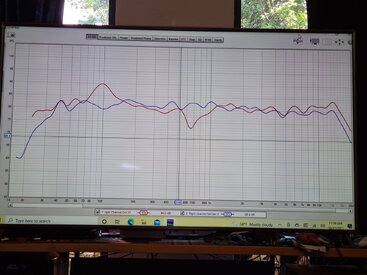
Now I just have to figure out why I have that dip/null...it was not there before I changed to 2 mono amps , with each powering a 4 ohm woofer. Before I was using 1 mono amp to power 2 4 ohm woofers.
AudiocRaver
Loved and Remembered Emeritus Reviewer
More
- Preamp, Processor or Receiver
- Onkyo TX-SR705 Receiver
- Main Amp
- Crown XLS 1502 DriveCore-2 (x2 as monoblock)
- Additional Amp
- Behringer A500 Reference Power Amplifier
- Front Speakers
- MartinLogan Electromotion ESL Electrostatic (x2)
- Center Channel Speaker
- Phantom Center
- Surround Speakers
- NSM Audio Model 5 2-Way (x2)
- Subwoofers
- JBL ES150P Powered Subwoofer (x2)
I sounds like you are saying that the blue trace represents the first situation, with two 4-ohm woofers connected in series, driven by s single mono amp, and the red trace represents the second situation, with the same two 4-ohm woofers each driven by a separate mono amp with the same sweep signal feeding both amps at once. Is that correct?
Yes, and the amps are the same model as the first tune used.I sounds like you are saying that the blue trace represents the first situation, with two 4-ohm woofers connected in series, driven by s single mono amp, and the red trace represents the second situation, with the same two 4-ohm woofers each driven by a separate mono amp with the same sweep signal feeding both amps at once. Is that correct?
I measured both times at 1 meter from the mouth of the horn. The only difference is running 1 amp per woofer vs 2 on one amp, and the first tune I used 1 r60 on each side of the horn like wings, 1 on the floor in front of the horn and one behind the mic stand. This time I am using 6" panels (each with 4" of Roxul r60...same as the first run but 2 layers) one on the floor, one bwhind the mic, and 4 are 90 degree tonthe horn. I now have a sort of a box which is 2' x 4' x 4'. Could the thicker panels be giving me the dip?NBPK402
were the first and second measurements from the same point in the room? Nothing moved between dimensions in the room? Take two new measurements now. With one and two amplifiers.
I really do not want to go into the speakers and rewire, as all the wiring was made as a harness, and I have both woofers connected to one Speakon and the connectors are very small and heatshrinked to tech flex sheathing.
I think yes. Try to measure without panels. Do you listen to music at a distance of 1m?Could the thicker panels be giving me the dip?
No...the REW run was for tuning the crossover. The person who designed the speakers likes to tune them at 1m. In my last HT, I did a simple tune from the MLP, and everyone said that they need to be tuned first at 1 meter.I think yes. Try to measure without panels. Do you listen to music at a distance of 1m?
Once I have the speaker retuned... I will use Dirac to tune for the MLP. It is currently tuned for low phase growth (don't ask me what that means, but it sounded great before I added a amp.For design, this makes sense. And not very good for listening. With 1 m, HF will be more than HF with 2.5 m, and LF, on the contrary.

AudiocRaver
Loved and Remembered Emeritus Reviewer
More
- Preamp, Processor or Receiver
- Onkyo TX-SR705 Receiver
- Main Amp
- Crown XLS 1502 DriveCore-2 (x2 as monoblock)
- Additional Amp
- Behringer A500 Reference Power Amplifier
- Front Speakers
- MartinLogan Electromotion ESL Electrostatic (x2)
- Center Channel Speaker
- Phantom Center
- Surround Speakers
- NSM Audio Model 5 2-Way (x2)
- Subwoofers
- JBL ES150P Powered Subwoofer (x2)
I agree with SM52 that the additional panels could have been responsible for the new dip on the earlier plot,
All due respect, I am having a hard time visualizing all that is going on. In general, once we get to about this point in such a discussion, we need
All due respect, I am having a hard time visualizing all that is going on. In general, once we get to about this point in such a discussion, we need
- pictures of your setup and measurement approach
- discipline - only change one variable at a time, assume that everything matters, don't change anything without telling us...
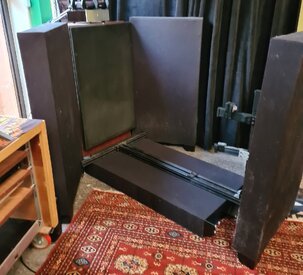
Here is my current measuring setup..the aluminum mic stand allows me to repeat the mic position very close to perfect every time. It has alignment pieces on the end so it is always the same.


 ..
..
Last edited:
I do not have any raw Roxul left nor could I find the pictures...so please use some imagination with this pic. The panels on each side were 1 layer of raw Roxul, and on the floor I had the mic stand on the floor with one layer of roxul laying on top of it to prevent first reflections. Behind the mic stand was a raw piece of roxul in position like the panel is.
Attachments
AudiocRaver
Loved and Remembered Emeritus Reviewer
More
- Preamp, Processor or Receiver
- Onkyo TX-SR705 Receiver
- Main Amp
- Crown XLS 1502 DriveCore-2 (x2 as monoblock)
- Additional Amp
- Behringer A500 Reference Power Amplifier
- Front Speakers
- MartinLogan Electromotion ESL Electrostatic (x2)
- Center Channel Speaker
- Phantom Center
- Surround Speakers
- NSM Audio Model 5 2-Way (x2)
- Subwoofers
- JBL ES150P Powered Subwoofer (x2)
Great pictures, that really helps us see what is going on. I am getting ready to check out the mdat file.
I wish I could have used my height panels to seal all around, but that is a bit of a pain...since they are so heavy.Great pictures, that really helps us see what is going on. I am getting ready to check out the mdat file.
AudiocRaver
Loved and Remembered Emeritus Reviewer
More
- Preamp, Processor or Receiver
- Onkyo TX-SR705 Receiver
- Main Amp
- Crown XLS 1502 DriveCore-2 (x2 as monoblock)
- Additional Amp
- Behringer A500 Reference Power Amplifier
- Front Speakers
- MartinLogan Electromotion ESL Electrostatic (x2)
- Center Channel Speaker
- Phantom Center
- Surround Speakers
- NSM Audio Model 5 2-Way (x2)
- Subwoofers
- JBL ES150P Powered Subwoofer (x2)
Here are a couple of quick thoughts.
Sometimes a quick look at a frequency response plot with minimum smoothing (1/48 octave) can help you spot problems (use this surgical view only when looking for a deeper understanding of mystifying problems; 1/6 or 1/3 oct smoothing is best for normal use).
Below, you can see room modes between 80 and 100 hz, plus a wider and deeper dip at 700 Hz, perhaps related to the dip you referred to in your earlier post? Room modes and reflections from floor and walls will haunt you with any indoor measurements. A layer of the best absorbing insulation will do little if anything to prevent it for these types of measurements. Believe me, I have tried.. Above 1 kHz or so, it is more useful.

The impulse diagram shows a big reflection at 1 ms that will certainly be very disruptive to measurement quality and usefulness. Beyond that, the diagram is fairly clean.
===============
This is to say that it is hard to get good measurements like you are looking for indoors.
Where are the woofers in these pictures?
Sometimes a quick look at a frequency response plot with minimum smoothing (1/48 octave) can help you spot problems (use this surgical view only when looking for a deeper understanding of mystifying problems; 1/6 or 1/3 oct smoothing is best for normal use).
Below, you can see room modes between 80 and 100 hz, plus a wider and deeper dip at 700 Hz, perhaps related to the dip you referred to in your earlier post? Room modes and reflections from floor and walls will haunt you with any indoor measurements. A layer of the best absorbing insulation will do little if anything to prevent it for these types of measurements. Believe me, I have tried.. Above 1 kHz or so, it is more useful.
The impulse diagram shows a big reflection at 1 ms that will certainly be very disruptive to measurement quality and usefulness. Beyond that, the diagram is fairly clean.
===============
This is to say that it is hard to get good measurements like you are looking for indoors.
Where are the woofers in these pictures?
It is a Synergy horn...the 2 15" woofers are in the horn. If you look at the pic of the mic setup, you will see there are 4 oval slots...1 woofer is behind each pair of slots.
This is a big room too...all brick and marble, so it will never ne tuned properly like my old setup was. The front wall is 19' wide, and the room is like 40' long with about a 10' ceiling for the rear 20' of the room, and a 32' Boveda ceiling for the living room ceiling. 13' high heavy stage curtains cover the front glass window wall , and the side walls for the first 7'. The left side also has a large glass wall (covered by the curtain), and the right side has a huge stone and brick fireplace. I have put some thick wool rugs down on the floor to try and make it better, and when we listen to music or watch movies...1 or 2 of rhe windows are open to knock the echo down more.
This is a big room too...all brick and marble, so it will never ne tuned properly like my old setup was. The front wall is 19' wide, and the room is like 40' long with about a 10' ceiling for the rear 20' of the room, and a 32' Boveda ceiling for the living room ceiling. 13' high heavy stage curtains cover the front glass window wall , and the side walls for the first 7'. The left side also has a large glass wall (covered by the curtain), and the right side has a huge stone and brick fireplace. I have put some thick wool rugs down on the floor to try and make it better, and when we listen to music or watch movies...1 or 2 of rhe windows are open to knock the echo down more.
Last edited:
AudiocRaver
Loved and Remembered Emeritus Reviewer
More
- Preamp, Processor or Receiver
- Onkyo TX-SR705 Receiver
- Main Amp
- Crown XLS 1502 DriveCore-2 (x2 as monoblock)
- Additional Amp
- Behringer A500 Reference Power Amplifier
- Front Speakers
- MartinLogan Electromotion ESL Electrostatic (x2)
- Center Channel Speaker
- Phantom Center
- Surround Speakers
- NSM Audio Model 5 2-Way (x2)
- Subwoofers
- JBL ES150P Powered Subwoofer (x2)
It looks like that big dip at 640 Hz must be right at the crossover frequency, like those drivers are battling each other there somehow. I suggest taking another very thorough look at your crossover / driver / amp wiring to be absolutely sure it is done correctly. Look for something wired out of phase, it is so easy to do. Focus on the recently made changes, but ASSUME NOTHING. There might be a little change that you are 100% certain could not be the cause of the problem, but that actually IS!
Just suggesting.
Just suggesting.
Thanks! I will open up the amp and make sure the XLRs, and speakons are all wired identical, and then verify the speakons are wired identical in the speaker cabinet...I was thinking originally one woofer out of phase with the other. I took pics of each speakers wiring to check and they are they are the same as the 1st one that is rewired.It looks like that big dip at 640 Hz must be right at the crossover frequency, like those drivers are battling each other there somehow. I suggest taking another very thorough look at your crossover / driver / amp wiring to be absolutely sure it is done correctly. Look for something wired out of phase, it is so easy to do. Focus on the recently made changes, but ASSUME NOTHING. There might be a little change that you are 100% certain could not be the cause of the problem, but that actually IS!
Just suggesting.
Are you familiar with tuning for low phase growth? I am wondering if the big hump on low end was lowered via filters...would it affect the phase growth?
AudiocRaver
Loved and Remembered Emeritus Reviewer
More
- Preamp, Processor or Receiver
- Onkyo TX-SR705 Receiver
- Main Amp
- Crown XLS 1502 DriveCore-2 (x2 as monoblock)
- Additional Amp
- Behringer A500 Reference Power Amplifier
- Front Speakers
- MartinLogan Electromotion ESL Electrostatic (x2)
- Center Channel Speaker
- Phantom Center
- Surround Speakers
- NSM Audio Model 5 2-Way (x2)
- Subwoofers
- JBL ES150P Powered Subwoofer (x2)
I am a LITTLE familiar with the Low Phase Growth terminology, and the concept of using low-order crossover designs to minimum phase shift, especially around the crossover frequency. I believe that the answer to your question is YES, that using filtering to lower that LF peak COULD also end up having an effect on the system's phase growth, depending on a number of factors.
There, that's the extent of my knowledge on Low Phase Growth, LOL.
There, that's the extent of my knowledge on Low Phase Growth, LOL.
I just thought of something...we lowered the gain on the woofers by 8db due to the huge peak around 100hz. I wonder if that is why we have the null higher up...I think I will raise it back up 8db and see if that is the problem.I am a LITTLE familiar with the Low Phase Growth terminology, and the concept of using low-order crossover designs to minimum phase shift, especially around the crossover frequency. I believe that the answer to your question is YES, that using filtering to lower that LF peak COULD also end up having an effect on the system's phase growth, depending on a number of factors.
There, that's the extent of my knowledge on Low Phase Growth, LOL.
The reason I asked about the low phase growth is that is how mine are tuned...no set crossover frequency...all done with the Xilica filters.
Last edited:




Popular tags
20th century fox
4k blu-ray
4k uhd
4k ultrahd
action
adventure
animated
animation
bass
blu-ray
calibration
comedy
comics
denon
dirac
dirac live
disney
dolby atmos
drama
fantasy
hdmi 2.1
home theater
horror
kaleidescape
klipsch
lionsgate
marantz
movies
onkyo
paramount
pioneer
rew
romance
sci-fi
scream factory
shout factory
sony
stormaudio
subwoofer
svs
terror
thriller
uhd
ultrahd
ultrahd 4k
universal
value electronics
warner
warner brothers
well go usa