





New room - new challenges

thexder

Member
Thread Starter
Joined
Jun 19, 2017
Posts
85
Hi fellow acoustic sufferers! ;-)

This year I decided to do my own little misagi: build (and actually finish) a new room and try not to repeat the same acoustic mistakes as last time. ;-)

The space is 5 × 7 × 2.5 m. Above a perforated ceiling there is 50 – 60 cm of glasswool insulation, so there’s roughly 3 m total ceiling build-up to work with. The room is still very much in construction mode: walls are open, unfinished and I currently have direct access to about 15 cm of mineral/rock wool behind the fabric/vapor barrier. No door yet, no real furniture.

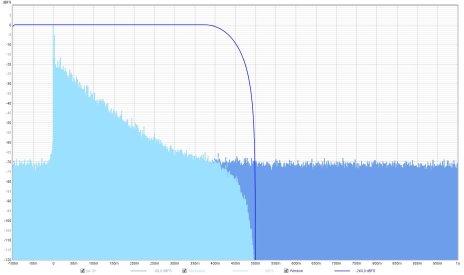
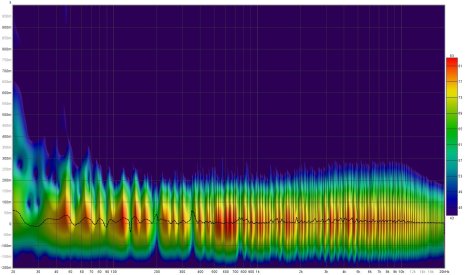
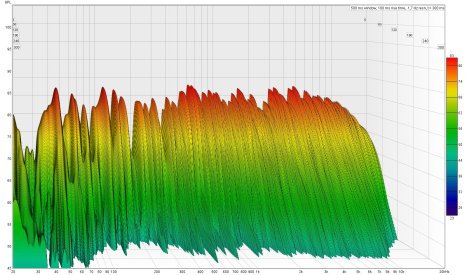
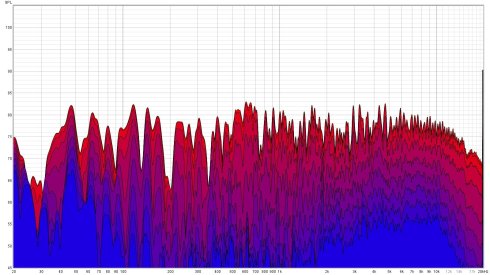
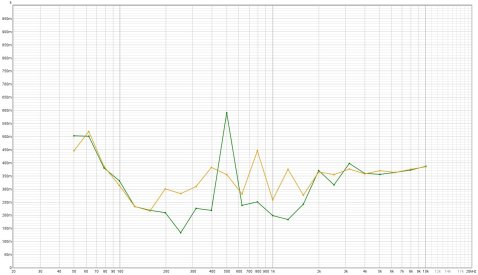
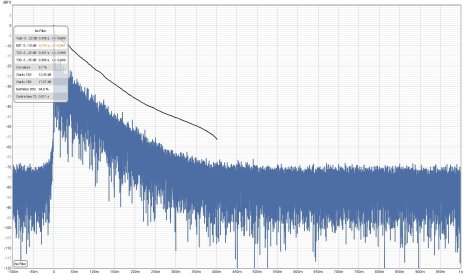
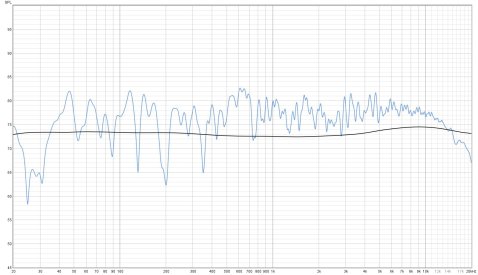
I’m attaching measurements and would love feedback - especially on what they suggest about modal behaviour, decay and whether this plan makes sense before I commit to sacrificing more space to treatment (the intiial plan is to add 45 cm of additional insulation on all walls).
I’m trying to understand whether my main LF problem is caused by room modes / cancellations or whether a significant amount of bass energy is simply escaping the room through the structure.

What puzzles me is:
  • bass is weak and dry almost everywhere in the room
  • moving the listening position along the length changes surprisingly little
  • I don’t really get strong pressure buildup anywhere
  • subjective impression: as if the room doesn’t 'hold' low frequencies

Before sacrificing more space for large traps, I’d like to understand whether this looks more like:
  • classic modal distribution / cancellations (so more trapping + placement work will help),
  • significant LF energy loss into the structure (in which case internal absorption won’t fix the core problem).
Based on these graphs alone, does anyone see indicators that point more in one direction than the other?

Any insight appreciated!
 

Attachments

  • impulse.jpg
    impulse.jpg
    150.8 KB · Views: 6
  • spectrogram.jpg
    spectrogram.jpg
    186.1 KB · Views: 6
  • waterfall.jpg
    waterfall.jpg
    351.2 KB · Views: 5
  • decay.jpg
    decay.jpg
    229.5 KB · Views: 6
  • RT.jpg
    RT.jpg
    217.8 KB · Views: 6
  • impulse response.jpg
    impulse response.jpg
    248.9 KB · Views: 5
  • SPL.jpg
    SPL.jpg
    170.4 KB · Views: 6
Ouch, could I kindly ask moderator to move this thread to the "Room Acoustics and Treatments" section.
Seems more appropriate.
Thank you!
 
I think your weak bass points to several factors... no door, open and unfinished wall, rockwool behind the fabric barrier, and that perforated ceiling with all the insulation above it. That's basically a huge bass-absorbing room, if you can even call it a room. You won't be able to build up bass pressure in that room as it is. At this point, I don't see how room modes can be an issue.

Maybe you could put up a temporary door and temporary walls? I'd do that before trying to acoustically treat the room. Get it temporarily sealed, and then do some more measurements. However, I'm not sure how you seal the ceiling, which is likely contributing to the measurement issues you are seeing right now.
 
Good evening @Sonnie Parker

Thank you for your input. The doors should be installed within the next couple of weeks. Still debating some details with the carpenter.

Regarding the walls and ceiling: they are intentionally left open at the moment. My original plan was to follow a concept I saw a few years ago (which I also used in my previous room, only much thinner), where the room is essentially lined with deep broadband absorption (around 60 cm) and then covered with diffusive / reflective panels. The idea is that the mid/highs remain lively (via the panels), while the LF still "see" the depth behind them and get absorbed. Looking at different porous absorber calculators, going beyond roughly 60 cm of depth seems to bring little additional broadband benefit. I’m attaching the whitepaper for reference.

That said, I recently came across a pressure-based approach suggesting the opposite: that the room should be sealed as tightly as possible and then treated with much shallower absorption (up to around 10"). This is relatively new to me and I’m having a hard time seeing how significantly thinner treatment could provide sufficient low-frequency control without relying on resonant systems.

I really want to explore this as thoroughly as possible. In my first room, I had a long and very helpful discussion with @John Mulcahy, where we were mostly trying to make the best out of an acoustically compromised treatment concept. In the end it sounded pretty good once @jtalden chimed in and tought me how to time align all 4 subs. But since this is a new (and bigger) room I'd very much like to start smart from the scratch.
 

Attachments

I went to great lengths to tightly seal my room, and have actually removed a lot of the acoustic panels over the last few years. I now let Dirac Live ART in my StormAudio MK3 do the acoustic treatment duties, and it seems to work just fine for the bass, more so than any physical treatments I could do, or that I could ever have modeled to accomplish what DLART does in that area below 150Hz. Above 150Hz... I believe the controlled directivity of my RTJ/JTR speakers (and previously my MartinLogans) helps eliminate the need for excessive acoustic treatments. There are also studies from Toole, Olive, and Harman research showing that some side reflections are preferred.

Here's a quote from my MK3 review that comes to mind when dealing with this sort of thing:
Considering what has been historically required to tame bass and room decay in frequencies below 100 Hz, I think of huge and super-thick bass traps, corner bass traps, and even Helmholtz resonators. Then, the proper placement must be determined to get the best possible results. Several years ago, I spoke with an acoustic engineer at a company that builds customized Helmholtz resonators to treat room issues below 100 Hz. The project for my room would have cost me well over the MSRP of the most expensive StormAudio processor and required substantial real estate in my dedicated room. Forget it… it is complicated, time-consuming, space-wasting, and expensive. On the contrary, StormAudio processors include DLART to do it all electronically, with precision, in only a few minutes (okay... maybe several minutes or more), and without occupying any additional space in our rooms beyond the space of a typical processor or AVR, and a few subwoofers. It might be hard to believe we have come this far, but we are here.
 
Last edited:
I completely agree that systems like Dirac Live ART are a huge step forward. Active multisub control can do things today that were simply not possible a decade ago, especially in terms of seat-to-seat consistency.

That said, ART reshapes and counteracts the pressure distribution, but it doesn’t actually remove acoustic energy from the room. A room with deep, lossy boundaries already has shorter natural decay, fewer extreme resonances and generally calmer LF behavior, which makes any active system more effective, more stable and less dependent on a single listening position.

Since I’m building the room from scratch, I’d rather first create a space that is physically well-behaved on its own (deep broadband / hybrid boundaries, controlled decay) and then let Dirac optimize what remains. In my view, passive structure defines the physics of the room; active processing refines it.

By the way, do you have any REW measurements of your room? It would be interesting to take a look at them! ;)
 
I think you have the right idea with your approach. I talked about starting from scratch and building a room that would make DLART's job easier. I decided that at my age, it doesn't make much sense to me, given how good my room sounds right now, though it would be fun.

Yes... you can see several graphs, and I believe I have the .mdat file for download in my review: https://www.avnirvana.com/threads/s...nsive-review-and-setup—exploring-dlart.14896/
 
Holy moly, now that is a review for the big boys. I agree with one of the users: it probably takes a sabbatical to read it all the way through. :D
That processor is an absolute monster. I wasn’t planning on spending 25k on a processor, but luckily the more affordable brands (Marantz, Denon, etc) upports Dirac ART, so that’s a nice surprise. I clearly haven’t been keeping up with gear lately. I was still mentally stuck in the era when Dirac Live Bass Control was the big upcoming thing. ;)

I took a quick look but couldn’t find the .mdat file anywhere. Did I miss it?
 
It may be that I didn't upload it, although I included several measurement graphs. I'm going to be doing some more measurements soon for setting it up again after adding my new center speaker and upgrading the unit with the latest board. I'll share that file once I've done that setup.
 
Hey @thexder, I agree with Sonnie's original reaction. You have a lot of absorption and open walls. I'm not a design expert by any stretch, but you definitely don't want to create an overly dead room. I like the idea of adding diffusion to keep the room alive. Just not sure if you want as much low-end absorption.

Hopefully some of the other audio experts will chime in.
 
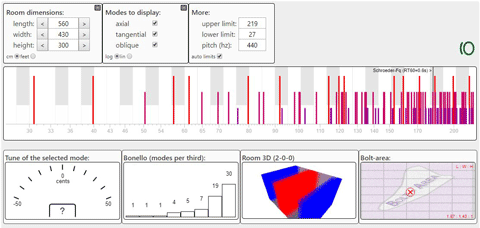
Interestingly, the wide 25Hz null is in a spot where room modes should be causing a peak. Did that change at all as you measured along the length of the room? Did you try side to side? Middles have weak bass spots but are best for symmetry for sound stage and imaging which I guess you know aleady. Or maybe the speaker you were measuring doesn’t have much output there. Or maybe I didn’t enter the dimensions into the calculator correctly.


That said, ART reshapes and counteracts the pressure distribution, but it doesn’t actually remove acoustic energy from the room.
I’m not knowledgeable enough to say with 100% confidence, but I believe it works by preventing acoustic energy in the bass region from occurring in the first place by playing frequencies from supporting speakers that will not excite the room in the same way as the target speaker would. What’s fascinating about it is the end result is every speaker sounds like a full range speaker with no sound perceived as coming from elsewhere. Imaging is pinpoint, yet soundstage seems bigger. Totally subjective, of course.
 
Back
Top