






phatziantoniou
Registered
Thread Starter
- Joined
- May 12, 2020
- Posts
- 2
Hi
I noticed something that I don't fully understand regarding impulse response export/import.
I measured a room impulse response in REW and saved the measurement as an .mdat file. Then I exported the impulse response as a WAV file and imported that WAV back into REW.
When I compare the original measurement (from the .mdat) with the imported WAV, I see differences in some sample values around the main impulse peak. I observe this behaviour with all export formats I have tried, including 32-bit float WAV.
The main peak aligns correctly, but the samples immediately before and after the peak differ slightly. The differences appear larger than what I would expect from simple quantization error.
Is the impulse response stored in the .mdat file exactly the same data that is written to the exported WAV file? Or does REW apply any processing during export or import (e.g. normalization, timing alignment, fractional-sample shifting, IR delay estimation, etc.) that could explain these differences?
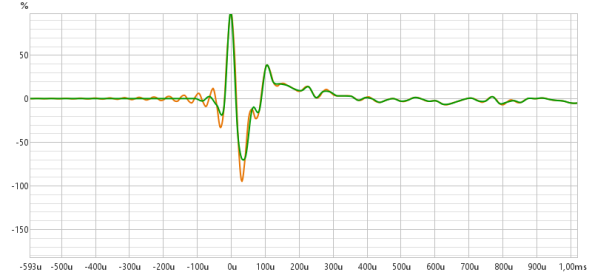
I have attached an overlay showing the original measurement (green) and the re-imported WAV (orange).
Thanks for any clarification.
Best regards,
Panos Hatziantoniou
I noticed something that I don't fully understand regarding impulse response export/import.
I measured a room impulse response in REW and saved the measurement as an .mdat file. Then I exported the impulse response as a WAV file and imported that WAV back into REW.
When I compare the original measurement (from the .mdat) with the imported WAV, I see differences in some sample values around the main impulse peak. I observe this behaviour with all export formats I have tried, including 32-bit float WAV.
The main peak aligns correctly, but the samples immediately before and after the peak differ slightly. The differences appear larger than what I would expect from simple quantization error.
Is the impulse response stored in the .mdat file exactly the same data that is written to the exported WAV file? Or does REW apply any processing during export or import (e.g. normalization, timing alignment, fractional-sample shifting, IR delay estimation, etc.) that could explain these differences?
I have attached an overlay showing the original measurement (green) and the re-imported WAV (orange).
Thanks for any clarification.
Best regards,
Panos Hatziantoniou