







Bob Rapoport
Music Reviewer
Thread Starter
- Joined
- Jan 29, 2018
- Posts
- 171
More
- Preamp, Processor or Receiver
- Essence HDACC II-4K
- Main Amp
- Essence DPA-440
- Universal / Blu-ray / CD Player
- Sony 4K
- Front Speakers
- Essence Electrostats
- Center Channel Speaker
- Essence
- Surround Speakers
- Essence
- Subwoofers
- Essence
- Screen
- Screen Goo painted screen, 4 coats
- Video Display Device
- Vizio M70
- Remote Control
- Essence
One of the biggest misunderstandings in modern home audio is where HDMI sources belong in the system.

They do not belong in the TV.
The TV is the end of the chain. It is the display. It is where the picture is supposed to arrive, not where your Apple TV 4K, Blu-ray player, or gaming console should be plugged in. That would make the TV the preamp, not its traditional role.
When you plug your sources into the TV first and then try to send the audio back upstream through ARC or eARC, or even the Optical output, you are asking the system to do things the long way around. ARC was created as a convenience feature. eARC improved bandwidth and expanded format support. But both still rely on the same basic idea: sending audio back from the TV instead of keeping the original signal path intact from the source forward.
There is a better way.
I call it the Direct Path.
In a Direct Path HDMI system, the source feeds the audio device first, and the video continues on to the TV. Audio and video stay together in one forward HDMI chain from the beginning. That is the cleanest way to preserve timing, maintain signal integrity, and reduce the chances of lip-sync problems.
It also keeps the HDMI handshake simpler.
That matters more than many people realize.
When the source, audio device, and display all stay in one forward HDMI chain, EDID communication is cleaner and more stable. But when the TV becomes the hub and has to send audio back upstream later, the system becomes more complicated. More processing. More handshaking. More chances for something to go wrong.
And once the picture reaches the screen, the clock is already running.
If the TV handles the video first and the audio has to be sent back afterward, every extra stage creates another opportunity for delay and sync errors. That is why so many users report lip-sync issues when the TV is used as the center of the system.
The Direct Path avoids that detour.
It starts with the source, keeps audio and video together, and sends the picture on to the display as the final destination. That is how HDMI works best.
Now let’s be fair.
ARC is not useless. It was created to simplify connectivity and reduce cable clutter. eARC is a real technical improvement over ARC. But neither changes the fact that the TV is still being asked to do a job it was never meant to do in a high-performance audio system: act as the traffic cop for your sources.
That may be fine for convenience.
It is not the best path for performance.
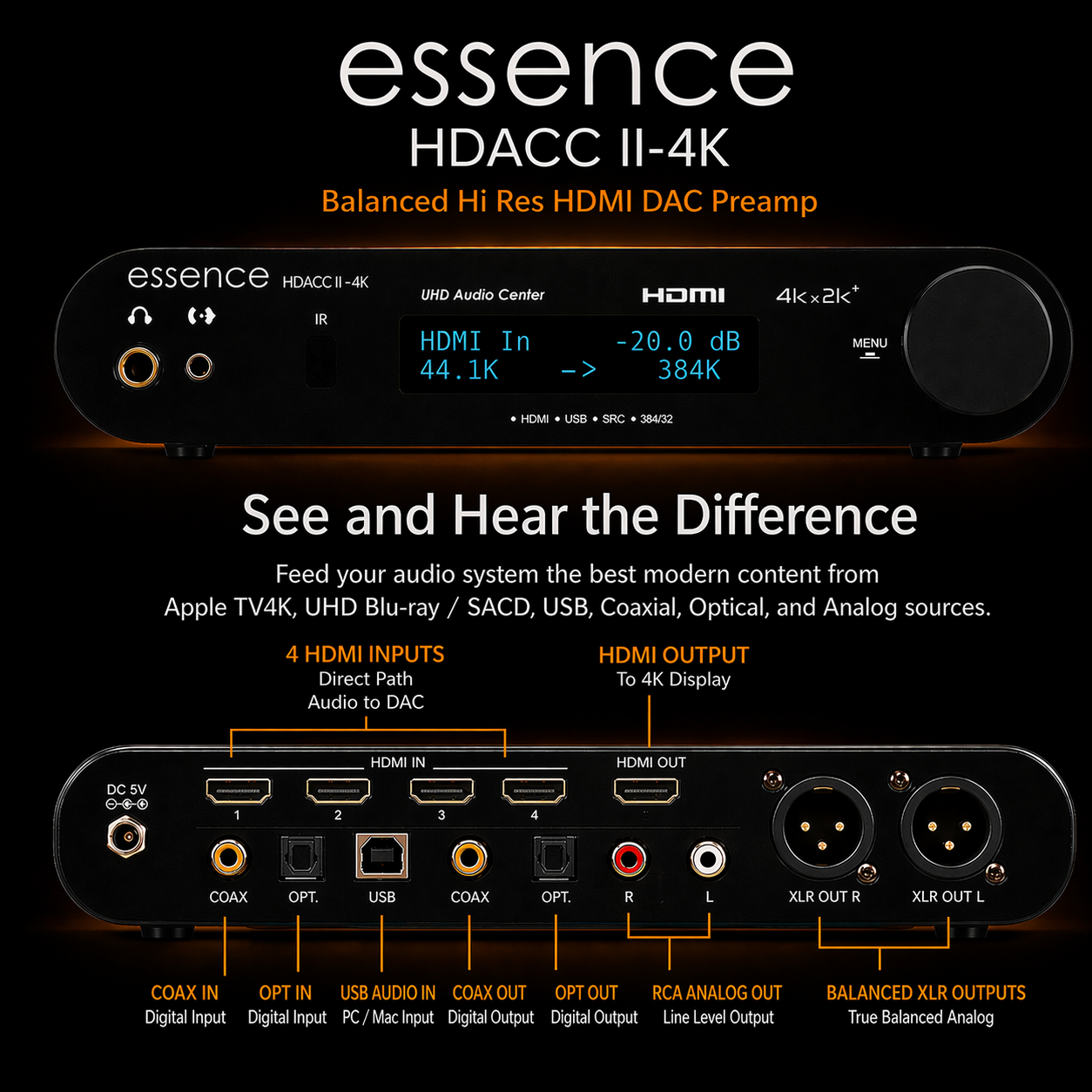
If you care about sound quality, sync, and system stability, feed the HDMI source into an HDMI DAC like the HDACC II-4K or Evolve II-4K, or a real HDMI preamp, AVR, or processor first. Then send the video on to the TV.
Let the TV do what it does best: display the picture.
In other words:
The TV is the end of the chain, not the place to plug in the sources.
That is the right way to do HDMI.
And in serious audio, it is the difference between a workaround and a design philosophy.
ARC and eARC are convenience features.
Direct Path HDMI is the performance path.
They do not belong in the TV.
The TV is the end of the chain. It is the display. It is where the picture is supposed to arrive, not where your Apple TV 4K, Blu-ray player, or gaming console should be plugged in. That would make the TV the preamp, not its traditional role.
When you plug your sources into the TV first and then try to send the audio back upstream through ARC or eARC, or even the Optical output, you are asking the system to do things the long way around. ARC was created as a convenience feature. eARC improved bandwidth and expanded format support. But both still rely on the same basic idea: sending audio back from the TV instead of keeping the original signal path intact from the source forward.
There is a better way.
I call it the Direct Path.
In a Direct Path HDMI system, the source feeds the audio device first, and the video continues on to the TV. Audio and video stay together in one forward HDMI chain from the beginning. That is the cleanest way to preserve timing, maintain signal integrity, and reduce the chances of lip-sync problems.
It also keeps the HDMI handshake simpler.
That matters more than many people realize.
When the source, audio device, and display all stay in one forward HDMI chain, EDID communication is cleaner and more stable. But when the TV becomes the hub and has to send audio back upstream later, the system becomes more complicated. More processing. More handshaking. More chances for something to go wrong.
And once the picture reaches the screen, the clock is already running.
If the TV handles the video first and the audio has to be sent back afterward, every extra stage creates another opportunity for delay and sync errors. That is why so many users report lip-sync issues when the TV is used as the center of the system.
The Direct Path avoids that detour.
It starts with the source, keeps audio and video together, and sends the picture on to the display as the final destination. That is how HDMI works best.
Now let’s be fair.
ARC is not useless. It was created to simplify connectivity and reduce cable clutter. eARC is a real technical improvement over ARC. But neither changes the fact that the TV is still being asked to do a job it was never meant to do in a high-performance audio system: act as the traffic cop for your sources.
That may be fine for convenience.
It is not the best path for performance.
If you care about sound quality, sync, and system stability, feed the HDMI source into an HDMI DAC like the HDACC II-4K or Evolve II-4K, or a real HDMI preamp, AVR, or processor first. Then send the video on to the TV.
Let the TV do what it does best: display the picture.
In other words:
The TV is the end of the chain, not the place to plug in the sources.
That is the right way to do HDMI.
And in serious audio, it is the difference between a workaround and a design philosophy.
ARC and eARC are convenience features.
Direct Path HDMI is the performance path.
Last edited: