






I recently decided to switch from my UMIK-1 to an external soundcard (focusrite Scarlett 2i2 4th) and XLR mic (Dayton EMM-6) setup thinking it would be relatively simple. So far its been pretty f***ed 
SHORT VERSION: Measurements with the new setup don't match the UMIK-1, except when I turn on 'Limit cal data boost to 20db' in preferences.
LONG VERSION: I messed up and did a whole lot of measurements with the wrong mic calibration file (same model, diff unit). I loaded the correct one, re-did some measurements expecting to see little variation but it was actually pretty significant below 3kHz (1-1.5db). Later on I opened up the file on a different computer and somehow the two measurements now line up but about 20db lower than before. They also now matched very nicely with the same measurement done with my UMIK-1 (in shape, not level). After some playing around I found that the 2nd computer had 'Limit cal data boost to 20db' ticked and unticking it returned them to the original state.
I've uploaded images of the correct Cal on the EMM-6 vs UMIK-1 with and without 'Limit cal boost' checked. I adjusted the SPL of the UMIK measurement to line up in both. I suppose it means there is an issue with my new setup but I'm not sure where to start trouble shooting. Could the noise floor be an issue? It's not exactly a dead quite environment but the UMIK has never had an issue.
Might not be relevant but calibrating the SPL levels has been a huge pain. I have to turn the mic gain up quite high in the 'check levels' section, then after calibrating the SPL with an external SPL meter, it tells me that the max SPL for my measurements will be only 95db or so, unless I turn down the mic gain. It didn't seem to stop me measuring above that SPL though so I decided it wasn't going to effect the shape of the response so I could come back later to get it right.
I have been following the instructions from VituixCAD "Measurements with Room EQ Wizard (REW)for crossover simulation with VituixCAD 2"
UMIK measurements are 48kHz, Java
UMM-6 at 88.2kHz, ASIO
Thanks!
SHORT VERSION: Measurements with the new setup don't match the UMIK-1, except when I turn on 'Limit cal data boost to 20db' in preferences.
LONG VERSION: I messed up and did a whole lot of measurements with the wrong mic calibration file (same model, diff unit). I loaded the correct one, re-did some measurements expecting to see little variation but it was actually pretty significant below 3kHz (1-1.5db). Later on I opened up the file on a different computer and somehow the two measurements now line up but about 20db lower than before. They also now matched very nicely with the same measurement done with my UMIK-1 (in shape, not level). After some playing around I found that the 2nd computer had 'Limit cal data boost to 20db' ticked and unticking it returned them to the original state.
I've uploaded images of the correct Cal on the EMM-6 vs UMIK-1 with and without 'Limit cal boost' checked. I adjusted the SPL of the UMIK measurement to line up in both. I suppose it means there is an issue with my new setup but I'm not sure where to start trouble shooting. Could the noise floor be an issue? It's not exactly a dead quite environment but the UMIK has never had an issue.
Might not be relevant but calibrating the SPL levels has been a huge pain. I have to turn the mic gain up quite high in the 'check levels' section, then after calibrating the SPL with an external SPL meter, it tells me that the max SPL for my measurements will be only 95db or so, unless I turn down the mic gain. It didn't seem to stop me measuring above that SPL though so I decided it wasn't going to effect the shape of the response so I could come back later to get it right.
I have been following the instructions from VituixCAD "Measurements with Room EQ Wizard (REW)for crossover simulation with VituixCAD 2"
UMIK measurements are 48kHz, Java
UMM-6 at 88.2kHz, ASIO
Thanks!
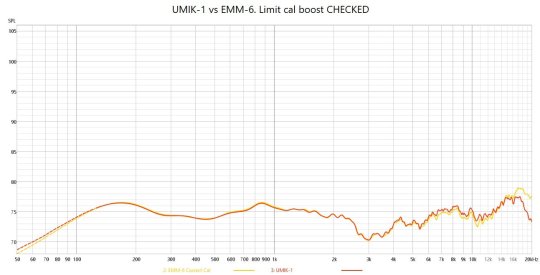
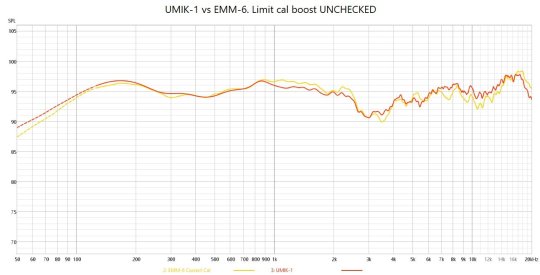

 It will be interesting to see how different it is. Worth pointing out that this assumes that the UMIK is flat, and in that case the EMM-6 is much closer to flat when 'limit cal boost' is enabled in my above measurements. I'll try calibrating the soundcard in preferences and 'use loopback for timing ref' in the measurement window.

 .
.
 . The UMIK cal file looks highly smoothed compared to EMM-6. Any ideas on why that is? Without knowing better, I would have guessed it meant the Dayton had better resolution in the calibration rather than noise. I'm not even sure how they would introduce that much noise...