






First Measurement Issues

Clover

Registered
Thread Starter
Joined
Aug 25, 2026
Posts
4
More  
Preamp, Processor or Receiver
PS Audio BHK Preamp
Main Amp
PS Audio BHK Signature Mono 300s
DAC
PS Audio DirectStream MK1
Universal / Blu-ray / CD Player
PS Audio PerfectWave Memory Player
Streaming Equipment
Wiim Pro
Streaming Subscriptions
Tital, Spotify
Other Equipment
PS Audio P12 Power Regenerator
Front Speakers
Magnepan 1.7 w/ GR Research Crossovers
Subwoofers
Rythmik F12, pair of Magnepan DWM bass panels
Hi Everyone,

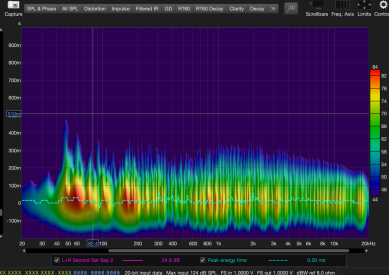
I'm new here trying to learn REW and acoustics to help get some speakers sounding better in my room. I switched to dipole speakers and have struggled with setup, so I bought a UMIK-1 and took my first set of measurements. I'm thinking I did something wrong as the top end is dropping off sharply and looks to have a lot of ringing in the waterfall. I'm not sure what I got wrong for it to look like that or if that is actually how my room sounds up top. There are a couple areas that give me some pause but I'm too new to know what I did wrong or if these results are legitimate. I had some trouble calibrating my sound card and ended up not using a calibration for it, so maybe that is my issue. Does it look like I made an error with these measurements to you and does anyone know what I should change? The below is with 1/12 smoothing of both L+R + Subs. Thanks for the help and please let me know if something other than what I provided is needed.

1787763166637.png


1787763212689.png
 

Attachments

I should have noted this is a starting point that I am looking to improve from and I do see the need to cut the gain on my sub from the initial look. I'll cut it some, but I do like a little extra bass so I'm okay with some shelf. I'm currently building six 9" thick + 3" air gap bass traps/panels to hang in my room at first reflection points. Thanks again.
 
To answer some of your questions:

1. Sound card calibration makes no sense if you are using a USB microphone. It only makes sense if you are using an interface with a physical loopback, and even then the deviations are in the order of +/- 0.5dB at the extreme ends of the frequency range, which is miniscule compared to your microphone. So this step is not needed.

2. You are sending REW's output through AirPlay. AirPlay is lossy, it is not bit perfect. I don't know exactly what AirPlay is doing, but lossy transmission typically cuts out high frequencies which is probably what is producing all that high freq noise. As a first step, STOP USING AIRPLAY and use a cabled connection.

3. None of your measurements have a timing reference.

1787797871102.png


4. You have four impulses in your IR, spaced exactly 500ms apart. There should only be one. Please show us a screenshot of your "Make a measurement" dialog box and "Preferences".

1787798105334.png


5. All your "Left" measurements have a tone at 125Hz. This same tone is missing in all your "Right" measurements. If the tone was present in both measurements, I would tell you to look for a source of noise in your room (computer fan, air-cond, neighbour playing bagpipes, etc) but since it is present in only your left measurements, one has to suspect something wrong with your left speaker or amp. Maybe a screw loose, maybe some kind of resonant vibration, maybe amplifier oscillation, etc. I suggest you use the tone generator to play a 125Hz tone and compare subjectively the sound of left and right. If you think it is a resonance, damp that surface by pushing on it. If you suspect an amplifier problem, swap left and right channels.

Interestingly, if you look at that spectrogram noise above 8kHz, you can see that it occurs in 500ms intervals (the same as those impulse peaks in your IR). Maybe John has an explanation for that, i'm not smart enough to know what is going on.

6. I wrote a free book on taking and interpreting REW measurements. I suggest you start there. Even with your flawed measurements I can already see a lot of problems with your room. But it's better to correct these mistakes first, take proper measurements, and then try to read them.

Good luck and welcome to AVNirvana.
 
Last edited:
Thanks for the help and guidance everyone. I’m certainly still learning. I got a cable to connect my laptop to my DAC and ran new measurements. Below is my measurement window with how I ran the new set of measurements today.

1788375636146.png


Here are the new measurements with subs and the DWM panels at 1/12 smoothing. I did turn down the sub some.

image


Below I have measurements for L+R(teal), L+R+DWM Panels(Purple), L+R+DWM+Sub(Blue), and L+R+Sub(Green). Sorry, I’m not sure how to set the colors and my attempt to went very wrong. The first measurement is with phychoaccoustic smoothing and the others have 1/12th smoothing.

image


image


Waterfall with subs and DWM panels

image


Spectrogram with L+R + Subs + DWM Panels.

image


Decay times with subs and DWM panels

image


The DWM panels really do provided a noticeable bass bump in there area. In the psychoacoustic smoothed measurements, it looks like I have a decent hole from 350-600 Hz. and another hole from 3800 - 6800 Hz. I think the lower one is the crossover from when I have the extra bass from the DWMs to the 1.7’s output without the DWMs above an around 200 Hz. The second one, I’m not sure about. Maybe just the 1.7s in my room where I have them.

I need to learn more about what these measurements means. What am I missing in those holes. Maybe I actually prefer a bit of a hole in certain areas but want to take down a couple peaks in specific areas.

Is anything standing out to anyone now?
 
Good progress! You should take separate measurements of the speakers and with also using an acoustic timing reference. See Measuring With a Timing Reference in the REW help. Particularly with high frequencies, unless the mic is placed perfectly equidistant from both speakers, you’ll see cancellations or peaks that don’t exist. (Not in phase.). REW has the ability to combine the measurements when you need to and also adjust for different distances when needed, as is typical with subs for example.

@Keith_W put a link to his e-book in his post above. Highly recommended and will be more time efficient for you in the long run.

Last tip is to use the REW camera icon instead of screenshots. You’ll see why when you try it. 🙂
 
In addition to what @JStewart said:

1. You did not post your MDAT.

2. Do not cut off the graph labels when posting screenshots. It makes your measurements impossible to interpret, e.g. your last screenshot with the RT60 graph.

3. If you want to find out the effect of your panels, it is meaningless to post only one spectrogram. You need a "before" and "after" for comparison.

4. You have almost certainly mislabelled your measurements. Using your colour key, I have labelled your measurements:

Below I have measurements for L+R(teal), L+R+DWM Panels(Purple), L+R+DWM+Sub(Blue), and L+R+Sub(Green)

1788398380573.png


That green measurement should be "L+R + Panels", and the purple measurement should be "L+R + Sub".

5. Dips in the frequency response that occur above the transition zone (about 400 - 800Hz depending on the size and absorption of your room) should follow the PIR (Predicted In-Room Response). So you need to find published measurements of your speaker (which you did not name) for comparison.

Those DWM panels seem to be surprisingly effective at low bass frequencies. I thought that hell would freeze over before I found room treatment that boosts bass like that, which is what makes me very suspicious. What are they? Can you post a link?
 
Thank you both for your help and patience. I'm sorry, I'm very much still learning what I am doing here and seem to have gotten a tool before I understood how to use it. I feel silly making so many mistakes, but I am learning and I do appreciate the help.

.mdat now attached. I won't be able to run new measurements until tomorrow.

Below is an updated RT60 chart at 1/12 smoothing with L+R + Subs + DWM Bass panels. I should have known to be sure everything was labeled and visible.

1788405237057.png


Below is the spectrogram of only L+R
1788406138418.png


L+R+DWMs:
1788406001338.png


L+R+Sub, no DWMs:
1788406383220.png


L+R+Sub+DWMs:
1788406489497.png


Sorry if the colors were off, I had tried to change the colors to make things vary more but it went wrong and I had to backtrack. I do have them labeled correctly, however, I think but my language with the DWM. panels was confusing, especially when I don't list the speakers or any context for them. The DWM panels are Magnepan DWM bass panels, which are passive dipole plainer magnetic woofers. Magnepan does not share a ton of info on them but they basically cover 40-200 Hz. I have one set of speaker cables going direct to the L+R speakers and one set going direct to the DWMs, so the L+R speaker's signal does not need to go through the DWM crossovers. The speakers are Magnepan 1.7s with GR Research crossovers. The subwoofer is a Rythmik F12.

GR Research published the below measurements that I think use 1/3 smoothing in a different range that stops at 200 Hz.

1788407167980.png


I've spent a little time moving the speakers around but want to use REW to figure out what is going on in my room and help place the speakers and my listening position better. This is my first "dedicated" listing room, which is not symmetrical and has been tricky for me as I work to improve things.

These measurements are going to serve as my starting point. I hope to first improve placement of my speakers and listening position. I know there is room for growth as I can hear problems but have not found the right compromise yet. I'm in the process of building myself six 9" thick bass traps/panels I plan to put in my first reflections. I'm also building myself a new rack to get my gear better positioned and off my in-laws old rack. Once I get all that done, I'll try to setup some form of EQ for the speakers. Lastly, I'll do it all over again for a set of speakers I built myself in the past and setup a comparison where both speakers are placed in their ideal location.

Below is the current listening position. I'm thinking that when I get the rack in place and move my amplifiers back onto it, the DWM panels can come into the middle where the amps currently are to be better aligned with the L+R speakers and away from the walls.

1788408589782.jpeg


Plus, a picture of the rack in progress. Dry fit looks good but glue up is going to be challenging. It looks close to finished but it will still take me at least a couple weeks to finish up. I have posts to go between the two sections so there will be four shelves with walnut burl for the top and bottom shelves and the curly maple for the two middle shelves.

1788409059577.jpeg


Thanks again for the guidance as I learn. I know I have a long way to go but I'll make progress with help.
 

Attachments

  • 1788405864774.png
    1788405864774.png
    638.6 KB · Views: 7
  • Second Set.mdat
    Second Set.mdat
    26.3 MB · Views: 17
Last edited:
Please edit your MDAT. You posted too many measurements. We don't need duplicates of measurements, I end up having to spend a lot of time deleting measurements which are exactly the same.

1788411204991.png


Here are 10 measurements, all labelled "L+R Second Set". If measurements have the same name, we expect to see the same measurement. But these are clearly all different. Because I don't know which is which, I deleted ALL of them. Without proper labels, they are meaningless.

1788411477831.png


And here are another 10 measurements which all have the same name, but with Psychoacoustic smoothing. All were removed.

If you opened a restaurant and you had 20 items on the menu, do you label all of them "Food"? Because that's what you are doing here. Please read that eBook. I made it free for a reason.
 
Thank you both for your help and patience. I'm sorry, I'm very much still learning what I am doing here and seem to have gotten a tool before I understood how to use it. I feel silly making so many mistakes, but I am learning and I do appreciate the help.

.mdat now attached. I won't be able to run new measurements until tomorrow.

Below is an updated RT60 chart at 1/12 smoothing with L+R + Subs + DWM Bass panels. I should have known to be sure everything was labeled and visible.

View attachment 96707

Below is the spectrogram of only L+R
View attachment 96711


L+R+DWMs:
View attachment 96710

L+R+Sub, no DWMs:
View attachment 96712

L+R+Sub+DWMs:
View attachment 96713


Sorry if the colors were off, I had tried to change the colors to make things vary more but it went wrong and I had to backtrack. I do have them labeled correctly, however, I think but my language with the DWM. panels was confusing, especially when I don't list the speakers or any context for them. The DWM panels are Magnepan DWM bass panels, which are passive dipole plainer magnetic woofers. Magnepan does not share a ton of info on them but they basically cover 40-200 Hz. I have one set of speaker cables going direct to the L+R speakers and one set going direct to the DWMs, so the L+R speaker's signal does not need to go through the DWM crossovers. The speakers are Magnepan 1.7s with GR Research crossovers. The subwoofer is a Rythmik F12.

GR Research published the below measurements that I think use 1/3 smoothing in a different range that stops at 200 Hz.

View attachment 96714

I've spent a little time moving the speakers around but want to use REW to figure out what is going on in my room and help place the speakers and my listening position better. This is my first "dedicated" listing room, which is not symmetrical and has been tricky for me as I work to improve things.

These measurements are going to serve as my starting point. I hope to first improve placement of my speakers and listening position. I know there is room for growth as I can hear problems but have not found the right compromise yet. I'm in the process of building myself six 9" thick bass traps/panels I plan to put in my first reflections. I'm also building myself a new rack to get my gear better positioned and off my in-laws old rack. Once I get all that done, I'll try to setup some form of EQ for the speakers. Lastly, I'll do it all over again for a set of speakers I built myself in the past and setup a comparison where both speakers are placed in their ideal location.

Below is the current listening position. I'm thinking that when I get the rack in place and move my amplifiers back onto it, the DWM panels can come into the middle where the amps currently are to be better aligned with the L+R speakers and away from the walls.

View attachment 96715

Plus, a picture of the rack in progress. Dry fit looks good but glue up is going to be challenging. It looks close to finished but it will still take me at least a couple weeks to finish up. I have posts to go between the two sections so there will be four shelves with walnut burl for the top and bottom shelves and the curly maple for the two middle shelves.

View attachment 96716


Thanks again for the guidance as I learn. I know I have a long way to go but I'll make progress with help.
Nice work on the rack!
 
I'm currently building six 9" thick + 3" air gap bass traps/panels to hang in my room at first reflection points.
The decay times you posted do seem higher than what is typically desired. I noticed too that decay of higher frequencies are longer than the lower frequencies. Usually lower frequencies take longer to decay because they are harder to absorb.
I don’t know the dispersion pattern of your magnepans, other than dipoles have less energy to the sides, and I’m absolutely not qualified in the area of room treatments, but I wonder about the possibility of 1st reflection placement adding to the tilt. If you’ll be able to easily move them to test the effects of other placement, I suppose it won’t matter.
If think I found myself at this point in the process I would reach out to GIK acoustics for a free room treatment plan once the initial measurements and speaker positions are both lined out.
 
Back
Top