






Why not linear phase?

GOULAS

New Member
Thread Starter
Joined
Oct 19, 2025
Posts
30
Location
France
Since a loudspeaker naturally exhibits a phase issue due to its high-pass and low-pass filters, isn't it mathematically correct to linearize its phase to 0° across its entire bandwidth?
With REW, wouldn't it be useful to have a program to achieve 0° phase, to satisfy those who think like me?
 
It's called "rePhase". John has previously said elsewhere that he does not see the point in duplicating the work.

And if you feel like paying money, there's also LinFIR (the new kid on the block, it's free to download and use!), and then there are a whole bunch of paid options - Acourate, Audiolense, Focus Fidelity, Eclipse Audio FIR Designer, etc.
 
Cela s'appelle « rePhase ». John a déjà déclaré ailleurs qu’il ne voyait pas l’intérêt de dupliquer l’œuvre.

Et si vous avez envie de payer, il y a aussi LinFIR (le nouveau venu, il est gratuit à télécharger et à utiliser !), et puis il y a tout un tas d'options payantes - Acourate, Audiolense, Focus Fidelity, Eclipse Audio FIR Designer, etc.

A ma connaissance, Rephase ne permet pas la phase linéaire en automatique.
Je vous remercie pour le lien avec LinFIR.
 
I've been using the Ultimate Equalizer (UE), part of the Bodzio software SoundEasy (SE) in my main dipole system for more than 10 years. 3-way system, linear (as in zero) phase, LR8 crossovers. It's commercial, yes, but worth the relatively cheap cost for the performance. This isn't guesswork, either, I measured the phase of mid/tweeter (can't measure w/m in-room for that). Also provides easy inclusion of the equivalent of a Linkwitz Transform to extend bass response (within driver limit, of course). SE is a full measurement/design suite.

As an aside, the UE allows for quick switching between minimum-phase and linear-phase. I never could hear the difference. I run it linear phase...because I can, not because I could hear a difference.
 
A quoi bon se casser la tête si finalement ça ne sert à rien, si on n'entend pas de différences!

Ca me fait penser à cette publicité :
 

Attachments

  • Capture d’écran (1719).png
    Capture d’écran (1719).png
    1 MB · Views: 22
A quoi bon se casser la tête si finalement ça ne sert à rien, si on n'entend pas de différences!
I left in that way because it's no effort either way. My point was to say that there is no audible difference between the two . I haven't tested that with my old 3-way that has PR system bass (I may at some point), but from all I've read there has not been any published research of which I'm aware that shows that anyone can hear the difference between minimum-phase and linear phase systems other than possibly the bottom octave. Leaving it in linear phase mode is simply because there is no effort needed either way. The UE does it all in software at the click of a button after setting it. No special time-consuming effort of rePhase or others like it. I started to try rePhase in the early days to experiment, but quickly decided it was a waste of my time.

Since a loudspeaker naturally exhibits a phase issue due to its high-pass and low-pass filters, isn't it mathematically correct to linearize its phase to 0° across its entire bandwidth?
The UE does precisely this automatically for each driver, then combines the responses for the system response. Each section phase must be linearized separately as it's not possible to do that after the sections are combined. It's all done at the click of a button on starting the system within the UE. It's Windows PC-based software.
 
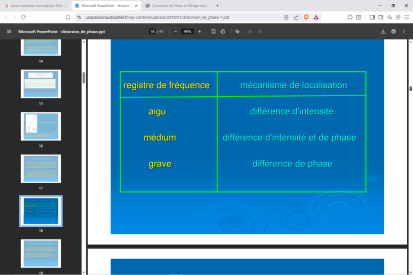
Thanks Dlr. Depending on the frequencies, it seems we're more sensitive to amplitude in the treble range at 0.1dB! In the mid-range frequencies, some are sensitive to both amplitude and phase. For the bass, it's the phase.
 

Attachments

  • Capture d’écran (1273).png
    Capture d’écran (1273).png
    357.2 KB · Views: 30
If you are doing Digital Room Correction, creating FIR filters and running thru a convolution engine like the Hang Loose Convolver you get linear phase for free... Also, several mastering quality software VST plug-in equalizers include the option of outputting linear phase...
 
I think you are confusing a filter creation tool such as REW, rePhase, Audiolense, Acourate and others @Keith_W mention above with convolution such as the HLC which uses said filter(s) created with those tools...

You might download the HLC users guide as well as read the HLC web page to get a better idea of what the HLC can do...
 
Use your words @GOULAS... Oh, and fill out your "more" area in your account details so we might be able to help you more..
 
I would like to know if the objective of perfect Dirac at the listening point is as relevant as the minimum phase step.
 
My personal view is that a perfect Dirac pulse at the listening position is pretty difficult to achieve... Especially given that we are mostly talking about a "small room" which may not have perfect anechoic properties...

Physical room correction with bass and wide band absorbers should be first on the list of things to do... Layer Room Correction DSP on top of that for time and phase adjustment...

For some added fun search the web for some articles that Rob Watts has to say on the subject of the Dirac pulse...
 
I would like to know if the objective of perfect Dirac at the listening point is as relevant as the minimum phase step.

A perfect Dirac pulse is impossible since it infinitely short and its integral over time is equal to 1. However, you can approximate it. You can get closer to a "perfect" Dirac pulse with linear phase filters than minimum-phase, but the real question is whether it is worth it. So let's do a quick cost-benefit analysis.

First, the cost. To approach a perfect Dirac as closely as you can, you will need a very specific type of hardware configuration. Active speakers with linear-phase DSP control over every driver, which means multiple DAC channels, multiple amplifiers, and with your speakers designed or modified to have the passive crossover bypassed. If you already have such a system, then implementation is much easier. Choose one of the DSP suites I mentioned earlier and go for it. Or you could struggle with REW and rePhase.

If you choose to take a conventional 2 or 3-way passive speaker and linearise the phase with FIR DSP, be aware that attempting to make high Q corrections substantially increases the chance of pre-ringing. Not to mention, you have to be VERY GOOD at taking measurements because you MUST capture the anechoic response before you attempt to DSP it.

The benefit: do these actually sound better? Well that is somewhat controversial. A lot of people say they don't, but I think that they do. And so does Mitch (the guy who made those videos you linked earlier). I don't think there has ever been a properly conducted blind test to prove the difference, which is why all you will hear is anecdote. How much attention you want to pay to anecdote is up to you.
 
Back
Top